As an ISO/IEC 17025 accredited (CNAS) independent laboratory, we provide professional erosion testing services to evaluate material degradation caused by solid particle impact, raindrop impingement, slurry flow, and cavitation. Our tests support qualification of coatings, turbine blades, pipelines, and outdoor structures per ASTM G76, G73, G134, MIL-STD-810G, and industrial specifications.
Product Samples We Regularly Test
Our erosion testing covers a wide range of materials and components:
- Gas turbine compressor blades and fan blades (Ti alloys, Ni alloys, composites)
- Aircraft leading edges, radomes, and windshield coatings
- Wind turbine blade leading edge protection (LEP) coatings and tapes
- Pipeline elbows, slurry transport pipes, and pump impellers
- Hydraulic turbine runners and valves (hydroelectric applications)
- Protective coatings (PVD, CVD, thermal spray, DLC, ceramic, epoxy)
- Solar photovoltaic glass and anti‑soiling coatings
- Automotive radiator fins, grilles, and underbody shields
- Mining equipment (chutes, cyclones, grinding mill liners)
- Military and defense hardware (helicopter rotor blades, armored vehicle windows)
Solid Particle Erosion (Sand/Dust/Grit – ASTM G76, G211, MIL-STD-810G Method 510.8)
- Gas‑jet solid particle erosion (ASTM G76) – Compressed air accelerates angular alumina or silica sand (50 µm to 500 µm) through a 1.5 mm nozzle. Impact velocity adjustable 30 m/s to 150 m/s, impact angle 15° to 90°, test temperature up to 600°C. Report erosion rate (mg/g of erodent) and dimensionless erosion resistance.
- High‑speed sand erosion (MIL‑STD‑810G Method 510.8, Procedure II) – Sand concentration 2.2 g/m³, particle size 150–850 µm, velocity 30–60 m/s (propeller blast), 0–2.5° angle of attack. Test duration 2 hours. Acceptance: no optical distortion of transparencies, coating loss < 5% of area.
- Sand erosion of coatings (ASTM D968 – falling sand abrasion) – For organic coatings (paint, varnish). Free‑fall sand (Ottawa sand, 20/30 mesh) from 1.5 m height through a guide tube onto coated panel. Report volume loss (liters of sand required to wear through to substrate).
- Slurry jet erosion (ASTM G73 modified, slurry pot) – Suspension of sand (20–40% by weight) in water or oil, nozzle diameter 4 mm, velocity up to 40 m/s. For pipe elbows and pump materials. Report erosion depth (µm) and wear scar diameter after 1–24 hours.
- High temperature erosion (up to 1000°C) – For gas turbine hot section coatings (MCrAlY, thermal barrier coatings). Use alumina particles at 150 m/s, 30° or 90° impact. Measure erosion rate before and after thermal cyclic aging (1100°C / 100 cycles).
- Image analysis of eroded surface – 3D laser profilometer (ISO 25178) to measure crater depth, pit density (pits/mm²), and surface roughness increase (Ra, Rz). For coatings, critical roughness (Ra > 2 µm) indicates breach of protective layer.
- Sand erosion of polymer matrix composites (carbon/epoxy, glass/polyester) – Per ASTM G76 but with modified specimen thickness (2–4 mm). Report erosion rate and fiber protrusion length (µm) using scanning electron microscopy. For radome materials: transmission loss after erosion ≤ 0.5 dB at 10 GHz.
Raindrop Erosion (Rain Erosion – ASTM G73, EN 16664, FAA AC 33.90)
- Whirling arm rain erosion test (ASTM G73) – Rotating arm with tip speed up to 300 m/s (Mach 0.88). Artificial rain at 25–50 mm/h, droplet diameter 1–2 mm. Test duration 1–4 hours. Report incubation period (time to first visible pit), erosion rate (mg/h), and maximum pit depth (µm). For aircraft windshield coatings: no visible pits after 2 hours at 250 m/s.
- Rotating disk rain erosion (alternate method) – Stationary nozzles spraying onto rotating disk (diameter 1 m), velocity 100–200 m/s. Simulates helicopter rotor blade and propeller leading edge exposure. Acceptance criteria: mass loss ≤ 10 mg/cm² after 3 hours for protective tapes.
- Multiple impact rain erosion with infrared thermography – High speed camera (50,000 fps) captures individual droplet impact events. Post‑test thermography detects delamination and subsurface cracks invisible to naked eye.
- Rain erosion of wind turbine blade leading edge protection (LEP) – Based on DNV‑GL‑RP‑0573. Test velocity 80 m/s to 120 m/s, rain intensity 30 mm/h, total 6 hours. Measure erosion depth using digital microscopy; acceptable LEP thickness loss ≤ 0.3 mm for 25‑year equivalent life.
- Rain erosion of solar glass (anti‑reflective coating) – Velocity 30 m/s (typical for dust storms with rain), 2 hours. Report haze increase (ASTM D1003) ≤ 3% and coating abrasion rating per ASTM D3363 (pencil hardness drop no more than 1 grade).
- Cavitation erosion (ASTM G32, vibratory apparatus) – For hydraulic machinery and marine propellers. Ultrasonic probe at 20 kHz, amplitude 50 µm, immersed in water or seawater. Report mean depth of erosion (MDE, µm/h) and incubation period. For stainless steel CA6NM: MDE ≤ 0.5 µm/h.
Slurry Erosion & Liquid Impingement (ASTM G73, G119, ISO 16967)
- Slurry pot erosion tester (ASTM G119, G75) – Rotating or slurry jet method. Abrasive slurry (silica, alumina, or iron oxide, 10–50% concentration) at 5–25 m/s. Test materials: pipe steels, rubber liners, hardfacings. Report volume loss (mm³) and normalized erosion resistance (volume loss per kg of erodent). For rubber liners in mining: acceptable volume loss ≤ 300 mm³ after 6 hours at 15 m/s.
- Jet impingement slurry erosion (ISO 16967) – Nozzle diameter 3 mm, distance 10 mm, velocity adjustable 10–80 m/s. Impact angle 30°, 45°, 60°, 90°. For ceramic coatings (WC‑CoCr, Cr₂O₃). Measure wear scar diameter, depth, and map erosion rate as function of angle.
- Coupled erosion‑corrosion test – Slurry with 3.5% NaCl or acidic mine drainage (pH 2–4). Use electrochemical cell with potentiostat to measure corrosion current (Icorr) simultaneous with erosion. For duplex stainless steels: synergistic effect (erosion + corrosion) > sum of individual rates.
- High temperature slurry erosion (oil sands, geothermal) – Test temperature up to 250°C with sand in oil or brine. For geothermal valves and oil sand pipelines. Report erosion rate (mm/year) extrapolated to field service.
Applications in Specific Industries
- Aerospace (engine compressor blades and radomes) – For Ti‑6Al‑4V blades: erosion rate < 1 mg per 10³ g of sand (ASTM G76 at 120 m/s, 90°). For radome honeycomb sandwich: rain erosion at 250 m/s for 1 hour, no core crush or face sheet perforation.
- Wind energy (blade leading edge protection) – Dual test: sand erosion (ASTM G76, 80 m/s, 30°, 5 hours) followed by rain erosion (ASTM G73, 100 m/s, 4 hours). Combined mass loss ≤ 0.5 g for 1 m long blade section.
- Oil & gas (choke valves, elbows) – Slurry erosion with produced sand (particle size 100–500 µm) at 30 m/s, 45° impact. For tungsten carbide coating: erosion rate < 0.01 mm/hour at 30° angle.
- Hydropower (Francis runners, Kaplan blades) – Cavitation erosion (ASTM G32) + slurry erosion (ASTM G119) to simulate sediment‑laden rivers. Stainless steel 04Cr13Ni5Mo: allowable MDE < 0.8 µm/h after 20 hours.
- Solar (photovoltaic glass in desert environments) – Sand erosion (ASTM G76, 30 m/s, 45°, 2 hours) followed by transmittance loss measurement (ISO 9050). Transmittance drop ≤ 2% for anti‑soiling coated glass.
Failure Analysis & Post‑Test Characterization
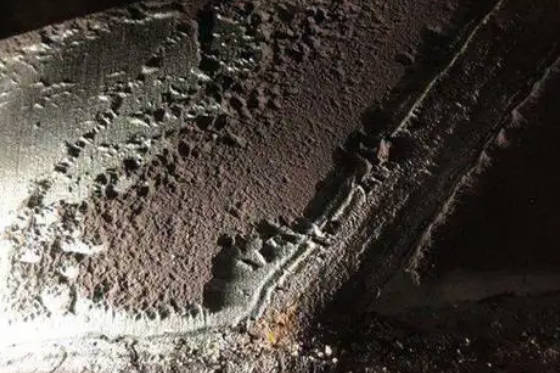
- Surface morphology (SEM/EDS) – Examine erosion craters, lip formation, microcracking, and embedded erodent particles. For coatings: measure remaining thickness and identify delamination zone.
- Cross‑sectional microhardness – Measure work‑hardened layer depth beneath eroded surface (Vickers HV 0.025). Acceptable hardened layer < 50 µm for ductile materials.
- Residual stress measurement (X‑ray diffraction, sin²ψ method) – For shot‑peened or coated surfaces after erosion. Compressive residual stress should remain above -200 MPa for fatigue critical parts.
- Weight loss and 3D profilometry – Pre‑ and post‑test mass measurement (precision 0.0001 g). 3D laser scanning to generate erosion depth map and calculate erosion volume (mm³) and maximum pit depth.
- Fracture toughness of eroded coating (micro‑indentation) – Using Vickers indenter at 500 gf, measure crack length from indentation corners, calculate K₁c. Loss of toughness > 30% indicates erosion‑induced embrittlement.
Report Accreditation & Compliance
All erosion test methods described above are performed under our ISO/IEC 17025:2017 scope (CNAS accreditation No. LXXXX). Our erosion testing reports are accepted by global regulatory bodies and certification schemes including: FAA (aircraft windshield and propeller erosion), EASA, China CAAC, DNV (wind turbine blade certification), Bureau of Reclamation (hydropower), API (oil & gas), and major aerospace primes (Rolls‑Royce, GE, Safran, Boeing, Airbus). Each report includes detailed test parameters (velocity, angle, erodent type and size, duration, temperature), raw mass loss data, erosion rate curves, before/after surface images, profilometry scans, and a clear statement of conformity against specified acceptance criteria (e.g., manufacturer drawing or industry standard). Materials engineers, coating suppliers, and asset integrity managers can directly use our data for life prediction, maintenance scheduling, and qualification of erosion‑resistant materials.