Comprehensive Testing of Glass Fiber Woven Fabric for Global Composite and Insulation Applications
As an ISO/IEC 17025 accredited laboratory, we deliver a rigorous testing of glass fiber woven fabric program that verifies physical strength, chemical composition, thermal resistance, and electrical insulation properties. Our testing of glass fiber woven fabric supports manufacturers and exporters supplying the aerospace, wind energy, marine, construction, and electronics sectors across the European Union, North America, and Asia. Every test is performed under our CNAS-accredited quality system, producing reports that are accepted by notified bodies, OEM specification authorities, and customs agencies worldwide.

Product Samples We Regularly Test in Our Glass Fiber Woven Fabric Testing Program
- E-glass and C-glass plain weave fabrics — for composite laminates, insulation boards, and surface veils
- S-glass and high-strength woven glass cloth — for aerospace, sporting goods, and ballistic applications
- Multiaxial and unidirectional glass fiber fabrics — for wind turbine blades and marine hulls
- Texturized and voluminous glass fiber cloth — for thermal insulation, welding blankets, and exhaust wraps
- Glass fiber mesh and scrim fabrics — for building reinforcement, plaster support, and roofing underlayment
- Silicone, PTFE, and vermiculite coated glass cloth — for fire curtains, expansion joints, and electrical sleeving
- Glass fiber fabric tapes and narrow widths — for cable wrapping, joint bandaging, and edge sealing
Physical and Mechanical Property Testing of Glass Fiber Woven Fabric
- Mass per unit area and fabric weight — determination of grammage according to ISO 3374 and ASTM D3776, verifying the fabric weight matches the specification for resin uptake and laminate thickness control.
- Fabric thickness under specified pressure — measurement per ISO 4603 and ASTM D1777 using a digital micrometer to confirm the nominal thickness and ensure uniform fabric construction across the roll.
- Tensile breaking force and elongation at break — strip method testing per ISO 13934-1 and ASTM D5035 in warp and weft directions, providing the ultimate tensile strength and stretch characteristics critical for reinforcing composite structures.
- Tear resistance — single-tear method per ISO 13937-2 and ASTM D1424 to measure the force required to propagate a tear, ensuring the fabric resists damage during handling, cutting, and lay-up.
- Flexural rigidity and bending stiffness — cantilever method per ISO 4604 and ASTM D1388 determines the drape and conformability of the glass fiber cloth to complex mold shapes.
- Bursting strength — ball burst test per ASTM D3786 for woven fabrics used in membrane and pressure-resistant applications, simulating multidirectional stress.
Chemical Composition and Sizing Analysis in Testing of Glass Fiber Woven Fabric
- Loss on ignition and organic sizing content — the fabric is ignited at 625 °C per ISO 1887 and ASTM D4963 to determine the percentage of organic binder or sizing applied to the fibers, critical for predicting resin-fiber adhesion in composite processing.
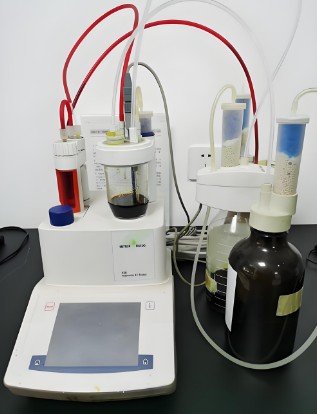
- Moisture content determination — oven-drying method per ISO 3344 to quantify residual moisture that could cause voids or hydrolysis in the cured laminate.
- Glass fiber type verification and oxide composition — X-ray fluorescence or wet chemical analysis per ASTM C169 confirms the glass formulation, distinguishing E-glass, S-glass, or C-glass by their silica, alumina, boron, and alkali oxide content.
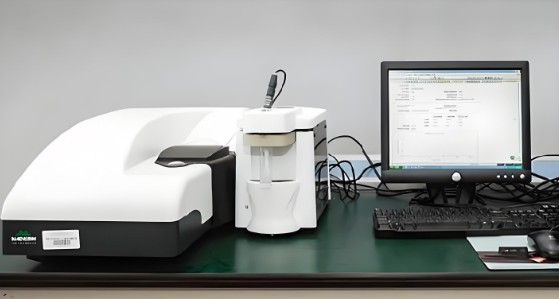
- Sizing and finish identification by FTIR and extraction — Fourier transform infrared spectroscopy and solvent extraction characterize the coupling agent and film former chemistry to ensure compatibility with polyester, epoxy, or phenolic resin systems.
- Silane coupling agent content — quantification of the active silane level on the fiber surface, directly influencing interfacial bond strength in the final composite product.
Thermal and Fire Performance Testing of Glass Fiber Woven Fabric
- Non-combustibility and limited combustibility test — per ISO 1182 and EN ISO 1716, the glass fiber cloth is exposed to a furnace at 750 °C to verify that it is non-combustible and suitable for fire-rated construction elements.
- Euroclass reaction-to-fire classification — testing according to EN 13501-1 including the small flame test (EN ISO 11925-2) and the single burning item test (EN 13823) where the cloth is used as a facing or membrane, generating the classification report for CE marking.
- Surface flame spread and smoke development — ASTM E84 Steiner tunnel test for glass fiber cloth used in North American building interiors and HVAC ductwork, typically achieving Class A rating due to the inert nature of glass.
- Limiting oxygen index determination — per ISO 4589-2, measuring the minimum oxygen percentage that supports combustion, providing a sensitive quality check for coated or treated glass fabrics.
- Thermal shrinkage and heat resistance — the cloth is exposed to a defined elevated temperature per ASTM D578 and the dimensional change is measured, ensuring the fabric remains stable under hot pressing, welding, or continuous service conditions.
- Thermogravimetric analysis — TGA per ASTM E1131 quantifies the thermal decomposition profile of the sizing, coating, and any organic content up to 1000 °C, supporting processing window definition for high-temperature composites.
Electrical Insulation Testing of Glass Fiber Woven Fabric
- Dielectric strength and breakdown voltage — per ASTM D149 and IEC 60243-1, the voltage at which the glass fiber cloth fails electrically is measured, confirming its suitability as an insulating layer in motors, transformers, and printed circuit boards.
- Volume and surface resistivity — per ASTM D257 and IEC 60093, the electrical resistance through and across the fabric is measured, verifying that the glass cloth meets the insulation resistance requirements for the intended voltage class.
- Dielectric constant and dissipation factor — per ASTM D150 and IEC 60250 at specified frequencies to qualify the fabric for high-frequency and RF insulation applications in electronics.
- Comparative tracking index — per IEC 60112, the resistance of the glass fiber cloth to tracking under voltage and contamination is evaluated, critical for printed wiring board reinforcement.
Durability and Environmental Resistance Testing of Glass Fiber Woven Fabric
- Resistance to acid and alkali environments — the cloth is immersed in dilute hydrochloric acid and sodium hydroxide solutions per ISO 175 and ASTM D543, then the retained tensile strength is measured to verify chemical stability, particularly for C-glass used in battery separators and filtration.
- Hydrolytic aging and wet strength retention — the fabric is subjected to hot water or steam at 85 °C to 100 °C for extended periods per ASTM D578, then the tensile breaking force is retested to predict performance in humid and water-immersion service.
- Neutral salt spray corrosion resistance — per ISO 9227 and ASTM B117, glass fiber cloth with metallic coatings or used in conjunction with metal fasteners is exposed to salt fog to assess any corrosion staining or degradation of the coating.
- Accelerated weathering and UV resistance of coated fabrics — per ISO 4892-2 and ASTM G155, PTFE, silicone, or vermiculite coated glass cloth is exposed to xenon-arc radiation and water spray, and changes in appearance, flexibility, and coating adhesion are evaluated.
- Low-temperature flexibility and fold endurance — the fabric is conditioned at sub-zero temperatures and then folded or creased to verify that the glass fibers do not fracture during installation in cold climates.
Report Recognition and ISO/IEC 17025 Compliance
Every method described in this testing of glass fiber woven fabric program falls within our ISO/IEC 17025 scope of accreditation. Our test reports are accepted by European notified bodies for CE marking, by aerospace and automotive OEMs for raw material qualification, and by building authorities and customs agencies across North America, the Middle East, and Asia Pacific. Whether you require a full initial type test for a new glass fabric, a batch release inspection for an incoming shipment, or a root cause failure analysis, our laboratory delivers the measurement precision and documentation integrity that global composite and insulation supply chains demand.