Tear Strength Testing Service – Accredited Tear Resistance and Toughness Evaluation for Global Markets
Our internationally accredited laboratory provides a specialist tear strength testing service that enables manufacturers of textiles, plastic films, rubber products, coated fabrics, paper and board, leather goods, and composite materials worldwide to independently measure the force or energy required to propagate a tear through their materials. Every test is conducted under the rigorous framework of ISO/IEC 17025, and each report bearing the ILAC mark is unconditionally accepted by regulatory authorities, notified bodies, and supply‑chain partners in all major economies. The tear strength testing service quantifies the resistance of a material to the propagation of an existing cut or a puncture, providing the fundamental data that design engineers, quality managers, and product developers use to guarantee the durability, the safety, and the serviceability of their products. By employing Elmendorf pendulum testers, trouser‑tear tensile machines, tongue‑tear fixtures, and precision cutters, we deliver the legally robust, traceable tear‑resistance data that underpin material selection, process control, and compliance with the relevant ISO, ASTM, EN, and customer‑specified standards.
Product Samples We Regularly Subject to Tear Strength Testing
Our calibrated test instruments and specimen‑preparation tools accommodate a vast range of flexible and semi‑rigid materials. The following categories represent the items most frequently evaluated through our tear strength testing service:
- Woven, knitted, and nonwoven textiles – apparel fabrics, upholstery, geotextiles, protective clothing, filter media, and technical textiles for automotive, medical, and industrial applications
- Plastic films and sheets – polyethylene, polypropylene, polyester, polyamide, and biodegradable films for packaging, agricultural, and construction uses
- Rubber and elastomer products – natural rubber, silicone, EPDM, and nitrile sheets, gaskets, seals, conveyor belts, and inflatable structures
- Coated and laminated fabrics – tent and awning materials, waterproof‑breathable membranes, inflatable‑boat fabrics, and chemical‑protective suits
- Paper, paperboard, and corrugated board – kraft paper, tissue, cardboard, and containerboard for packaging and converting operations
- Leather and synthetic leather – shoe uppers, handbag materials, automotive‑interior leather, and upholstery hides
- Multi‑layer and composite flexible materials – aluminium‑foil laminates, medical‑device pouches, vacuum‑insulation panels, and flexible printed‑circuit substrates
Textile Fabrics and Flexible Sheet Materials – Tear Strength Testing According to ISO 13937, ASTM D1424, and ASTM D2261
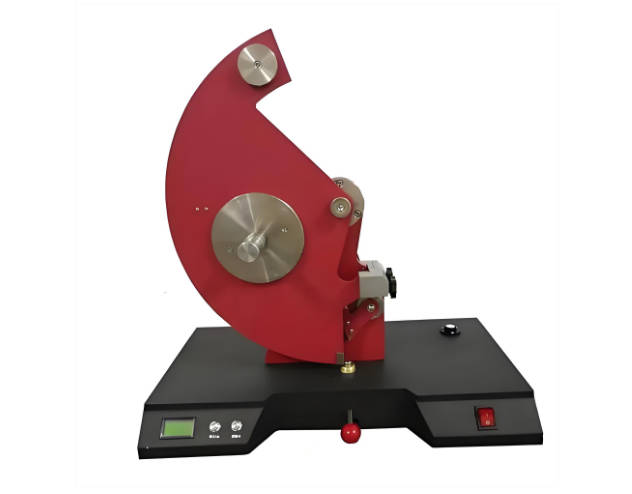
- Determination of the tearing force by the Elmendorf pendulum method according to ISO 13937‑1 (Textiles – Tear properties of fabrics – Part 1: Determination of tear force using ballistic pendulum method – Elmendorf) and ASTM D1424: a stacked set of fabric specimens is pre‑notched, and the pendulum of the Elmendorf tear tester is released. The kinetic energy absorbed in tearing the specimens is measured, and the tear force is reported in newtons or millinewtons per specimen. This tear strength testing service is the most widely used quality‑control method for woven and nonwoven textiles, and the result is directly referenced in the purchase specifications of garment manufacturers, military‑textile buyers, and geotextile installers.
- Trouser‑tear (single‑rip) method according to ISO 13937‑2 and ASTM D2261: a rectangular specimen is cut with a longitudinal slit to form two “legs”, which are clamped in a tensile testing machine and pulled apart at a constant speed. The average tear force and the peak‑to‑trough pattern are recorded, and the resistance to the tear propagation along the direction of the test is reported. The method is particularly suited to the evaluation of the directional tear resistance of coated and laminated fabrics where the yarn‑pull‑out and the coating‑failure mechanisms interact.
- Wing‑rip and tongue‑tear methods for textiles according to ISO 13937‑3 and ISO 9073‑4 (for nonwovens): a specimen is cut and clamped to produce a tear that propagates along the centre of the specimen, and the tear force and the failure mode are reported. The test is applied to nonwoven geotextiles, filter fabrics, and medical‑grade nonwovens where the fibre‑entanglement and the bonding point‑failure determine the tear resistance.
- Influence of the specimen orientation, the coating, and the finishing on the tear strength: the tear resistance is measured in the warp, the weft, and the bias directions, and the anisotropic ratio is reported. The test is repeated on the coated, the washed, or the weathered fabric, and the retention of the tear strength is calculated, providing the data that the product developer uses to guarantee the durability of the outdoor‑apparel, the tent, and the sailcloth over the intended service life.
Plastic Films, Sheets, and Thin‑Gauge Materials – Tear Strength Testing According to ASTM D1004, ASTM D1922, and ISO 6383
- Determination of the Graves (initiation) tear resistance of plastic films and sheeting according to ASTM D1004 and ISO 6383‑1: a trouser‑shaped or a crescent‑shaped specimen is cut from the film and pulled in a tensile tester. The maximum force required to initiate the tear from the pre‑cut slit is measured, and the tear resistance is reported in newtons or kilonewtons per metre of thickness. This tear strength testing service measures the resistance to the start of a tear, which is critical for the packaging films that must survive the puncture and the snagging during the automated filling and the transport.
- Elmendorf tear resistance of plastic films and thin sheets according to ASTM D1922 (Propagation tear resistance of plastic film and thin sheeting by pendulum method) and ISO 6383‑2: the specimen is notched and torn by the Elmendorf pendulum, and the energy consumed in the tear propagation is reported. The method is widely used for the quality control of polyethylene, polypropylene, and polyester films, and the results are specified in the purchasing agreements between the film producers and the packaging converters.
- Trouser‑tear method for the plastic films and the laminates: the specimen is pulled in a tensile tester, and the steady‑state tear‑propagation force is recorded. The tear strength test reveals the sensitivity of the film to the orientation, the extrusion‑direction, and the heat‑seal history, and the data are used to optimise the film‑blowing and the orientation processes.
- Tear strength of the biodegradable and the compostable films after the environmental conditioning: the film is exposed to a defined humidity, a temperature, or a microbial environment, and the residual tear strength is measured. The experiment supports the development of the packaging that maintains the tear resistance during the shelf life but degrades rapidly after the disposal.
Rubber, Elastomers, and Coated Fabrics – Tear Strength Testing According to ISO 34‑1, ASTM D624, and ISO 4674‑1
- Determination of the tear strength of the vulcanized and the thermoplastic rubber by the trouser‑tear, the angle‑tear, and the crescent‑tear methods according to ISO 34‑1 (Rubber, vulcanized or thermoplastic – Determination of tear strength) and ASTM D624: the specimen is prepared in one of the standardised shapes – trousers, an angle without a nick, or a crescent with a nick – and stretched in a tensile testing machine. The maximum force and the tear‑propagation resistance are reported in newtons per millimetre of thickness. This tear strength testing service is the primary method by which the rubber compounders and the seal manufacturers verify the toughness of the material and its ability to resist the tearing during the demoulding, the installation, and the service.
- Tear resistance of the coated fabrics and the rubber‑textile laminates according to ISO 4674‑1 (Rubber‑ or plastics‑coated fabrics – Determination of tear resistance): the trapezoidal or the trouser‑tear method is applied to the coated fabric, and the tear force and the failure mechanism – the coating‑cracking, the yarn‑breakage, or the delamination – are reported. The test qualifies the material for the inflatable boats, the tension‑fabric structures, and the protective‑clothing applications.
- Influence of the temperature, the ageing, and the immersion in the fluids on the tear strength of the elastomers: the specimen is aged in a hot‑air oven, immersed in an oil or a fuel, or exposed to the ozone before the tear test. The retention of the tear strength is calculated, and the data are used to predict the service life of the rubber hoses, the seals, and the gaskets in the automotive and the industrial environments.
- Trouser‑tear test for the determination of the tearing energy and the fracture‑mechanics parameters of the rubber: the tear force is measured as a function of the crack length, and the characteristic tearing energy T and the limiting‑tear‑energy T₀ are calculated. The data are used by the rubber formulators to develop the high‑tear‑strength compounds for the tyre treads, the conveyor‑belt covers, and the vibration mounts.
Paper, Board, and Fibre‑Based Products – Tear Strength Testing According to ISO 1974, TAPPI T 414, and ASTM D689
- Determination of the internal tearing resistance of the paper and the paperboard by the Elmendorf method according to ISO 1974 (Paper – Determination of tearing resistance – Elmendorf method) and TAPPI T 414: a stack of four or more sheets is torn by the Elmendorf pendulum, and the tearing resistance is reported in millinewtons. The test is a fundamental quality parameter for the printing and the writing papers, the sack kraft, the wrapping papers, and the tissue, and it is used by the paper mills to control the fibre‑furnish and the refining process.
- Tear resistance of the corrugated board and the solid fibreboard according to the principles of ASTM D689 and the relevant ISO standards: the Elmendorf or the trouser‑tear method is applied to the combined board, and the tear force and the failure mode – the liner‑rupture, the medium‑fracture, or the delamination – are reported. This tear strength testing service provides the data that the packaging designer uses to specify the correct board grade for the die‑cutting and the folding of the cartons.
- In‑plane and the out‑of‑plane tear resistance of the tissue and the sanitary products: the tissue sheet is torn in the machine direction and the cross direction, and the tear index (the tear resistance divided by the grammage) is reported. The data correlate with the softness and the handling of the tissue product and are used to benchmark the different grades and the suppliers.
- Tear strength after the environmental conditioning and the ageing of the paper: the specimen is exposed to an elevated temperature, a high humidity, or a pollutant gas, and the residual tear resistance is measured. The experiment assesses the permanence and the durability of the paper for the archival, the currency, and the security‑document applications.
Report Acceptance and Global Regulatory Compliance
All measurements performed within our tear strength testing service are executed under the fully accredited scope of our ISO/IEC 17025 quality management system. Each test report that carries the ILAC mark is therefore automatically recognised by regulatory authorities, notified bodies, customs offices, and supply‑chain partners in all major economies. For textile mills, film producers, rubber compounders, paper manufacturers, and flexible‑packaging converters anywhere in the world, the report constitutes legally robust, internationally accepted evidence that the tear resistance and the toughness of the material have been determined in accordance with the applicable ISO, ASTM, EN, TAPPI, and customer‑specified methods. The documentation can be directly used to support CE marking, the issue of inspection certificates according to EN 10204 or equivalent national standards, the compilation of technical files for type‑examination, and the resolution of commercial and technical disputes concerning the tear performance and the durability of any flexible material.