Comprehensive Substrate Glass Inspection Service for Global Electronics and Display Industries
As an ISO/IEC 17025 accredited testing laboratory, we deliver a specialized substrate glass inspection service that verifies dimensional precision, mechanical strength, optical clarity, chemical durability, and thermal stability. Our substrate glass inspection service supports manufacturers and exporters of flat panel display glass, cover glass, optical lens blanks, and specialty thin glass who must conform to SEMI, ISO, ASTM, and regional electronics standards across the European Union, North America, East Asia, and the Middle East. Every test is performed under our CNAS-accredited quality system, producing reports accepted by display OEMs, semiconductor equipment manufacturers, and global procurement authorities.

Product Samples We Regularly Test in Our Substrate Glass Inspection Service
- LCD and OLED glass substrates — alkali-free aluminosilicate and borosilicate thin glass for Gen 5 to Gen 10.5 panel fabrication
- Chemically strengthened cover glass — ion-exchanged aluminosilicate glass for smartphones, tablets, and automotive displays
- Touch sensor and ITO-coated glass — patterned and unpatterned conductive glass for capacitive touch panels
- Optical lens blanks and precision glass wafers — for camera modules, augmented reality waveguides, and MEMS devices
- Display backplane and TFT glass — low-CTE glass for high-resolution and flexible display applications
- Sapphire and ultra-thin flexible glass — for foldable device screens, watch crystals, and advanced optical components
- Patterned and masked glass substrates — with photoresist, dielectric, or metal layers for photolithography and wafer-level packaging
Dimensional and Geometrical Inspection of Substrate Glass
- Thickness, total thickness variation, and bow/warp measurement per SEMI MF1530 and SEMI MF1390 — laser interferometry and non-contact capacitance gauges scan the entire substrate surface to quantify the global flatness deviation, bow, warp, and total thickness variation, verifying the glass meets the tight tolerances required for photolithography overlay and cell gap control.
- Length, width, and edge straightness verification per SEMI D15 and ISO 13385 — precision video measuring machines and laser micrometers confirm that the substrate outer dimensions and edge linearity conform to the cassette and handling robot specifications for automated production lines.
- Corner chamfer and edge profile inspection — optical comparator and 3D profilometry assess the ground and polished edge geometry to ensure no chipping or micro-cracks that could initiate fracture during thermal processing or lamination.
- Surface waviness and ripple measurement per SEMI MF1811 and ISO 25178 — white light interferometry and stylus profilometry quantify mid-spatial frequency waviness that can cause visible mura defects in high-resolution displays.
Mechanical and Strength Testing in Substrate Glass Inspection
- Flexural strength by ring-on-ring and ball-on-ring tests per ASTM C1499 and ASTM C158 — biaxial flexure loading of the glass substrate generates the characteristic strength and Weibull modulus, providing statistical reliability data for design against mechanical failure during handling and in-service bending.
- Surface compressive stress and depth of compressive layer per ASTM C1279 and ASTM C1422 — photoelastic measurement using a surface stress meter quantifies the CS and DOL of chemically strengthened cover glass, confirming that the ion-exchange process has achieved the specified values for scratch resistance and impact toughness.
- Fracture toughness by indentation method per ISO 24370 and ASTM C1421 — Vickers indentation crack length measurement determines the resistance to crack propagation, a material property governing the critical flaw size for brittle failure.
- Edge strength by four-point bending with edge loading per SEMI MF2181 and customer protocols — specifically testing the ground and as-cut edges under tensile stress to rank edge finishing quality and predict glass breakage during robotic handling.
- Drop impact and ball drop resistance per UL 60950-22 and internal specifications — a falling ball or phone-shaped impactor strikes the cover glass to simulate real-world device drops, with post-impact inspection for crack initiation and propagation.
Optical and Surface Quality Analysis for Substrate Glass
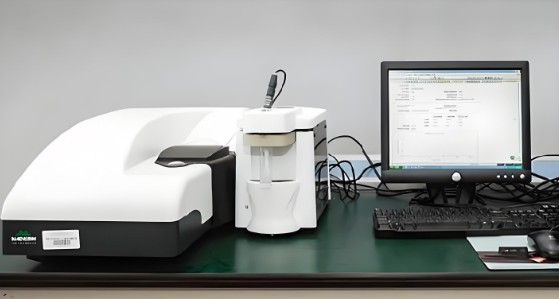
- Transmittance, reflectance, and haze measurement per ISO 13468, ISO 14782, and ASTM D1003 — spectrophotometry with integrating sphere across the UV, visible, and near-infrared ranges provides the total luminous transmittance, diffuse transmittance, and haze values that define the optical quality of display and cover glass.
- Surface roughness and defect inspection per ISO 4287 and SEMI MF1569 — stylus profilometry, atomic force microscopy, and automated optical inspection systems map the nanoscale roughness and detect pits, scratches, stains, and particles that would cause yield loss in subsequent coating or bonding steps.
- Refractive index and Abbe number per ISO 489 and ASTM E1967 — refractometry at multiple wavelengths determines the optical constants needed for anti-reflection coating design and ray-tracing simulation of optical systems.
- Stress birefringence and retardation per SEMI MF2610 and ASTM F218 — polarimetric measurement quantifies residual stress in the glass substrate that causes optical distortion in LCD and OLED panels, with results reported as optical retardation in nanometers per centimeter.
Chemical Composition and Thermal Analysis in Substrate Glass Inspection
- X-ray fluorescence for oxide composition per ASTM E1621 and ISO 12677 — the major oxide content including SiO2, Al2O3, B2O3, Na2O, and K2O is quantified to verify the glass type and confirm it meets the alkali-free specification required for TFT backplane compatibility.
- Coefficient of thermal expansion by dilatometry per ISO 7991 and ASTM E228 — the linear thermal expansion from ambient to the strain point is measured to ensure CTE matching with deposited thin-film layers and to prevent warpage during thermal processing.
- Strain point, annealing point, and softening point per ASTM C338 and ASTM C598 — fiber elongation and beam-bending viscometry define the characteristic viscosity temperatures that govern the thermal tempering, chemical strengthening, and dimensional stability of the glass substrate.
- Density and refractive index correlation per ASTM C729 — sink-float or gas pycnometry provides the density value used for process control and to verify batch-to-batch consistency in the glass melting and forming process.
- Trace metal and impurity analysis by ICP-MS — acid digestion followed by inductively coupled plasma mass spectrometry quantifies ppm and ppb levels of iron, copper, and other transition metals that degrade optical transmission and color neutrality.
Chemical Durability and Environmental Resistance Evaluation of Substrate Glass
- Resistance to acids and alkalis per ISO 695 and ISO 719 — the glass substrate is immersed in hydrochloric acid and sodium hydroxide solutions at defined temperatures, then the mass loss and surface degradation are measured to verify that the glass withstands etch and cleaning processes in panel fabrication.
- Humidity and damp heat resistance per IEC 60068-2-78 and SEMI MF1824 — exposure to 85 °C and 85% relative humidity for 1000 hours evaluates the long-term stability of the glass surface and any coated layers against hydrolytic attack and staining.
- Thermal shock and rapid temperature cycling per IEC 60068-2-14 and ASTM C149 — the substrate is rapidly transferred between hot and cold environments to verify resistance to cracking from thermal gradients experienced during sputtering, annealing, and bonding processes.
- Resistance to cleaning solvents and process chemicals per ISO 175 and ASTM D543 — immersion in isopropyl alcohol, acetone, and proprietary photoresist strippers tests the chemical inertness of the glass and the stability of any applied coatings or masks.
- Restricted substance compliance per EU RoHS and REACH — ICP-OES and GC-MS screening for lead, cadmium, mercury, hexavalent chromium, phthalates, and PAHs ensures the substrate glass meets global environmental regulations for electronic components.
Report Recognition and ISO/IEC 17025 Compliance
All methods described in this substrate glass inspection service are included within our ISO/IEC 17025 scope of accreditation. Our test reports are accepted by global display and semiconductor manufacturers, by notified bodies in the European Union, and by customs and procurement authorities across North America and Asia Pacific. Whether you require a complete qualification of a new glass substrate supplier, a batch release inspection of incoming Gen 8.5 sheets, or a root cause failure analysis of a display defect, our laboratory provides the measurement precision and technical depth that the flat panel display and precision optics industries demand.