Static Friction Coefficient Experiment – Accredited Slip Resistance and Frictional Performance Evaluation for Global Markets
Our internationally accredited laboratory delivers a specialist static friction coefficient experiment service that enables manufacturers of packaging materials, flooring products, automotive components, medical devices, consumer goods and industrial equipment worldwide to independently measure the initial resistance to sliding between two surfaces. Every test is conducted under the rigorous framework of ISO/IEC 17025, and each report bearing the ILAC mark is unconditionally accepted by regulatory authorities, notified bodies and supply‑chain partners in all major economies. The static friction coefficient experiment quantifies the ratio of the tangential force required to initiate the relative motion of two contacting bodies to the normal force pressing them together, providing the fundamental data that design engineers, packaging technologists and safety specialists use to guarantee the safe handling of stacked goods, the reliable feeding of films through converting machinery, the slip resistance of floor surfaces and the tactile grip of handles and controls. By employing calibrated horizontal‑plane sled apparatuses, inclined‑plane testers and precision force transducers, our platform generates the legally robust, traceable friction data that underpin product certification, regulatory compliance and the optimisation of surface treatments and material pairs.
Product Samples We Regularly Subject to Static Friction Coefficient Experiments
The friction test frames, weighted sleds, interchangeable counter‑surface plates and environmental chambers in our facility accommodate a vast variety of material pairs and finished products. The following categories represent the items most frequently evaluated through our static friction coefficient experiment programme:
- Flexible packaging films and sheets – polyethylene, polypropylene, polyester, polyamide and biodegradable films whose surface slip properties determine the efficiency of form‑fill‑seal operations, the ease of opening of the finished package and the stability of the palletised load
- Paper, paperboard and corrugated board – kraft liner, coated folding boxboard, tissue and containerboard where the friction coefficient governs the feeding reliability in printing and die‑cutting machines and the stacking stability of the finished boxes
- Floor coverings and pedestrian surfaces – ceramic and porcelain tiles, vinyl and linoleum flooring, laminated wood flooring, polished concrete and anti‑slip coatings for which the static coefficient of friction is a mandatory safety parameter
- Automotive interior and exterior components – brake‑pad friction materials, tyre‑tread compounds, clutch facings, gear‑shift knob materials, pedal‑pad covers and seat‑upholstery fabrics
- Medical device and laboratory consumables – syringe plungers and barrels, vial stoppers, catheter tubing, surgical‑glove surfaces and pipette tips where the consistent, low‑friction behaviour is critical for the accurate and the safe operation
- Consumer and industrial products – grip surfaces of tools and sports equipment, conveyor‑belt top covers, printer‑roller elastomers, bottle‑cap threads and closure liners, and adhesive‑tape unwind characteristics
- Metallic and ceramic tribological couples – bearing materials, guide‑rail and slide‑way pairs, piston‑ring and cylinder‑liner combinations and orthopaedic‑implant bearing surfaces
Determination of Static Friction Coefficient by the Horizontal‑Plane Sled Method – According to ASTM D1894 and ISO 8295
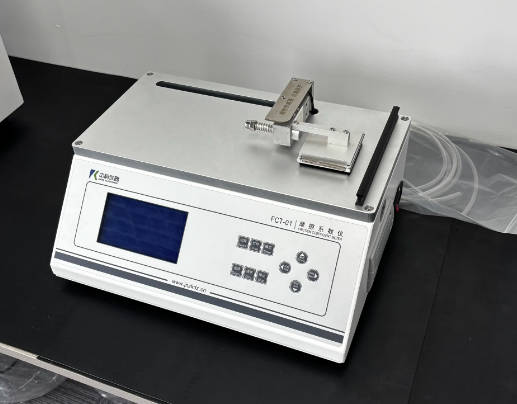
- Standard test procedure for the static coefficient of friction of plastic films and sheeting according to ASTM D1894 (Standard Test Method for Static and Kinetic Coefficients of Friction of Plastic Film and Sheeting) and ISO 8295 (Plastics – Film and sheeting – Determination of the coefficients of friction): a specimen of the film is mounted on a fixed horizontal plane, and a sled of a specified mass and a known bottom‑surface material – often a polished‑steel or a film‑covered block – is placed on top. A calibrated force transducer pulls the sled at a constant speed, and the maximum force recorded just before the sled begins to move is the static friction force. The static coefficient of friction μs is calculated as the ratio of the static friction force to the normal force (the sled weight), and the result is reported to three decimal places. This static friction coefficient experiment is the primary method by which film producers and converters control the slip‑additive level, the corona‑treatment effect and the batch‑to‑batch consistency of the packaging film.
- Measurement of the static coefficient of friction between a film and a metal, a glass or a ceramic counter‑surface: the standard sled is replaced by a sled faced with the counter‑material of interest – a stainless‑steel plate, a glass sheet or a plasma‑sprayed ceramic tile – and the static friction coefficient of the film against that surface is determined. The data are used to design the chutes, the guides and the rollers of the packaging machine and to select the correct film for the high‑speed wrapping of the glass or the metal containers.
- Determination of the paper‑to‑paper and the paper‑to‑metal static friction coefficient according to TAPPI T 549 and ISO 15359: a paper or a board specimen is mounted on the horizontal plane, and a sled of a defined weight and a paper‑covered or a steel bottom is pulled across it. The static friction coefficient is reported, providing the data that the paper‑mill and the printing‑house engineers need to prevent the double‑feeding, the jamming and the scuffing of the sheets in the high‑speed feeders and the folders.
- Influence of the dwell time, the temperature and the humidity on the static friction coefficient: the sled is placed on the specimen and left for a defined dwell time – from a few seconds to several hours – before the pull is initiated, and the static friction coefficient is measured as a function of the dwell time. The experiment is repeated at several temperatures and relative‑humidity levels, and the data are used to predict the blocking tendency of the film or the paper in the warehouse, the shipping container and the tropical climate.
- Measurement of the static friction coefficient after the surface treatment – corona, plasma, flame or coating: the treated and the untreated film specimens are compared, and the effect of the treatment on the static coefficient of friction is reported. This static friction coefficient experiment verifies that the treatment that improves the printability or the adhesion does not unacceptably increase or decrease the slip characteristics of the film.
Static Friction Coefficient Experiment for Flooring, Pedestrian Safety and Footwear – According to ASTM C1028, ANSI A137.1 and EN 13893
- Determination of the static coefficient of friction of flooring surfaces by the horizontal‑pull method with a Neolite or a leather slider according to ASTM C1028 (Standard Test Method for Determining the Static Coefficient of Friction of Ceramic Tile and Other Like Surfaces) and the principles of ANSI A137.1: a weighted sled fitted with a standardised Neolite or a leather test foot is placed on the floor surface, and the force required to initiate the sliding is measured. The static coefficient of friction is reported for the dry, the wet and the oil‑contaminated condition, and the result is compared with the minimum value – typically 0.42 or 0.60 – specified by the building code, the insurance requirement or the workplace‑safety regulation. This static friction coefficient experiment provides the legally recognised slip‑resistance data that the flooring manufacturer, the architect and the facility manager use to certify the safety of the pedestrian surface.
- Inclined‑plane (ramp) test for the determination of the static coefficient of friction of the flooring and the footwear according to EN 13893 (Resilient, laminate and textile floor coverings – Measurement of dynamic coefficient of friction on dry floor surfaces, of static coefficient of friction on dry and wet floor surfaces, and of the stick‑slip effect) and the methods of the Health and Safety Executive: a test subject or a mechanical surrogate wearing the specified footwear walks or stands on the floor surface, which is gradually inclined until the slip occurs. The tangent of the angle of inclination is the static coefficient of friction, and the result is reported for the dry, the wet and the glycerol‑contaminated condition, directly representing the real‑world pedestrian slip hazard.
- Friction‑screening of the anti‑slip coatings, the tapes and the stair‑nosings: the static friction coefficient of the treated surface is measured before and after the abrasion, the weathering and the chemical‑cleaning exposure, and the durability of the slip‑resistant property is quantified, supporting the specification of the anti‑slip treatment for the public‑transport stations, the swimming‑pool surrounds and the industrial kitchens.
- Static friction coefficient of the shoe‑sole materials against the standard floor surfaces: the sled is fitted with a sample of the shoe‑sole compound, and the static friction coefficient against the dry and the wet tile, the wood, the vinyl and the concrete is reported, providing the data that the footwear designer uses to meet the slip‑resistance requirements of the European and the international safety‑footwear standards.
Static Friction Coefficient Experiment for Automotive, Industrial and Medical Applications – Specialised Tribological Evaluation
- Determination of the static friction coefficient of the brake‑pad and the clutch‑facing materials against the cast‑iron or the steel counter‑disc according to the principles of ISO 26867 and the automotive OEM test procedures: a specimen of the friction material is loaded against a rotating or a stationary disc, and the break‑away torque is measured. The static coefficient of friction is reported as a function of the temperature, the contact pressure and the sliding history, providing the data that the brake‑system engineer uses to predict the hill‑hold performance, the creep‑groan susceptibility and the cold‑judder behaviour.
- Measurement of the static friction coefficient of the elastomeric seals, the O‑rings and the gaskets against the metal or the plastic housing: the rubber specimen is pressed against a counter‑surface under a controlled normal load, and the tangential force at the onset of the sliding is measured. This static friction coefficient experiment quantifies the stick‑slip tendency of the seal during the assembly and the operation, and the data are used to select the correct elastomer compound, the surface roughness and the lubrication for the pneumatic and the hydraulic actuators.
- Static friction coefficient of the syringe plunger‑stopper against the glass or the plastic barrel according to ISO 7886‑1 and the pharmacopoeial requirements: the plunger is extracted from the barrel at a controlled speed, and the break‑loose force and the running force are measured. The static friction coefficient determines the smoothness and the ease of the injection, and the experiment verifies that the lubricious coating or the silicone‑oil treatment of the stopper meets the specification for the pre‑filled syringe or the auto‑injector.
- Determination of the static friction coefficient of the fastener threads and the bearing surfaces for the torque‑tension relationship according to ISO 16047: the bolt, the nut and the washer are assembled, and the torque, the clamp force and the thread‑friction and the bearing‑friction torques are measured by a multi‑axis torque‑tension test rig. The static coefficient of friction under the head and in the threads is reported, providing the data that the joint designer uses to set the tightening specification and to guarantee the reliable preload of the bolted connection.
Report Acceptance and Global Regulatory Compliance
All measurements performed within our static friction coefficient experiment service are executed under the fully accredited scope of our ISO/IEC 17025 quality management system. Each test report that carries the ILAC mark is therefore automatically recognised by regulatory authorities, notified bodies, customs offices and supply‑chain partners in all major economies. For film producers, flooring manufacturers, automotive‑component suppliers, medical‑device developers and consumer‑product designers anywhere in the world, the report constitutes legally robust, internationally accepted evidence that the static coefficient of friction and the slip‑resistance characteristics of the material or the product have been determined in accordance with the applicable ASTM, ISO, EN, ANSI and customer‑specified methods. The documentation can be directly used to support CE marking, the issue of inspection certificates according to EN 10204 or equivalent national standards, the compilation of technical files for type‑examination, and the resolution of commercial and technical disputes concerning the frictional performance and the slip safety of any product.