Room Temperature Volume Resistivity Experiment – Accredited Electrical Insulation and Conductivity Evaluation for Global Markets
Our internationally accredited laboratory provides a specialist room temperature volume resistivity experiment service that empowers manufacturers of electrical insulation materials, cable jackets, polymer compounds, electronic packaging films and antistatic products worldwide to independently quantify the bulk electrical resistance of their materials. All tests are conducted within the strict framework of ISO/IEC 17025, and each report carrying the ILAC mark is unconditionally accepted by regulatory authorities, notified bodies and supply‑chain partners in all major economies. The room temperature volume resistivity experiment precisely measures the direct‑current resistance of a material under a defined electrode configuration and voltage, providing the fundamental data that design engineers and quality managers use to verify that an insulator will prevent leakage currents, that an antistatic or conductive compound will safely dissipate charge, and that the material conforms to the relevant IEC, ASTM, ISO and customer‑specified performance standards.
Product Samples We Regularly Subject to Room Temperature Volume Resistivity Experiments
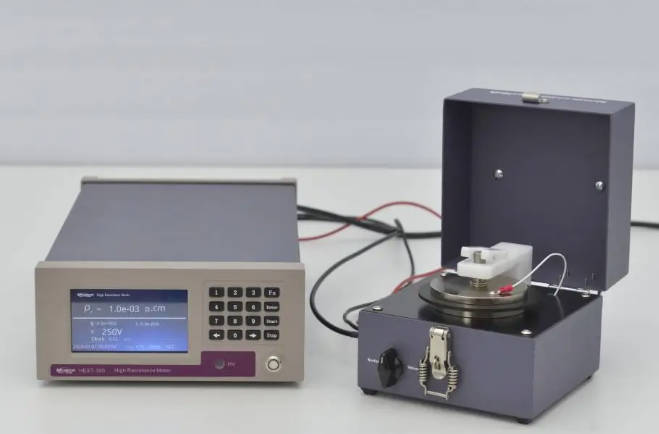
Our guarded‑electrode test cells, high‑resistance pico‑ammeters, precision voltage sources and temperature‑controlled chambers accommodate solid sheets, films, tubes and moulded plaques. The following categories represent the most frequently tested items:
- Solid insulating materials and laminates – rigid epoxy‑glass laminates, phenolic paper and cotton‑fabric sheets, melamine‑glass composites, and polyester‑glass plates for switchgear, transformers and terminal boards
- Plastic films, sheets and moulded parts – polyethylene, polypropylene, polyester, polycarbonate, polyimide and fluoropolymer films and mouldings used in capacitors, printed‑circuit‑board substrates and wire‑and‑cable insulation
- Elastomers and rubber products – silicone, ethylene‑propylene‑diene monomer, nitrile and natural rubber sheets, O‑rings and gaskets where the volume resistivity indicates the filler loading and the cross‑link density
- Conductive, static‑dissipative and antistatic materials – carbon‑black‑filled, carbon‑fibre‑reinforced and intrinsically conductive polymer compounds for electrostatic‑discharge protection, cleanroom flooring and electronic packaging
- Cable and wire insulation and jacketing – cross‑linked polyethylene, polyvinyl chloride, thermoplastic elastomer and low‑smoke zero‑halogen jackets for power, control and data cables
- Paints, varnishes and conformal coatings – insulating varnishes, conformal coating films and powder‑coating layers on metal substrates where the volume resistivity of the cured film must be verified
- Ceramic and glass products – alumina, steatite, porcelain and glass insulator bodies for high‑voltage transmission, spark‑plug cores and furnace elements
- Textile and nonwoven products – antistatic carpets, filter‑media felts and cleanroom garments where the volume resistivity governs the charge‑decay behaviour
Solid Insulating Materials, Films and Laminates – Room Temperature Volume Resistivity Experiment According to IEC 62631‑3‑1 and ASTM D257
- Determination of the volume resistivity and the volume conductivity of solid insulating materials by the three‑terminal guarded‑electrode method according to IEC 62631‑3‑1 (Dielectric and resistive properties of solid insulating materials – Part 3‑1: Determination of resistive properties – Volume resistance and volume resistivity, general method) and ASTM D257 (Standard Test Methods for DC Resistance or Conductance of Insulating Materials): a circular or a rectangular specimen is placed between a main electrode and an unguarded counter‑electrode, with a guard electrode surrounding the main electrode to divert the surface leakage current. A known, stable direct‑current voltage – typically 100 V, 500 V or 1 000 V – is applied, and the current that flows through the bulk of the material is measured by a pico‑ammeter or an electrometer after a defined electrification time, usually 60 seconds. The volume resistivity ρv in ohm‑metres is calculated from the measured resistance, the effective electrode area and the specimen thickness, and the result is reported together with the applied voltage and the electrification time. This room temperature volume resistivity experiment is the primary method by which insulating‑material manufacturers certify that their products meet the minimum resistivity requirements of the application – for example, above 10¹⁰ Ω·m for general‑purpose insulation and above 10¹² Ω·m for high‑quality capacitor dielectrics.
- Influence of the electrification time, the voltage and the temperature on the measured volume resistivity: the current is recorded at several electrification times – 15 s, 60 s and 600 s – and the time‑dependent absorption current and the steady‑state conduction current are separated. The test is repeated at several voltages to verify that the material obeys Ohm's law, and any deviation from the linear behaviour is reported. The room temperature volume resistivity experiment provides the complete resistive fingerprint of the material, which the insulation‑design engineer uses to predict the long‑term leakage current under the service voltage.
- Measurement of the volume resistivity of flexible films and thin sheets according to the principles of ASTM D257 and IEC 62631‑3‑1 with the appropriate electrode arrangement: the film is placed between two circular electrodes, or a conductive‑rubber electrode is used to avoid the mechanical damage. The volume resistivity is measured and the result is reported in ohm‑metres or ohm‑centimetres, supporting the specification of the film for the capacitor, the flexible‑printed‑circuit and the insulating‑tape applications.
- Volume resistivity of the polymeric and the elastomeric materials after the conditioning in the standard atmosphere and after the drying: the specimen is tested after the conditioning at 23 °C and 50 % relative humidity, and also after a period of drying in a desiccator, to quantify the contribution of the absorbed moisture to the conductivity. This room temperature volume resistivity experiment distinguishes the intrinsic resistivity of the polymer from the effect of the humidity, and it guides the selection of the material for the high‑humidity or the tropical environments.
- Surface resistivity and the volume‑resistivity correlation for the classification of the antistatic and the static‑dissipative materials: the surface resistivity is measured on the same specimen by the guarded‑electrode method, and the data are compared with the volume resistivity. The material is classified as insulative, static‑dissipative or conductive according to the ranges defined by the IEC 61340‑2‑3 and the ANSI/ESD standards, providing the evidence that the flooring, the packaging or the garment meets the electrostatic‑discharge protection requirements.
- Volume resistivity after the thermal ageing, the immersion in the liquids and the mechanical flexing: the specimen is exposed to the environmental stress and then retested. The retention of the volume resistivity is reported, and the data are used to assess the long‑term stability of the electrical insulation in the transformer oil, the engine coolant or the dynamic‑flexing application.
Report Acceptance and Global Regulatory Compliance
All measurements performed within our room temperature volume resistivity experiment service are executed under the fully accredited scope of our ISO/IEC 17025 quality management system. Each test report that carries the ILAC mark is therefore automatically recognised by regulatory authorities, notified bodies, customs offices and supply‑chain partners in all major economies. For manufacturers of electrical insulation, cable compounds, antistatic materials and electronic‑grade films anywhere in the world, the report constitutes legally robust, internationally accepted evidence that the volume resistivity, the surface resistivity and the electrical‑insulation performance of the material have been determined in accordance with the applicable IEC, ASTM, ISO and customer‑specified methods. The documentation can be directly used to support CE marking, the issue of inspection certificates according to EN 10204 or equivalent national standards, the compilation of technical files for type‑examination, and the resolution of commercial and technical disputes concerning the electrical‑resistance characteristics of any insulating or conductive product.