Printing Film Testing Service for Global Packaging and Graphic Arts Compliance
As an ISO/IEC 17025 accredited laboratory, we deliver a specialized printing film testing service that verifies the print adhesion, surface energy, optical clarity, mechanical strength, thermal stability, and chemical resistance of films used in flexible packaging, labels, and graphic arts. Our printing film testing service supports manufacturers and exporters of BOPP, PET, PE, PVC, and specialty printing films who must demonstrate conformity to ASTM, ISO, EN, and regional packaging and printing standards across the European Union, North America, the Middle East, and Asia. Every test is performed under our CNAS-accredited quality system, producing reports accepted by notified bodies, brand owners, and procurement teams worldwide.

Product Samples We Regularly Test in Our Printing Film Testing Service
- Biaxially oriented polypropylene films for flexographic and gravure printing — clear, white, and metallized grades for snack food, confectionery, and label applications
- Polyester printing films — for high-temperature labels, durable tags, and industrial graphic overlays
- Polyethylene and cast polypropylene printing films — for shrink sleeves, stretch labels, and in-mold labeling
- PVC and PETG shrink films with printability — for full-body shrink sleeves and tamper-evident bands
- Surface-treated and coated printing films — with corona, plasma, or chemical primer treatments for enhanced ink adhesion
- Anti-static and low-friction printing films — for high-speed printing and converting operations
- Custom-formulated and OEM-specific printing film products — with defined surface energy, clarity, and barrier requirements
Printing Film Testing Service for Surface Energy and Ink Adhesion
- Wetting tension and surface energy measurement per ASTM D2578 and ISO 8296 — dyne pen or contact angle methods determine the surface energy of the printing film, verifying that the corona, plasma, or chemical treatment provides the specified wettability for the target ink system.
- Surface energy stability and decay after storage per internal validated protocol — the printing film is stored under controlled conditions and the surface energy is measured at intervals to predict the shelf life of the surface treatment and to verify stable printability from roll to roll.
- Ink adhesion by tape test and cross-cut method per ASTM D3359 and ISO 2409 — the printed film is scribed and tape-pulled to quantify the adhesion of flexographic, gravure, or digital inks to the film surface, ensuring durable print that withstands converting and end-use.
- Blocking resistance and anti-block performance per ASTM D3354 — the printing film is subjected to pressure and temperature to verify the printed or unprinted surfaces do not stick together in roll form, preventing print transfer and feeding problems.
- Coefficient of friction per ISO 8295 and ASTM D1894 — the static and dynamic friction of the printing film surface are measured to ensure smooth movement through printing presses, bag-making machines, and form-fill-seal equipment.
- Surface roughness and profile per ISO 4287 — stylus profilometry quantifies the micro-roughness of the printing film to verify the specified surface for ink holdout and print sharpness.
Printing Film Testing Service for Optical and Visual Quality
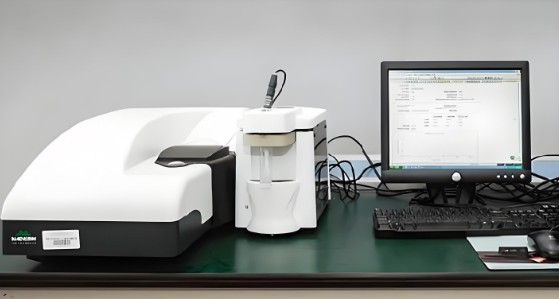
- Haze and total luminous transmittance per ASTM D1003 and ISO 14782 — the clarity and light transmission of the printing film are measured using an integrating sphere spectrophotometer, ensuring the film provides the required transparency or opacity for the packaging application.
- Gloss and surface reflectance per ASTM D2457 and ISO 2813 — the specular gloss of the printing film surface is measured at defined angles to verify the specified finish for high-quality printed graphics.
- Color measurement and color difference per ISO 7724 and ASTM E308 — CIE L*a*b* coordinates and delta E values are determined to verify film color consistency and to match brand specifications.
- Print quality and resolution evaluation per ISO 12647 and internal protocols — the printed film is assessed for dot gain, print density, registration accuracy, and line sharpness to ensure the film supports high-resolution graphic reproduction.
- Visual defect inspection under D65 illumination — systematic examination for gels, fisheyes, streaks, and surface contamination against agreed acceptance criteria and master reference samples.
Printing Film Testing Service for Mechanical and Thermal Properties
- Tensile strength and elongation at break per ISO 527-3 and ASTM D882 — the printing film is stretched to failure in machine and transverse directions to measure breaking force and stretch, ensuring the film withstands printing tension, converting, and packaging machine stresses.
- Tear resistance by Elmendorf method per ISO 6383-2 and ASTM D1922 — the force required to propagate a tear is measured to verify resistance to nicks and splitting during slitting and packaging operations.
- Puncture and probe resistance per ASTM D5748 — the force required to push a pointed probe through the printing film is quantified to ensure resistance to product corners and sharp edges.
- Dart drop impact resistance per ASTM D1709 and ISO 7765-1 — a weighted dart is dropped onto the film to measure the energy required to cause failure, simulating impact loads on packaged products.
- Thermal shrinkage and dimensional stability per ASTM D1204 and ISO 11501 — the printing film is exposed to elevated temperature and the percentage shrinkage is recorded to ensure dimensional stability during heat sealing, hot filling, and shrink sleeve application.
- Heat seal strength and hot tack per ASTM F88 and ASTM F1921 — the seal strength and the strength while still hot are measured to validate the sealing performance of the printing film on high-speed packaging lines.
- Coefficient of linear thermal expansion per ASTM E831 — the dimensional change with temperature is measured for printing films used in precision label and graphic applications.
Printing Film Testing Service for Barrier and Permeation Performance
- Water vapor transmission rate per ASTM F1249 and ISO 15106-2 — the moisture vapor permeability of the printing film is measured using a modulated infrared sensor to verify the barrier for moisture-sensitive products.
- Oxygen transmission rate per ASTM D3985 and ISO 15105-2 — the oxygen permeability is measured using a coulometric sensor to confirm the oxygen barrier for shelf-life extension.
- Carbon dioxide and nitrogen transmission rate per ASTM F2476 — for modified atmosphere packaging films, the permeability to CO2 and N2 is determined to predict package headspace changes.
- Aroma and solvent barrier by gravimetric permeation cells — the film's ability to retain flavor compounds and resist solvent penetration is evaluated for high-barrier packaging applications.
- Light and UV transmission per ASTM E1348 and ISO 13468 — for light-sensitive products, the spectral transmittance of the printing film is measured to verify the specified opacity and UV blocking.
Chemical Safety and Restricted Substance Compliance for Printing Films
- RoHS compliance per IEC 62321 and EU Directive 2011/65/EU — quantitative screening for lead, mercury, cadmium, hexavalent chromium, PBBs, and PBDEs in the film, inks, and any coatings.
- REACH Annex XVII and SVHC screening — targeted analysis of Substances of Very High Concern including phthalate plasticizers and organotin stabilizers.
- Overall migration and specific migration for food contact per EU Regulation 10/2011 and FDA 21 CFR — the printed film is exposed to food simulants and the total extractable mass and specific migrant levels are quantified to confirm safety for food packaging.
- Formaldehyde and volatile organic compound emission per ISO 16000-3 — chamber testing verifies that the printing film does not release harmful VOCs into the indoor air.
- Heavy metals in packaging per EU Directive 94/62/EC — verification that the sum concentration of lead, cadmium, mercury, and hexavalent chromium is below the 100 ppm regulatory limit.
- Polycyclic aromatic hydrocarbons per AfPS GS 2019:01 PAK — for carbon-black-filled or dark-colored printing films, the 15 restricted PAHs are extracted and quantified.
- Halogen content by combustion ion chromatography per EN 14582 — the total fluorine, chlorine, bromine, and iodine content is measured to support halogen-free declarations.
Report Recognition and ISO/IEC 17025 Compliance
All methods described in this printing film testing service are covered by our ISO/IEC 17025 scope of accreditation. Our technical reports are accepted by European notified bodies for packaging and food contact materials, by North American brand owners and converters referencing ASTM and ISO standards, and by customs and regulatory authorities across the Middle East, Australia, and Asia. Whether you require a complete qualification dossier for a new printing film, a batch release inspection for an incoming shipment, or a root cause failure analysis of a print adhesion or performance issue, our laboratory provides the measurement accuracy and technical expertise that the global flexible packaging and printing industries demand.