Polyamide Particle Testing Service for Global Industrial Supply Chains
As an ISO/IEC 17025 accredited testing laboratory, our dedicated Polyamide Particle Testing Service provides comprehensive analytical support for manufacturers, exporters, and procurement managers across the polymer, automotive, electronics, and additive manufacturing sectors. Our Polyamide Particle Testing Service verifies chemical identity, thermal behavior, particle size distribution, mechanical flow properties, and regulatory compliance of PA6, PA66, PA11, PA12, and specialty polyamide granules and powders. From raw material qualification to batch release inspection, every test is conducted under our CNAS-accredited quality system, producing reports accepted by notified bodies, customs authorities, and major industrial buyers across the European Union, North America, and Asia.

Product Samples We Regularly Test in Our Polyamide Particle Testing Service
- PA6 and PA66 virgin granules and chips — for injection molding, extrusion, and textile fiber production
- PA11 and PA12 bio-based polyamide particles — for automotive fluid lines, flexible tubing, and high-performance coatings
- Selective laser sintering (SLS) polyamide powders — PA12 and PA11 fine powders for additive manufacturing and rapid prototyping
- Glass-fiber reinforced and mineral-filled polyamide pellets — for structural automotive components and electrical housings
- Flame-retardant and heat-stabilized polyamide compounds — for electrical connectors, circuit breakers, and railway applications
- Polyamide microparticles and spherical beads — for cosmetic exfoliants, industrial abrasives, and surface finishing
- Recycled and post-industrial polyamide regrind and flakes — for sustainability programs and closed-loop manufacturing
Chemical and Thermal Property Testing in Our Polyamide Particle Testing Service
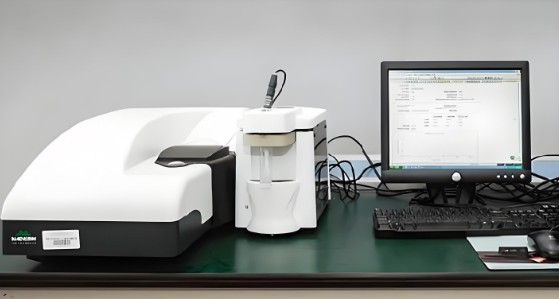
- Fourier transform infrared spectroscopy for polymer identification per ASTM E1252 and ISO 4650 — the infrared absorption spectrum of the polyamide particle is acquired and compared against reference libraries to confirm the specific nylon type and detect the presence of blends, copolymers, or chemical degradation.
- Differential scanning calorimetry for melting point, crystallinity, and glass transition per ISO 11357-1, ISO 11357-2, and ASTM D3418 — the thermal transitions of the polyamide particles are measured under controlled heating and cooling to determine the melting temperature, enthalpy of fusion, and percentage crystallinity, which directly influence mechanical properties and processing behavior.
- Thermogravimetric analysis for filler content, carbon black, and thermal stability per ASTM E1131 and ISO 11358-1 — the mass loss of the polyamide sample is recorded as it is heated to 900 °C under nitrogen and air to quantify the organic polymer fraction, reinforcing fiber content, carbon black, and ash residue.
- Intrinsic viscosity and relative viscosity of polyamide solution per ISO 307 and ASTM D2857 — the flow time of a dissolved polyamide sample in sulfuric acid or formic acid is measured using an Ubbelohde capillary viscometer to calculate the viscosity number and molecular weight, controlling the mechanical strength and moldability of the material.
Physical and Particle Size Distribution Analysis for Polyamide Particles
- Particle size distribution by laser diffraction per ISO 13320 and ASTM B822 — wet or dry dispersion laser scattering determines the D10, D50, and D90 values of polyamide powders and microparticles, verifying that the particle cut conforms to the specification for SLS printing, coating, or cosmetic use.
- Sieve analysis for granular polyamide chips per ASTM D1921 and ISO 4610 — mechanical or air-jet sieving quantifies the fraction of oversize and undersize pellets that could cause feeding inconsistencies in injection molding hoppers and extruders.
- Apparent density, tap density, and Hausner ratio per ASTM D1895 and ISO 60 — the freely poured and tapped density of polyamide particles are measured to predict bulk handling behavior and hopper discharge consistency in automated processing lines.
- Flowability and Hall flow rate measurement per ASTM D1895 and ISO 6186 — the time required for a defined mass of polyamide powder or granules to flow through a calibrated funnel is recorded, providing a direct measure of powder feedability for SLS machines and extrusion dosing units.
- Scanning electron microscopy for particle shape and surface morphology per ASTM E1508 — high-magnification imaging reveals the sphericity, surface roughness, and presence of agglomerates or satellites on polyamide microparticles, critical for powder bed fusion and surface finish quality.
Moisture and Volatile Content Analysis in Our Polyamide Particle Testing Service
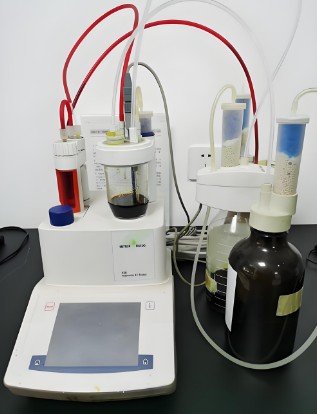
- Karl Fischer coulometric titration for water content per ISO 15512 and ASTM D6869 — the polyamide particles are heated in a vial and the released moisture is titrated by a Karl Fischer system to determine the precise water content in ppm or percentage, as moisture directly causes hydrolysis, bubble formation, and viscosity loss during melt processing.
- Loss on drying and moisture by hot air oven per ASTM D6980 and ISO 960 — a gravimetric method measures the mass loss of polyamide granules after heating at a defined temperature, providing a rapid pass/fail check for pre-drying requirement before extrusion or injection molding.
- Volatile organic compound emission by headspace gas chromatography per ASTM D4526 and VDA 277 — the polyamide particles are heated in a sealed vial and the released volatiles are analyzed by GC-FID or GC-MS to screen for residual monomers, oligomers, and solvent residues that affect indoor air quality and automotive interior compliance.
Mechanical and Flow Characterization of Molded Polyamide Specimens from Particles
- Melt mass-flow rate and volume-flow rate per ISO 1133-1 and ASTM D1238 — the polyamide granules are extruded through a standardized die under controlled temperature and load, and the mass of material extruded in 10 minutes is measured to classify the flow grade and predict mold filling behavior.
- Tensile strength and elongation of injection-molded specimens per ISO 527-2 and ASTM D638 — the polyamide particles are injection molded into standard test bars, then the yield stress, break stress, and elongation are measured to verify that the material meets the mechanical property specification for its grade.
- Charpy and Izod impact strength of notched specimens per ISO 179-1 and ASTM D256 — the impact toughness of the molded polyamide is determined at ambient and low temperatures to evaluate resistance to sudden shocks, particularly important for glass-reinforced and flame-retardant compounds used in structural parts.
- Flexural modulus and strength per ISO 178 and ASTM D790 — three-point bending tests on molded bars provide the stiffness and bending strength data needed for component design and material substitution analysis.
Restricted Substance and Regulatory Compliance Testing for Polyamide Particles
- RoHS compliance per IEC 62321 and EU Directive 2011/65/EU — ICP-OES screening for lead, mercury, cadmium, and hexavalent chromium, and GC-MS for polybrominated biphenyls and diphenyl ethers in flame-retardant polyamide grades, ensuring the particles meet the maximum concentration values for electronic and electrical equipment.
- REACH Annex XVII and SVHC screening — targeted analysis of Substances of Very High Concern including phthalates, short-chain chlorinated paraffins, and specific aromatic amines that may be present in recycled or colored polyamide particles.
- Polycyclic aromatic hydrocarbons per AfPS GS 2019:01 PAK — extraction and GC-MS quantification of the 15 restricted PAHs in carbon-black-filled or dark-colored polyamide granules, addressing the safety requirements for consumer products on the European market.
- Heavy metals and specific migration for food contact applications per EU Regulation 10/2011 — when polyamide particles are intended for food packaging or kitchenware production, the overall migration into food simulants and specific migration of primary aromatic amines and caprolactam are verified.
- Halogen and sulfur content by combustion ion chromatography per EN 14582 — the total fluorine, chlorine, bromine, iodine, and sulfur content is measured to support halogen-free declarations and to prevent corrosion in processing equipment and electrical contacts.
Report Recognition and ISO/IEC 17025 Compliance
All test methods described in this Polyamide Particle Testing Service are covered by our ISO/IEC 17025 scope of accreditation. Our technical reports are accepted by European notified bodies, North American automotive OEMs and resin distributors, and customs and regulatory authorities across the Gulf, Australia, and Asia. Whether you require a complete raw material qualification, a batch release inspection for an incoming container of polyamide granules, or a failure analysis of a processing issue, our laboratory provides the measurement accuracy and polymer science expertise that the global plastics industry demands.