Perfluorohexanone Particle Detection Service for High-Purity Clean Agent Systems
As an ISO/IEC 17025 accredited laboratory, we deliver a specialized Perfluorohexanone Particle Detection Service designed to verify the cleanliness, chemical purity, and particulate contamination levels of FK-5-1-12 clean agent. Our Perfluorohexanone Particle Detection Service supports manufacturers, distributors, and end-users of engineered fire suppression systems who must demonstrate compliance with SEMI, ISO, and regional cleanroom standards across the European Union, North America, and Asia. Every test is performed under our CNAS-accredited quality system, producing reports accepted by facility engineers, safety authorities, and semiconductor procurement teams worldwide.

Product Samples We Regularly Test in Our Perfluorohexanone Particle Detection Service
- Bulk perfluorohexanone liquid samples — from storage tanks, drums, and intermediate bulk containers prior to system filling
- Pressurized perfluorohexanone gas samples — from cylinders, distribution piping, and discharge manifolds
- Post-discharge residue swabs and rinsate — collected from nozzles, pipe interiors, and protected equipment surfaces
- Airborne particulate samples from discharge plumes — captured on membrane filters during system commissioning and performance testing
- Environmental air samples from protected enclosures — canisters and impactor plates from data centers, server rooms, and museum storage
- Pre-filtration and post-filtration clean agent samples — to verify filter element performance and agent cleanliness lifecycle
Particle Counting and Size Distribution Analysis
- Liquid-borne particle counting per SEMI C56 and ISO 21501-1 — a laser light extinction or scattering sensor quantifies the number of particles per milliliter at defined size thresholds from 0.1 µm to 10 µm, ensuring the perfluorohexanone liquid meets the stringent particle budget for advanced semiconductor cleanrooms.
- Gas-borne particle counting during and after discharge per ISO 14644-1 and SEMI F-50 — a condensation particle counter samples the discharged agent vapor, quantifying ultrafine particles down to 10 nm that could contaminate sensitive optics, wafers, and electronic assemblies.
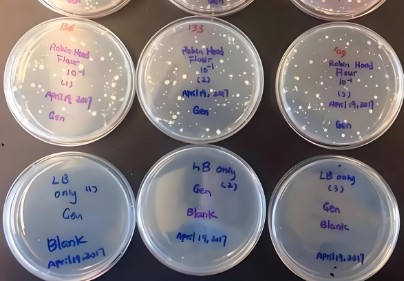
- Microscopic particle sizing and counting on membrane filters per ASTM D6786 and ISO 16232 — particles collected on a filter from a known volume of liquid perfluorohexanone are sized and counted under an optical microscope, providing a direct visual record of particle type, shape, and size distribution.
- Online particle monitoring during agent transfer and filling — continuous real-time particle counting is applied to verify that no particle spikes occur during the pumping, filtration, and cylinder filling processes at the perfluorohexanone production facility.
Non-Volatile Residue and Gravimetric Analysis
- Non-volatile residue determination per SEMI C3.9 and ASTM D2369 — a known mass of perfluorohexanone is evaporated under controlled cleanroom conditions and the residual mass is weighed on a microbalance, reporting the NVR in parts per billion by weight to verify the agent will not leave a conductive or corrosive film on protected equipment.
- Total suspended solids by vacuum filtration and gravimetry per ASTM D5907 — the perfluorohexanone liquid is filtered through a pre-weighed membrane and the mass of retained particulate is determined, providing a direct measure of filterable solids that could clog nozzles or reduce discharge efficiency.
- Residue after evaporation on witness plates per internal and customer protocols — the clean agent is sprayed onto polished silicon or glass witness plates, evaporated, and the surface is inspected by optical microscopy and white light interferometry to detect any residual film or spot formation.
Chemical Purity and Trace Contaminant Detection
- Gas chromatography-mass spectrometry for volatile organic impurities per ASTM D8506 and internal methods — the perfluorohexanone sample is injected and the full volatile profile is acquired, quantifying residual solvents, unreacted intermediates, and any decomposition by-products that could affect agent stability or toxicity.
- Inductively coupled plasma mass spectrometry for trace metals per SEMI C43 and ASTM E3061 — the liquid agent is analyzed for critical metal contaminants including iron, sodium, calcium, copper, and nickel at parts-per-trillion levels, ensuring no metal ions are present that could cause electrical short circuits or catalyze agent decomposition.
- Ion chromatography for halide and anion contamination per ASTM D4327 and SEMI C3.52 — the agent is extracted with ultrapure water and the levels of fluoride, chloride, bromide, sulfate, and phosphate are measured to verify that corrosive ions are below the permissible limits for clean agent applications.
- pH and conductivity measurement per ASTM D5464 and internal methods — the aqueous extract is tested to detect any acidic or basic contaminants that could indicate agent degradation or process contamination during perfluorohexanone manufacturing.
Moisture Content and Volatile Impurity Detection
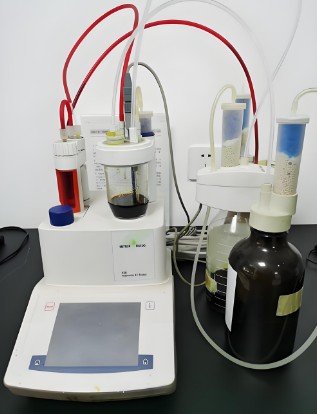
- Karl Fischer coulometric titration for water content per ASTM D6869 and ISO 15512 — the moisture level in the liquid perfluorohexanone is measured at the parts-per-million level to confirm that the agent meets the dryness specification required to prevent ice formation, hydrolysis, and corrosion during discharge and long-term storage.
- Headspace gas chromatography-mass spectrometry for dissolved gases and volatiles per ASTM D4526 and VDA 277 — the agent is equilibrated in a sealed vial and the headspace vapor is analyzed to quantify dissolved oxygen, nitrogen, and any volatile decomposition products that could contribute to system pressure anomalies.
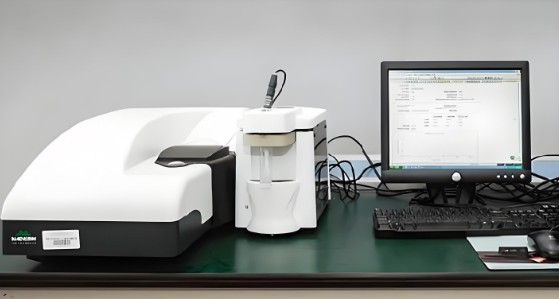
- Fourier transform infrared spectroscopy for agent identity and purity per ASTM E1252 — the infrared spectrum of the perfluorohexanone is compared against a certified reference standard to confirm the chemical identity and to detect any gross contamination or degradation of the agent.
Environmental Monitoring and Post-Discharge Residue Evaluation
- Surface particle and residue wipe sampling per ISO 14644-10 and SEMI F-24 — a defined surface area is wiped with a cleanroom-compatible swab after a discharge test, and the swab is analyzed for particle count, NVR, and ionic residue to demonstrate that the fire suppression event does not contaminate the protected space.
- Airborne concentration monitoring during discharge tests per ISO 16000 and customer protocols — real-time aerosol monitors and filter samplers are deployed in the protected enclosure to measure the airborne particle concentration during and after agent discharge, generating the data required to qualify the system for cleanroom and museum use.
- Scanning electron microscopy with energy dispersive X-ray spectroscopy of collected particles per ASTM E1508 — individual particles are imaged and their elemental composition is determined to identify the particle source, whether from the agent itself, the storage cylinder, or the discharge piping.
Report Recognition and ISO/IEC 17025 Compliance
All methods described in this Perfluorohexanone Particle Detection Service are included within our ISO/IEC 17025 scope of accreditation. Our test reports are accepted by semiconductor facility engineers and insurance risk assessors, by European notified bodies for clean agent system compliance, and by regulatory authorities across North America, the Middle East, and Asia. Whether you require a full chemical and particulate qualification of a new perfluorohexanone lot, a post-installation discharge residue assessment, or a root cause investigation of a particle excursion event, our laboratory provides the measurement accuracy and clean agent expertise that the global fire suppression and contamination control industries demand.