
PVC Steel Wire Hose Testing Service – Accredited Mechanical, Hydraulic and Durability Evaluation for Global Markets
Our internationally accredited laboratory delivers a specialist PVC steel wire hose testing service that provides manufacturers of industrial hoses, agricultural equipment, hydraulic systems, construction machinery and fluid‑transfer products worldwide with the independent, traceable data they need to verify the burst strength, vacuum resistance, adhesion between the PVC layers and the steel helix, low‑temperature flexibility and long‑term durability of their reinforced hose constructions. Every test is conducted under the rigorous framework of ISO/IEC 17025, and each report bearing the ILAC mark is unconditionally accepted by regulatory authorities, notified bodies and supply‑chain partners in all major economies. The PVC steel wire hose testing programme subjects the complete hose or its constituent layers to a comprehensive suite of dimensional, hydrostatic, mechanical, thermal and chemical‑resistance evaluations, quantifying the maximum working pressure, the minimum burst pressure, the adhesion strength, the abrasion resistance and the degradation after exposure to oils, acids and alkalis. For a hose producer certifying a suction‑and‑delivery grade for the European market, a pump manufacturer specifying a vacuum‑resistant hose for a water‑treatment plant, or an importer verifying the compliance of a batch of hoses with the relevant ISO, ASTM, EN and customer‑specified standards, this service delivers the legally robust, defensible data that underpin product certification, warranty validation and safe, reliable operation in the field.
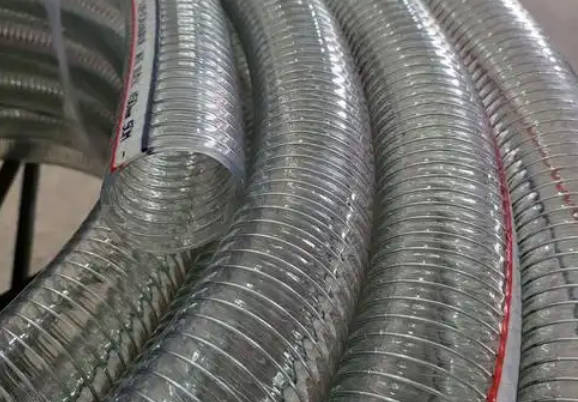
Product Samples We Regularly Subject to PVC Steel Wire Hose Testing
Our hydrostatic burst test benches, vacuum chambers, low‑temperature flexing rigs, adhesion‑peel testers and environmental‑ageing ovens accommodate a wide variety of PVC steel wire reinforced hoses. The following categories represent the most frequently tested items:
- PVC steel wire suction and discharge hoses – hoses with a rigid or a semi‑rigid PVC helix embedded in the wall, used for the suction and the delivery of water, slurry, chemicals and food‑grade liquids in the agricultural, the construction and the industrial sectors
- PVC steel wire braided and spiral‑reinforced hoses – clear or coloured PVC hoses with a braided steel‑wire textile or a spiral‑wound steel‑wire reinforcement, intended for the high‑pressure pneumatic and the hydraulic applications
- Anti‑static and electrically conductive PVC steel wire hoses – hoses incorporating a conductive PVC layer or a copper‑wire strand to dissipate the static charge, evaluated for the surface resistivity and the electrical continuity
- Food‑grade and potable‑water PVC steel wire hoses – transparent, non‑toxic PVC formulations reinforced with a stainless‑steel wire helix, tested for the migration of the plasticisers and the heavy metals into the conveyed fluid
- Flame‑retardant and self‑extinguishing PVC steel wire hoses – hoses for the mining, the tunnelling and the ventilation applications, evaluated for the flammability, the smoke density and the toxic‑gas emission
- Pre‑cut hose assemblies and fitted‑coupling samples – hoses that have been crimped, clamped or bonded to the end‑fittings, tested for the joint integrity under the pressure and the mechanical loads
Hydrostatic Pressure, Burst Strength and Vacuum Resistance – PVC Steel Wire Hose Testing According to ISO 1402, ISO 7751 and ASTM D380
- Determination of the maximum working pressure and the minimum burst pressure according to ISO 1402 (Rubber and plastics hoses and hose assemblies – Hydrostatic testing) and ASTM D380 (Standard Test Methods for Rubber Hose): a length of the hose with the end‑fittings is filled with water and pressurised at a controlled rate. The pressure at which the hose leaks, distorts or bursts is recorded, and the minimum burst pressure must be at least three to four times the declared working pressure, depending on the hose type and the safety factor. This PVC steel wire hose testing verifies the fundamental pressure‑containing capability of the hose and is the primary acceptance criterion for the production‑line quality control.
- Proof‑pressure and the volumetric‑expansion test according to ISO 1402: the hose is subjected to a defined proof pressure – typically 1.5 or 2 times the working pressure – and the change in the diameter, the length and the volume is measured, providing the data that the system designer uses to calculate the pressure‑surge and the expansion losses in the pipeline.
- Determination of the vacuum resistance and the collapse behaviour according to the internal procedures based on ISO 7233 (Rubber and plastics hoses and hose assemblies – Determination of resistance to vacuum): the hose is evacuated to a specified negative pressure, and the ovality, the flattening or the separation of the steel wire from the PVC wall is observed, verifying that the hose will not collapse during the suction service.
- Pulsating‑pressure and the impulse‑cycle testing for the high‑pressure spiral‑reinforced hoses: the hose is subjected to a cyclic pressure waveform that simulates the pump‑pulsation or the hydraulic‑system transient at a defined frequency, and the number of the cycles to the failure is reported, providing the fatigue‑life data for the critical hydraulic and the pneumatic applications.
- Hydrostatic‑pressure test at the elevated and the sub‑zero temperatures: the hose is pressurised while being conditioned in a climatic chamber at the maximum and the minimum rated service temperatures, and the burst pressure and the leakage are evaluated, ensuring the safe operation of the hose in the engine‑compartment, the cold‑storage and the outdoor‑winter environments.
Adhesion Strength, Mechanical Integrity and Dimensional Stability – PVC Steel Wire Hose Testing According to ISO 8033, ISO 36 and ASTM D413
- Determination of the adhesion between the PVC layers and the steel‑wire helix according to ISO 8033 (Rubber and plastics hoses – Determination of adhesion between components) and ASTM D413 (Standard Test Methods for Rubber Property – Adhesion to Flexible Substrate): a strip of the outer or the inner PVC layer is peeled from the steel wire or the adjacent PVC layer at a constant speed and angle, and the force per unit width is recorded in newtons per millimetre. This PVC steel wire hose testing verifies that the helix will not separate from the PVC body under the flexing and the pressure cycling, which would cause the hose to kink or to collapse.
- Tensile strength and the elongation at break of the PVC compound according to ISO 37 (Rubber, vulcanized or thermoplastic – Determination of tensile stress‑strain properties) and ASTM D412: dumbbell specimens are cut from the PVC wall and stretched to the failure, and the tensile strength, the elongation and the modulus are reported, providing the data that the compounder uses to verify the plasticiser level and the filler content.
- Measurement of the wall thickness, the internal and the external diameter, and the helix‑pitch according to ISO 4671 (Rubber and plastics hoses and hose assemblies – Methods of measurement of the dimensions of hoses and the lengths of hose assemblies) and the internal procedures: the dimensional conformance of the hose is verified against the declared specification, ensuring the correct fitting retention and the flow‑rate capacity.
- Kink‑resistance and the minimum bend‑radius test: the hose is bent around a mandrel of a specified radius until the cross‑section flattens by a defined percentage, and the minimum bend radius is reported, providing the data that the installer uses to design the hose routing and to prevent the flow restriction.
- Resistance to the crush and the impact loading: a steel plate or a falling weight is applied to the hose, and the force or the energy required to produce a specified deformation or to cause the layer‑separation is measured, simulating the accidental run‑over or the rock‑fall damage in the mining and the construction environments.
Low‑Temperature Flexibility, Thermal Ageing and Environmental Resistance – PVC Steel Wire Hose Testing According to ISO 4672, ASTM D2136 and ISO 188
- Determination of the low‑temperature flexibility and the brittleness according to ISO 4672 (Rubber and plastics hoses – Sub‑ambient flexibility tests) and ASTM D2136 (Standard Test Method for Coated Fabrics – Low‑Temperature Bend Test): the hose is conditioned at -10 °C, -20 °C or -30 °C and then bent around a mandrel or impacted by a falling weight, and the surface is inspected for the cracking or the fracture, ensuring that the hose remains flexible and can be uncoiled and installed in the cold weather.
- Accelerated thermal ageing in a forced‑air oven according to ISO 188 (Rubber, vulcanized or thermoplastic – Accelerated ageing and heat resistance tests) and the internal procedures: the hose is exposed to a defined temperature – typically 70 °C, 85 °C or 100 °C – for a period of 7, 14 or 28 days, and the retained tensile strength, the elongation and the adhesion are measured, predicting the service life of the PVC at the elevated operating temperatures.
- Resistance to the ultraviolet radiation and the accelerated weathering according to ASTM G154 (Standard Practice for Operating Fluorescent Ultraviolet Lamp Apparatus for Exposure of Non‑Metallic Materials) and ISO 4892‑2: the hose is exposed to a cycle of the UV‑A or the UV‑B radiation and the condensation, and the colour change, the surface cracking and the loss of the mechanical properties are evaluated, supporting the specification of the outdoor‑grade hoses for the irrigation, the solar‑thermal and the exposed‑industrial applications.
- Ozone‑resistance test according to ISO 7326 (Rubber and plastics hoses – Assessment of ozone resistance under static conditions): the hose is clamped at a defined elongation and exposed to an ozone‑rich atmosphere, and the time to the first crack is recorded, quantifying the resistance of the PVC to the atmospheric ozone attack in the polluted urban and the industrial environments.
Chemical Compatibility, Electrical Properties and Fire Performance – PVC Steel Wire Hose Testing According to ISO 175, ASTM D257 and ISO 8030
- Determination of the resistance to the conveyed liquids according to ISO 175 (Plastics – Methods of test for the determination of the effects of immersion in liquid chemicals): the PVC wall or the complete hose is immersed in the chemical medium – such as the dilute acids, the alkalis, the oils, the fuels or the detergents – for a defined period at a controlled temperature, and the change in the mass, the dimensions, the tensile strength and the adhesion is measured, verifying the compatibility of the hose with the intended fluid.
- Measurement of the electrical resistance and the anti‑static properties according to ASTM D257 (Standard Test Methods for DC Resistance or Conductance of Insulating Materials) and ISO 8030 (Rubber and plastics hoses – Method of test for flammability): the surface resistivity and the volume resistivity of the anti‑static or the conductive PVC layer are measured, and the electrical continuity between the end‑fittings is verified, ensuring that the static charge generated by the flowing fuel or the powder is safely dissipated.
- Flame‑retardancy and the fire‑performance testing according to ISO 8030 (Rubber and plastics hoses – Method of test for flammability) and the mining‑industry standards: the hose is exposed to a defined gas‑flame, and the after‑flame time, the after‑glow time and the char‑length are recorded, providing the data for the certification of the hose for the use in the underground mines, the tunnels and the public‑assembly spaces.
- Migration of the plasticisers and the heavy metals for the food‑grade and the potable‑water hoses according to the EU Regulation (EC) No 1935/2004 and the national drinking‑water regulations: the hose is filled with the appropriate food simulant or the test water, and the concentration of the phthalate plasticisers, the organotin stabilisers and the heavy metals in the extract is determined by the GC‑MS or the ICP‑MS, supporting the declaration of the compliance for the food‑contact and the drinking‑water applications.
Report Acceptance and Global Regulatory Compliance
All measurements performed within our PVC steel wire hose testing programme are executed under the fully accredited scope of our ISO/IEC 17025 quality management system. Each test report that carries the ILAC mark is therefore automatically recognised by regulatory authorities, notified bodies, customs offices and supply‑chain partners in all major economies. For PVC‑hose manufacturers, fluid‑system integrators, agricultural and construction‑equipment producers and industrial‑hose importers anywhere in the world, the report constitutes legally robust, internationally accepted evidence that the burst strength, the adhesion, the low‑temperature flexibility, the chemical resistance and the long‑term durability of the PVC steel wire hose have been determined in accordance with the applicable ISO, ASTM, EN and customer‑specified methods. The documentation can be directly used to support CE marking under the applicable EU directives, the issue of inspection certificates according to EN 10204 or equivalent national standards, the compilation of the technical file for the type‑examination, and the resolution of commercial and technical disputes concerning the performance and the safe service life of any PVC steel wire reinforced hose.




