Comprehensive Oxide Film Testing Service for Global Surface Engineering and Electronics Markets
As an ISO/IEC 17025 accredited laboratory, we deliver a specialized oxide film testing service that verifies thickness, chemical composition, optical performance, electrical characteristics, mechanical integrity, and long-term environmental durability. Our oxide film testing service supports manufacturers and exporters of semiconductor wafers, optical coatings, transparent conductive oxides, anodized aluminum, and functional oxide layers who must demonstrate conformity to ASTM, ISO, EN, SEMI, and regional material standards across the European Union, North America, East Asia, and the Middle East. Every test is performed under our CNAS-accredited quality system, producing reports accepted by notified bodies, electronics OEMs, and procurement teams worldwide.

Product Samples We Regularly Test in Our Oxide Film Testing Service
- Silicon dioxide and high-k gate dielectric films — thermally grown or ALD-deposited oxide layers on silicon wafers for semiconductor devices
- Transparent conductive oxide films — ITO, FTO, AZO, and GZO coatings for touch panels, displays, and solar cells
- Anodized aluminum oxide films — decorative and hard anodic coatings on aluminum profiles, automotive trim, and consumer electronics
- PVD and CVD oxide films — titanium dioxide, aluminum oxide, zirconium dioxide, and silicon dioxide for optical filters, hard coatings, and barrier layers
- Photocatalytic and self-cleaning oxide films — TiO2-based coatings for building materials, air purification, and anti-fogging applications
- Corrosion-resistant and passivation oxide layers — chromium oxide, cerium oxide, and mixed oxide conversion coatings on metals
- Multilayer oxide stacks and gradient films — for anti-reflection coatings, Bragg mirrors, and laser optics
Oxide Film Testing Service for Thickness and Composition Analysis
- Spectroscopic ellipsometry per SEMI MF42 and ASTM E2389 — the oxide film thickness and optical constants are determined by analyzing the change in polarization state of light reflected from the film, with sub-nanometer accuracy for films from a few angstroms to several micrometers, providing the primary metrology data for semiconductor gate oxides and optical coatings.
- X-ray photoelectron spectroscopy per ASTM E1078 and ISO 15472 — the surface elemental composition, chemical bonding states, and stoichiometry of the oxide film are quantified to verify the oxide phase, detect sub-oxides, and identify any interfacial contamination that would degrade electrical or optical performance.
- Auger electron spectroscopy depth profiling per ASTM E996 — the elemental concentration is mapped as a function of depth through the oxide film, providing the compositional gradient and the interface sharpness between the oxide and the underlying substrate, essential for multilayer coating qualification.
- Rutherford backscattering spectrometry per ASTM E1735 — the absolute areal density and depth distribution of elements in the oxide film are measured without destructive sample preparation, used for referee analysis and for calibrating other thickness measurement methods.
- X-ray fluorescence spectrometry per ASTM B568 and ISO 3497 — the mass per unit area and the derived thickness of oxide films on metals and glass are non-destructively verified, with particular application to anodized layers and conversion coatings on aluminum and steel.
- Transmission electron microscopy cross-section imaging per ASTM E2530 — the oxide film is sectioned and imaged at atomic resolution to observe the actual physical thickness, interface roughness, and any crystallographic defects or voids that would compromise the film's function.
Oxide Film Testing Service for Optical Performance
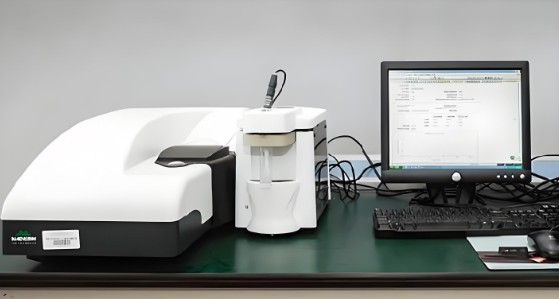
- Spectral transmittance and reflectance per ISO 15368 and ASTM E903 — the oxide film on a transparent substrate is scanned across the ultraviolet, visible, and near-infrared wavelength ranges to determine the transmittance, reflectance, and absorptance, verifying the film meets the optical specification for display windows, laser optics, and solar cell anti-reflection coatings.
- Refractive index and extinction coefficient by spectroscopic ellipsometry per ISO 23216 — the wavelength-dependent optical constants of the oxide film are derived from ellipsometric data, providing the dispersion curve required for optical design and for evaluating film density and composition.
- Haze, clarity, and total luminous transmittance per ASTM D1003 and ISO 14782 — the percentage of scattered light and the total transmitted light through the oxide film are measured using an integrating sphere to ensure optical clarity and uniformity for transparent conductive oxide films and optical windows.
- Optical band gap determination by Tauc plot analysis per internal validated protocol — the absorption coefficient is calculated from transmittance data and the Tauc plot is constructed to determine the direct or indirect band gap of the oxide film, a critical parameter for semiconductor and photocatalytic oxide applications.
- Photoluminescence and defect emission analysis per ASTM E1217 — the oxide film is excited with a laser and the emitted light is analyzed to detect defect states, oxygen vacancies, and impurity-related transitions that influence the film's electrical and optical properties.
- Angle-resolved transmittance and reflectance for graded and multilayer oxide films — the optical properties are measured at multiple incidence angles to characterize anti-reflection and high-reflection coatings designed for oblique illumination.
Oxide Film Testing Service for Electrical Properties
- Sheet resistance and resistivity by four-point probe per ASTM F390 and SEMI MF84 — the sheet resistance of conductive oxide films such as ITO and AZO is mapped across the substrate to verify the specified ohms-per-square value and to detect any local thickness or composition variations that would cause non-uniform device performance.
- Capacitance-voltage measurement for dielectric constant and interface trap density per SEMI MF102 and ASTM E2603 — a metal-oxide-semiconductor capacitor is fabricated on the oxide film and the capacitance is measured as a function of voltage to extract the dielectric constant, flat-band voltage, and interface trap density, essential for gate oxide quality control.
- Breakdown voltage and leakage current per ASTM D149 and IEC 60243-1 — the oxide film is subjected to an increasing voltage until dielectric breakdown occurs, and the leakage current is measured at defined electric fields to verify the insulation integrity required for capacitor and gate dielectric applications.
- Hall effect measurement for carrier concentration and mobility per ASTM F76 — the Hall voltage and resistivity of the oxide film are measured in a magnetic field to determine the carrier type, concentration, and mobility, quantifying the doping efficiency and electrical transport properties of the oxide film.
- Work function and surface potential by Kelvin probe force microscopy per ASTM E2716 — the work function of the oxide film surface is measured to assess its suitability as an electrode, buffer layer, or passivation layer in organic and inorganic electronic devices.
Oxide Film Testing Service for Mechanical and Adhesion Properties
- Nanoindentation hardness and reduced elastic modulus per ISO 14577-1 — the oxide film is indented with a Berkovich diamond tip under controlled load, and the hardness and elastic modulus are calculated from the load-displacement curve, providing the mechanical property data for hard coatings, protective layers, and MEMS structures without the need to remove the film from the substrate.
- Scratch adhesion and critical load per ASTM C1624 and ISO 20502 — a diamond stylus is drawn across the oxide film surface under progressively increasing load, and the load at which the film first cracks, delaminates, or spalls is recorded, quantifying the practical adhesion between the oxide layer and the substrate for mechanical and tribological applications.
- Nano-scratch and micro-wear resistance per ASTM G171 and internal methods — the oxide film is subjected to controlled nanoscale scratching and repeated sliding contact, and the wear track depth and film removal rate are measured to rank the abrasion resistance of the coating.
- Flexural and tensile elongation tolerance for oxide films on flexible substrates — the coated substrate is bent to a defined radius or stretched to a specified strain, and the oxide film is inspected for cracking or delamination, verifying its suitability for flexible electronics and roll-to-roll processed coatings.
- Residual stress measurement by X-ray diffraction per ASTM E915 and wafer curvature per SEMI MF534 — the residual stress in the oxide film is quantified to predict the risk of cracking, buckling, or wafer warpage during subsequent processing and thermal cycling.
Oxide Film Testing Service for Environmental Durability and Reliability
- Damp heat and humidity exposure per IEC 60068-2-78 and ASTM D2247 — the oxide film is stored at 85 °C and 85% relative humidity for extended durations, and the electrical, optical, and adhesion properties are remeasured to verify resistance to moisture-induced degradation in tropical and humid environments.
- Thermal cycling and thermal shock per IEC 60068-2-14 and ASTM D4762 — the coated specimen is cycled between defined temperature extremes to evaluate the oxide film's resistance to thermal expansion mismatch stresses and to detect any cracking, delamination, or property drift after hundreds of cycles.
- Neutral salt spray and cyclic corrosion per ISO 9227 and ASTM B117 — the oxide film, particularly anodized aluminum and passivation layers, is exposed to salt fog for up to 2000 hours, and the pitting, under-film corrosion, and coating integrity are evaluated to predict service life in marine and industrial atmospheres.
- Chemical and solvent immersion resistance per ASTM D543 and ISO 175 — the oxide film is immersed in acids, alkalis, and organic solvents to verify compatibility with cleaning agents, process chemicals, and the intended service environment, with post-exposure optical and electrical characterization.
- UV and xenon-arc accelerated weathering per ASTM G155 and ISO 4892-2 — the oxide film is exposed to simulated sunlight and moisture cycles to evaluate photochemical stability, color retention, and adhesion after prolonged outdoor exposure.
- Electromigration and bias-temperature stress testing for conductive oxide films per JEDEC and customer protocols — the film is subjected to elevated current density and temperature to verify the long-term electrical stability and resistance to ion migration under operational bias conditions.
Report Recognition and ISO/IEC 17025 Compliance
Every test method described in this oxide film testing service is included within our ISO/IEC 17025 scope of accreditation. Our technical reports are accepted by European notified bodies, by North American electronics and aerospace OEMs referencing ASTM and SEMI standards, and by customs and procurement authorities across Japan, Korea, and the Gulf region. Whether you require a complete qualification dossier for a new oxide film product, a batch release inspection for an incoming shipment, or a root cause failure analysis of a film performance issue, our laboratory provides the measurement accuracy and materials science expertise that the global surface engineering and semiconductor industries demand.