
Near Infrared Spectrometer (NIR) Testing Service – Accredited Rapid Quantitative Analysis for Global Markets
Our internationally accredited laboratory provides a high‑throughput Near Infrared Spectrometer (NIR) testing service that empowers food processors, feed manufacturers, pharmaceutical producers, chemical companies, biofuel refiners and agricultural enterprises worldwide with the rapid, non‑destructive multi‑constituent data they need for real‑time process control, incoming material verification and regulatory compliance. All measurements are performed within the rigorous framework of ISO/IEC 17025, and each report bearing the ILAC mark is unconditionally accepted by regulatory authorities, customs offices and notified bodies in all major economies. This NIR testing service exploits the overtone and combination bands of fundamental molecular vibrations occurring in the 780 nm to 2500 nm region to quantify moisture, protein, fat, fibre, starch, ethanol, hydroxyl value, iodine value and a host of other parameters in less than a minute – without the use of reagents, without destroying the sample, and often directly through glass or plastic packaging. By employing scanning monochromator and Fourier‑transform NIR spectrometers, integrating spheres for diffuse reflectance, fibre‑optic probes for process streams and powerful chemometric calibration models, we deliver the legally robust, defensible analytical data that underpin global supply‑chain efficiency, nutritional labelling, pharmacopoeial conformity and sustainability programmes.
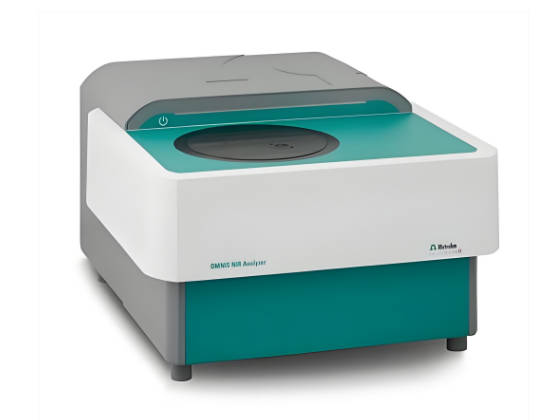
Product Samples We Regularly Subject to Near Infrared Spectrometer (NIR) Testing
The non‑destructive, minimal‑preparation nature of NIR spectroscopy makes it applicable to an exceptionally wide variety of sample types. The following categories represent the materials most frequently analysed through our Near Infrared Spectrometer testing service:
- Foods and food ingredients – grains, flours, starches, bakery mixes, milk powder, whey protein, butter, cheese, chocolate, coffee, tea, spices, fruit purees and vegetable oils
- Animal feeds and pet foods – compound feed, soybean meal, fishmeal, distillers grains, silage, hay and extruded kibble
- Pharmaceuticals and excipients – active pharmaceutical ingredients, lactose, microcrystalline cellulose, starch, magnesium stearate, granulated blends and finished tablets
- Bioprocessing and fermentation samples – cell‑culture media, clarified broths, buffer solutions and biocatalyst resins
- Polymers and plastics – polyolefin pellets, PET flakes, recycled plastic bales, plasticiser‑loaded compounds, polyurethane foam and textile fibres
- Chemicals and petrochemicals – polyols, surfactants, lubricants, biodiesel, ethanol‑gasoline blends, crude oil and hydrocarbon condensates
- Agricultural raw materials – unground whole grains, oilseeds, hay, straw, fresh fruits, vegetables and soil organic matter
- Personal‑care and household products – bar soaps, detergent powders, toothpaste and cosmetic creams
NIR Testing Service for Foods, Feeds and Agricultural Commodities – Proximate Analysis and Quality Screening
- Simultaneous determination of moisture, protein, fat, ash and starch in cereals and oilseeds according to ISO 12099 and the principles of AACC Method 39‑25: the whole or ground sample is placed in a sample cup or poured over a fibre‑optic probe, and the NIR spectrum is acquired in transmission or diffuse‑reflectance mode. The concentrations are calculated using a validated chemometric model derived from a calibration set of hundreds of samples that have been analysed by the reference chemical methods. This NIR testing service delivers the proximate analysis data in under 30 seconds, enabling grain traders, flour mills and feed compounders to make instantaneous acceptance decisions at the weighbridge and to optimise the blending of raw materials.
- Protein and moisture in milk powder, whey and dairy products according to ISO 21543 and AOAC Official Method 997.06: the powder is placed in a sample cup with a quartz window, and the NIR reflectance spectrum is collected. The protein and moisture contents are predicted against a calibration that has been validated to meet the stringent performance requirements of the USDA and the EU Common Agricultural Policy, directly supporting the payment‑by‑quality schemes used in international dairy trade.
- Fibre fractions – acid‑detergent fibre, neutral‑detergent fibre and lignin – in forages and ruminant feeds according to the NIRS Forage and Feed Testing Consortium guidelines: dried, ground hay or silage samples are scanned, and the fibre composition is predicted using globally maintained calibration models. The data are used to formulate total mixed rations for dairy cattle, to assess the digestibility of pasture grasses and to verify the nutritional label of bagged horse and rabbit feeds.
- Fatty acid profile and iodine value in vegetable oils and oilseeds: the NIR spectrum correlates strongly with the degree of unsaturation. The iodine value, an important quality parameter for palm oil, soybean oil and rapeseed oil, is reported, and the predicted individual fatty‑acid concentrations – oleic, linoleic, linolenic – are used to verify the identity of high‑oleic sunflower oil and to detect adulteration with less expensive oils.
- Total sugar, reducing sugar and moisture in honey, fruit juices and syrups: the sample is measured directly in a disposable glass vial. The NIR method predicts the sugar profile with an accuracy comparable to HPLC, enabling the rapid screening of honey for authenticity and the adjustment of the Brix value in fruit‑juice concentrates.
NIR Testing Service for Pharmaceuticals and Nutraceuticals – Identity, Potency and Process Analytical Technology
- Identity and blend uniformity of pharmaceutical powders according to USP ⟨1119⟩, Ph. Eur. 2.2.40 and the ICH Q8 guideline on process analytical technology: the NIR spectrum of a powder blend is acquired through the wall of a transparent container, and a spectral match against a reference library of each individual component confirms the presence and the identity of the active ingredient and the major excipients. This Near Infrared Spectrometer (NIR) testing service supports the real‑time release of blended batches and eliminates the delay and waste associated with traditional wet‑chemical blend‑uniformity testing.
- Moisture content of granulated formulations, lyophilised cakes and fluid‑bed dried powders: water absorbs strongly in the NIR region, and the moisture content from 0.1 % to 30 % can be determined in a single scan. The method is validated against loss‑on‑drying and Karl‑Fischer titration, and it is used to monitor the drying endpoint, to control the moisture in tableting blends and to verify the quality of moisture‑sensitive effervescent products.
- Polymorph and hydrate form monitoring in active pharmaceutical ingredients: different crystalline forms and hydrates exhibit distinct NIR spectra due to the differences in hydrogen‑bonding patterns. The technique is used to ensure that the desired polymorph is present in the raw material and that conversion does not occur during wet granulation or storage, directly supporting the requirements of ICH Q6A.
- Determination of total alkaloids, flavonoids and marker compounds in herbal supplements: a calibration model is developed using reference data from HPLC or UV‑Vis spectroscopy, and the NIR spectrum of the ground botanical powder is used to predict the content of the active markers – such as hypericin in St. John's Wort or curcuminoids in turmeric. The test provides a rapid, non‑destructive alternative to chromatographic analysis for the quality control of nutraceuticals.
NIR Testing Service for Polymers, Plastics and Chemicals – Fast Material Verification
- Identification of plastic pellets and flakes for recycling and incoming inspection: the NIR spectrum of a bulk sample or an individual pellet is acquired, and the polymer type – polyethylene, polypropylene, PET, PVC, polystyrene, polyamide, polycarbonate – is identified by chemometric classification. This NIR testing service enables the high‑speed sorting of plastic waste streams and the verification of resin silo contents, reducing cross‑contamination and increasing the value of recycled material.
- Hydroxyl value, acid value and moisture in polyols and isocyanates for polyurethane production: the NIR spectrum of the liquid polyol or isocyanate is measured through a glass vial or a flow‑cell, and the key quality parameters are predicted. The method replaces wet‑chemical titration and provides the results in seconds, allowing the polyurethane formulator to adjust the catalyst and blowing‑agent levels in real time.
- Ethanol, methanol and water content in biofuel blends according to ASTM E1655 and EN 15948: the fuel sample is introduced into a temperature‑controlled cuvette, and the NIR spectrum is acquired. The ethanol and methanol concentrations are predicted with a precision that meets the regulatory requirements for fuel‑quality certification, supporting the blending of gasoline and the monitoring of biodiesel esterification.
- Additive levels and filler content in compounded plastics: the concentration of plasticisers, flame retardants, talc or calcium carbonate in a masterbatch or a finished moulded part is predicted from the NIR spectrum, enabling the rapid release of batches and the detection of off‑spec material before it enters the injection‑moulding machine.
Method Validation, Chemometric Modelling and Quality Assurance for NIR Testing
- Calibration development and validation according to ISO 12099 and the ASTM E1655 standard practices: a calibration set of representative samples is analysed by the primary reference method, and the NIR spectra are acquired. The spectral data are pre‑treated with derivatives, scatter correction and smoothing algorithms, and a partial‑least‑squares or principal‑component regression model is built. The model is validated with an independent test set, and the root‑mean‑square error of prediction, the correlation coefficient and the bias are reported, providing the transparent performance metrics that regulators and customers require.
- Instrument performance verification using NIST‑traceable wavelength and photometric standards: the wavelength accuracy and the photometric linearity of the NIR spectrometer are checked daily with a certified reference tile and a set of polymer films. The instrument performance data are reviewed before any client sample is analysed, and the control charts are maintained as part of our Near Infrared Spectrometer (NIR) testing service quality system.
- Transferability and ruggedness of NIR calibrations across instruments and sites: calibration models are transferred between multiple spectrometers using a cloning procedure and a set of transfer standards. The performance of the transferred model is validated against the same test set, ensuring that the results obtained in the laboratory are identical to those delivered by on‑line analysers in the production plant.
- Participation in international proficiency‑testing programmes: our laboratory participates in programmes for NIR analysis of wheat, soybean meal, milk powder, ethanol‑gasoline blends and pharmaceutical powders, and our performance is monitored by the relevant accreditation bodies, demonstrating the ongoing accuracy and comparability of our results.
Report Acceptance and Global Regulatory Compliance
All measurements performed within our Near Infrared Spectrometer (NIR) testing service are executed under the fully accredited scope of our ISO/IEC 17025 quality management system. Each test report that carries the ILAC mark is therefore automatically recognised by regulatory authorities, notified bodies, customs offices and supply‑chain partners in all major economies. For food manufacturers, feed compounders, pharmaceutical producers, biofuel refiners and polymer processors anywhere in the world, the report constitutes legally robust, internationally accepted evidence that the compositional parameters have been determined in accordance with the applicable ISO, ASTM, AOAC, USP and Ph. Eur. methods. The documentation can be directly used for nutritional labelling, pharmacopoeial compliance, import‑export clearance, the issue of inspection certificates according to EN 10204 or equivalent national standards, and the resolution of commercial and technical disputes concerning the composition and quality of any material.




