
Magnetic Induction Intensity Experiment – Accredited Magnetic Field Measurement and Characterization for Global Markets
Our internationally accredited laboratory provides a specialist magnetic induction intensity experiment service that enables manufacturers of permanent magnets, soft magnetic cores, electromagnetic coils, magnetic sensors, shielding materials and data‑storage media worldwide to independently measure the flux density, hysteresis characteristics, permeability and field homogeneity of their products. Every measurement is performed within the rigorous framework of ISO/IEC 17025, and each report bearing the ILAC mark is unconditionally accepted by regulatory authorities, notified bodies and supply‑chain partners in all major economies. The magnetic induction intensity experiment quantifies the remanence, coercivity, saturation polarisation, energy product and demagnetisation curves of hard and soft magnetic materials, using calibrated vibrating‑sample magnetometers, BH loop tracers, Helmholtz coil systems, Hall‑effect gaussmeters and fluxgate magnetometers. For an electric‑vehicle motor producer certifying a rotor magnet, a magnetic‑shielding sheet manufacturer optimising the attenuation factor, or a sensor developer calibrating the linearity of a Hall probe, our platform provides the legally robust, traceable magnetic data that underpin product qualification, process control and compliance with the relevant IEC, ASTM, ISO and customer‑specified standards.
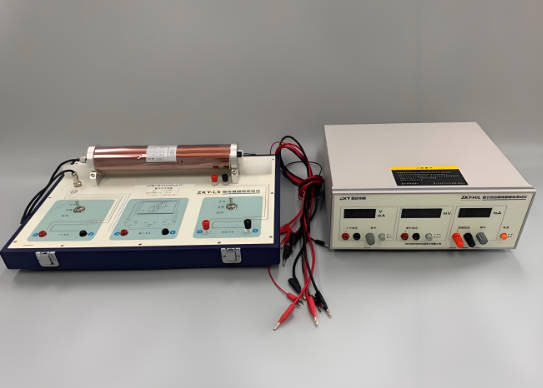
Product Samples We Regularly Subject to Magnetic Induction Intensity Experiments
Our magnetometers, electromagnets, cryostats and Helmholtz coil systems accommodate a wide range of magnetic materials and devices. The following categories represent the items most frequently evaluated through our magnetic induction intensity experiment programme:
- Permanent magnets – sintered and bonded Nd‑Fe‑B, samarium‑cobalt, ferrite and alnico magnets in block, disc, ring, arc‑segment and irregular shapes for motors, generators, loudspeakers, sensors, couplings and magnetic‑separation equipment
- Soft magnetic materials and cores – silicon‑iron electrical steels, nickel‑iron permalloys, cobalt‑iron alloys, ferrite cores, amorphous and nanocrystalline ribbons, powder‑metallurgy soft magnetic composites and dust cores for transformers, inductors, chokes and electric‑machine stators
- Magnetic shielding sheets, films and enclosures – mumetal, permalloy and amorphous‑alloy shielding foils, cabinets and chambers for the protection of electron microscopes, MRI scanners, photomultiplier tubes and sensitive electronics
- Magnetic sensors and transducers – Hall‑effect sensors, magnetoresistive elements, fluxgate magnetometers, SQUID sensors and the test magnets that calibrate them
- Recording media and magnetic nanoparticles – magnetic tapes, hard‑disk‑drive platters, magnetic inks, ferrofluids and superparamagnetic nanoparticles for biomedical imaging and hyperthermia
- Electromagnets, solenoids and actuator coils – iron‑core and air‑core coils for MRI gradient systems, particle accelerators, magnetic levitation and industrial magnetic‑chuck systems
Permanent Magnet Characterisation – Magnetic Induction Intensity Experiment According to IEC 60404‑5, ASTM A977 and IEC TR 61807
- Determination of the demagnetisation curve and the principal magnetic parameters of a permanent magnet according to IEC 60404‑5 (Magnetic materials – Permanent magnet (magnetically hard) materials – Methods of measurement of magnetic properties) and ASTM A977: a magnet specimen of a standardised geometry is magnetised to saturation in a pulsed field or an electromagnet, and its open‑circuit flux or the second‑quadrant demagnetisation curve is measured by an integrating fluxmeter and a BH loop tracer. The remanence Br, the normal coercivity HcB, the intrinsic coercivity HcJ, the maximum energy product (BH)max and the knee‑point field are reported. This magnetic induction intensity experiment provides the fundamental performance data that motor designers use to select the correct magnet grade, to predict the back‑EMF and the torque, and to ensure that the magnet will not demagnetise under the expected short‑circuit current or the elevated operating temperature.
- Temperature‑dependent magnetisation and thermal‑demagnetisation mapping: the specimen is placed in a furnace or a cryostat integrated with the magnetometer, and the demagnetisation curve is recorded at a series of temperatures from -40 °C to +200 °C or higher. The temperature coefficients of the remanence and the coercivity, and the irreversible‑loss curve after thermal cycling, are reported, enabling the prediction of the magnetic performance under the cold‑start and the hot‑soak conditions of an electric‑vehicle traction motor.
- Irreversible‑flux‑loss and ageing stability testing: the magnet is exposed to an elevated temperature for a defined duration, or to a counter‑field, radiation or mechanical shock, and the flux loss is measured. This magnetic induction intensity experiment determines the long‑term stability of the magnetisation and supports the warranty specification for the magnetic‑circuit assembly.
- Angular‑ and surface‑flux‑density mapping of multi‑pole and Halbach arrays: the magnetic induction intensity is measured at a controlled distance above the rotor or the stator assembly using a three‑axis Hall probe or a scanning magnetometer. The pole‑transition profile, the peak‑flux density per pole and the total‑harmonic‑distortion of the flux waveform are reported, providing the data that the servo‑drive engineer needs to calculate the cogging torque and the torque ripple of the precision motor.
- Comparative evaluation of magnet grades and the identification of counterfeit magnets: the demagnetisation curve and the chemical composition (by X‑ray fluorescence) of the magnet are measured and compared with the datasheet of the declared grade. This magnetic induction intensity experiment detects the substitution of a lower‑energy‑product grade or a mislabelled alloy, protecting the supply chain of the automotive and the wind‑turbine industries.
Soft Magnetic Materials and Cores – Magnetic Induction Intensity Experiment According to IEC 60404‑4, IEC 60404‑6 and ASTM A596
- DC magnetic property measurement of soft magnetic materials by the ring‑method or the Epstein‑frame according to IEC 60404‑4 (Magnetic materials – Methods of measurement of the DC magnetic properties of magnetically soft materials): a toroidal core or an Epstein‑frame specimen is wound with primary and secondary coils, and the magnetic‑polarisation J versus the magnetic‑field‑strength H curve is recorded. The saturation magnetic polarisation Js, the coercivity Hc, the remanence Br and the maximum permeability μmax are reported. This magnetic induction intensity experiment provides the core‑material data that transformer and inductor designers use to calculate the magnetising current, the inrush current and the core loss at the line frequency.
- AC magnetic property measurement of electrical steels and ferrite cores at frequencies from 50 Hz to 1 MHz according to IEC 60404‑6 (Magnetic materials – Methods of measurement of the magnetic properties of magnetically soft metallic and powder materials at frequencies up to 200 kHz by the Epstein frame and the ring specimen): the specific‑total‑loss Ps (W/kg), the apparent power Ss (VA/kg) and the amplitude permeability μa are measured at a defined frequency and magnetic‑polarisation amplitude. The loss‑separation into the hysteresis loss, the classical eddy‑current loss and the excess loss is performed, and the data are used to select the correct steel grade, the lamination thickness and the annealing treatment for the target efficiency class of the motor or the transformer.
- Incremental permeability and DC‑bias superposition test on powder cores and gapped ferrite cores: a DC current is applied to a separate bias winding, and the small‑signal AC permeability and the inductance factor AL are measured as a function of the DC magnetisation. This magnetic induction intensity experiment quantifies the soft‑saturation behaviour of the core under the DC‑load condition, which is critical for the design of filter chokes, storage inductors and flyback transformers in switched‑mode power supplies.
- Permeability‑versus‑temperature and Curie‑temperature determination: the initial permeability and the saturation polarisation are measured from cryogenic temperatures up to the Curie point, and the Curie temperature TC of the soft ferrite or the amorphous alloy is reported. The data are used to guarantee that the core will not lose its magnetic functionality at the maximum operating temperature of the component.
- Magnetic‑ageing and stress‑sensitivity evaluation of high‑permeability alloys: the specimen is subjected to a thermal‑ageing cycle, a mechanical shock, or a compressive stress, and the change in the initial permeability and the coercivity is measured. This magnetic induction intensity experiment verifies that the magnetic‑shielding foil, the current‑sensor core or the magnetic‑modulator ring will maintain its performance after the assembly, the soldering or the encapsulation process.
Magnetic Shielding, Sensors and Special Devices – Magnetic Induction Intensity Experiment for Field Mapping and Attenuation
- Measurement of the magnetic‑shielding factor (attenuation ratio) of shielding sheets and enclosures according to the principles of IEC 62333 and the magnetic‑shielding‑industry standards: a known, uniform magnetic field is generated by a Helmholtz coil or a solenoid, and the magnetic‑induction intensity inside the shielded volume is measured by a miniature Hall probe or a fluxgate magnetometer. The ratio of the external field to the internal field – the shielding factor – is reported as a function of the frequency and the field amplitude, providing the data that the electron‑microscope or the MRI‑room designer uses to specify the thickness and the heat‑treatment of the mumetal lining.
- Calibration of the sensitivity, linearity and frequency response of Hall‑effect and magnetoresistive sensors: the sensor is placed in a calibrated electromagnet or a Helmholtz coil, and the output voltage is recorded as a function of the applied magnetic‑induction intensity. The sensitivity in mV/mT, the non‑linearity in percent of full scale, the hysteresis and the bandwidth are reported. This magnetic induction intensity experiment issues the calibration certificate that is traceable to the national standards of magnetic flux density.
- Magnetic‑field uniformity and gradient mapping of MRI magnet assemblies, beam‑line magnets and electromagnetic chucks: a three‑axis Hall probe or an array of miniature fluxgate sensors is scanned through the working volume, and the spatial distribution of the magnetic induction intensity B and its gradient are plotted. The data are used to verify that the field uniformity meets the stringent requirements of the imaging sequence or the particle‑beam optics.
- Measurement of the magnetic moment and the stray‑field of magnetised components for space‑qualified and sensitive‑instrument applications: the component is placed in a Helmholtz‑coil moment‑meter, and its dipole moment and the higher‑order multipole moments are reported. This magnetic induction intensity experiment certifies that the spacecraft part, the optical‑bench fixture or the implantable medical device will not interfere with the magnetic‑attitude‑control system or the navigation sensor.
- Low‑temperature and high‑field characterisation of superconducting magnets and magnet wires: the critical current, the critical magnetic‑induction intensity and the quench behaviour of superconducting coils and short‑sample wires are measured in a liquid‑helium cryostat with a background‑field magnet, providing the data that the MRI, NMR and fusion‑magnet developers require to design the winding pack and the protection circuit.
Report Acceptance and Global Regulatory Compliance
All measurements performed within our magnetic induction intensity experiment programme are executed under the fully accredited scope of our ISO/IEC 17025 quality management system. Each test report that carries the ILAC mark is therefore automatically recognised by regulatory authorities, notified bodies, customs offices and supply‑chain partners in all major economies. For permanent‑magnet producers, electrical‑steel manufacturers, magnetic‑shielding suppliers, sensor developers and electromagnetic‑device designers anywhere in the world, the report constitutes legally robust, internationally accepted evidence that the magnetic induction intensity, the hysteresis characteristics and the field‑distribution data have been determined in accordance with the applicable IEC, ASTM, ISO and customer‑specified methods. The documentation can be directly used to support CE marking, the issue of inspection certificates according to EN 10204 or equivalent national standards, the compilation of technical files for type‑examination, and the resolution of commercial and technical disputes concerning the magnetic performance and the electromagnetic compatibility of any material or device.




