Laser Protection Film Testing Service for Global Optical and Safety Compliance
As an ISO/IEC 17025 accredited laboratory, we provide a specialized laser protection film testing service that verifies optical density, laser damage threshold, spectral attenuation, mechanical durability, and environmental stability. Our laser protection film testing service supports manufacturers and exporters of laser safety windows, protective films, and optical filters who must demonstrate conformity to ANSI Z136, EN 207, EN 208, and regional laser safety regulations across the European Union, North America, East Asia, and the Middle East. Every test is performed under our CNAS-accredited quality system, producing reports accepted by notified bodies, laser equipment OEMs, and procurement teams worldwide.
Product Samples We Regularly Test in Our Laser Protection Film Testing Service
- Laser protective films for glass and polycarbonate windows — applied to laser enclosure windows, viewing ports, and machine guarding
- Multi-layer reflective and absorptive laser protection films — for high-power CO2, fiber, and solid-state laser systems
- Anti-laser films for optical instruments and camera sensors — protecting CCD and CMOS detectors from beam damage
- Flexible laser protection films for curved and irregular surfaces — for robotic enclosures, medical laser rooms, and research laboratories
- Weather-resistant laser protection films for outdoor laser shows and construction — with UV stabilization and anti-yellowing properties
- Anti-fog and anti-scratch coated laser protection films — for cleanroom and high-visibility laser safety applications
- Custom-wavelength and broadband laser protection films — for multi-laser and tunable laser systems
Laser Attenuation and Optical Density Testing
- Optical density measurement at designated laser wavelengths per EN 207 and ANSI Z136.7 — the laser protection film is exposed to a calibrated laser source at the specified wavelength, and the transmitted power is measured to calculate the optical density, verifying that the film provides the required attenuation for the laser class and operating wavelength.
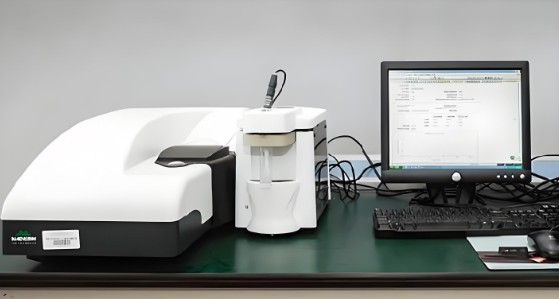
- Spectral transmittance and reflectance scanning per ISO 15368 and ASTM E903 — a spectrophotometer measures the transmission and reflection of the laser protection film across the ultraviolet, visible, and near-infrared spectrum, ensuring the film blocks the target laser wavelength while maintaining acceptable visual light transmission for the application.
- Laser damage threshold and maximum permissible exposure verification per ISO 21254 and ISO 11382 — the film is subjected to increasing laser energy or power density until visible damage occurs, determining the laser damage threshold and confirming the film can withstand the specified laser intensity without degradation.
- Attenuation stability under multiple wavelength and multi-pulse exposure — the laser protection film is exposed to repeated laser pulses at varying wavelengths and the optical density is remeasured to verify the protective function is maintained after extended laser irradiation.
- Beam attenuation uniformity across the film surface — the optical density is measured at multiple points across the film to detect any local coating variations or defects that would create weak spots in laser protection.
Mechanical and Adhesion Testing for Laser Protection Films
- Adhesion by cross-cut and pull-off methods per ISO 2409 and ISO 4624 — the bond strength between the laser protection film and the glass or polycarbonate substrate is quantified to ensure the film remains firmly attached during temperature changes, cleaning, and mechanical stress.
- Scratch and abrasion resistance per ISO 15184 and ASTM D4060 — the surface hardness and wear resistance of the laser protection film are measured to verify it withstands routine cleaning and handling without losing its optical properties.
- Impact resistance and flexibility per ASTM D522 and ISO 6272-2 — the film-coated substrate is bent and impacted to evaluate the resistance to cracking, delamination, and chipping under mechanical shock.
- Tear and puncture resistance per ISO 6383-2 and ASTM D5748 — the film is tested for its ability to withstand cuts and punctures during installation and service, preventing damage that would compromise laser protection.
Environmental Durability and Aging Testing
- Thermal cycling and thermal shock per IEC 60068-2-14 — the laser protection film is cycled between the minimum and maximum rated temperatures to verify it does not crack, peel, or lose optical density under thermal expansion and contraction.
- Damp heat and humidity resistance per IEC 60068-2-78 — the film is exposed to 85 °C and 85% relative humidity for extended periods, followed by optical density and adhesion retests to confirm no moisture-induced degradation.
- UV and xenon-arc accelerated weathering per ISO 4892-2 and ASTM G155 — the laser protection film is subjected to simulated sunlight and moisture cycles to evaluate yellowing, embrittlement, and loss of laser attenuation after prolonged outdoor exposure.
- Chemical resistance to cleaning agents and solvents per ISO 175 and ASTM D543 — the film surface is exposed to common industrial cleaners and solvents to verify no staining, softening, or delamination occurs during maintenance.
- Neutral salt spray and cyclic corrosion resistance per ISO 9227 and ASTM B117 — for laser protection films used in marine and industrial environments, the corrosion and coating degradation are evaluated after salt fog exposure.
Chemical Safety and Regulatory Compliance for Laser Protection Films
- RoHS compliance per IEC 62321 and EU Directive 2011/65/EU — quantitative screening for lead, mercury, cadmium, hexavalent chromium, PBBs, and PBDEs in the film layers, adhesives, and any coatings to ensure the laser protection film meets global substance restrictions.
- REACH Annex XVII and SVHC screening — targeted analysis of Substances of Very High Concern including specific phthalate plasticizers, organotin stabilizers, and restricted solvents used in the polymer matrix.
- Heavy metals in packaging per EU Directive 94/62/EC — verification that the sum concentration of lead, cadmium, mercury, and hexavalent chromium in the protective packaging and labels is below the 100 ppm regulatory limit.
- Volatile organic compound emission per ISO 16000-3 — chamber testing confirms the laser protection film does not release harmful VOCs into the indoor environment after installation.
Report Recognition and ISO/IEC 17025 Compliance
Every method described in this laser protection film testing service is covered by our ISO/IEC 17025 scope of accreditation. Our technical reports are accepted by European notified bodies, by North American laser safety officers and equipment manufacturers referencing ANSI and ASTM standards, and by customs and procurement authorities across Japan, Korea, and the Gulf region. Whether you require a complete qualification dossier for a new laser protection film product, a batch release inspection for an export shipment, or a root cause failure analysis of a laser safety incident, our laboratory provides the measurement accuracy and optical safety expertise that the global laser industry demands.