High Pressure/Performance Liquid Chromatography (HPLC) Testing Service – Accredited Separation and Quantification for Global Markets
Our internationally accredited laboratory delivers a comprehensive High Pressure/Performance Liquid Chromatography (HPLC) testing service that enables pharmaceutical manufacturers, food processors, environmental agencies, chemical producers, cosmetics formulators and clinical researchers worldwide to separate, identify and quantify the non‑volatile, thermally labile and polar compounds in their products, raw materials and biological specimens. Every analysis is performed within the rigorous framework of ISO/IEC 17025, and each report bearing the ILAC mark is unconditionally accepted by regulatory authorities, customs offices and notified bodies in all major economies. The HPLC testing service employs a full suite of separation modes – reversed‑phase, normal‑phase, ion‑exchange, size‑exclusion and chiral chromatography – coupled to ultraviolet‑visible diode‑array, fluorescence, refractive‑index, evaporative light‑scattering and mass‑selective detectors, achieving the sensitivity, selectivity and dynamic range required for applications from sub‑nanogram impurity profiling in drug substances to the quantification of vitamins in fortified foods. For an exporter submitting a generic‑drug dossier to the FDA, a winery verifying the authenticity of its vintage, or a municipal water authority monitoring pesticide residues, our platform provides the legally robust, defensible data that underpin pharmacopoeial compliance, food‑safety certification, environmental discharge permits and international trade.
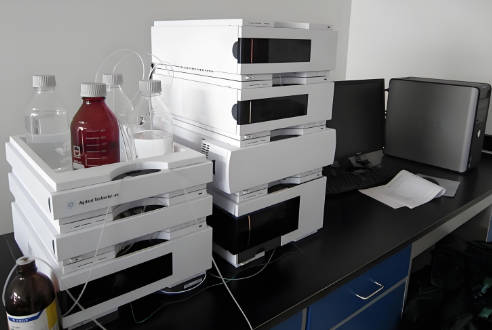
Product Samples We Regularly Subject to High Pressure/Performance Liquid Chromatography (HPLC) Testing
The versatile sample‑introduction and column‑switching capabilities of our HPLC systems accept an extraordinarily diverse range of liquid, solid and semi‑solid matrices. The following categories represent the most frequently tested items:
- Pharmaceutical raw materials and finished dosage forms – active pharmaceutical ingredients, excipients, tablets, capsules, injectables, syrups, creams, ointments and inhalation products
- Food, beverages and nutraceuticals – dairy products, edible oils, fruit juices, wine, beer, cereals, infant formula, honey, spices, functional foods and dietary supplements
- Environmental waters, soils and air – drinking water, groundwater, surface water, wastewater, soil extracts, sediment and workplace air on filters or sorbent tubes
- Chemicals and industrial intermediates – surfactants, plasticisers, monomers, polymer additives, detergents, dyes, pesticides and technical‑grade solvents
- Cosmetics and personal‑care products – creams, lotions, shampoos, hair dyes, sunscreens, fragrances and nail varnishes
- Biological fluids and clinical specimens – blood, plasma, serum, urine, saliva, cerebrospinal fluid and tissue homogenates
- Petroleum and fuel products – diesel, biodiesel, lubricating oils and fuel‑ethanol blends for the determination of additives and degradation markers
HPLC Testing Service for Pharmaceuticals, Excipients and Biopharmaceuticals – Assay, Impurities and Dissolution
- Assay and content uniformity of active pharmaceutical ingredients and finished drug products according to USP ⟨621⟩, Ph. Eur. 2.2.29 and the ICH Q2(R1) validation guideline: the sample is dissolved or extracted, and the analyte is separated on a C18, phenyl or polar‑end‑capped column with a mobile phase optimised for resolution and peak symmetry. The concentration is calculated from a multi‑point calibration curve prepared with a certified reference standard, and the result is reported in percentage of the label claim. This HPLC testing service provides the mandatory batch‑release data required by the FDA, EMA and other global health authorities.
- Determination of organic impurities and degradation products according to the thresholds of ICH Q3A and Q3B: the chromatographic conditions are selected to resolve all known and unknown impurities from the main peak. The relative response factors are determined for each specified impurity, and the concentrations are reported in percent area or weight percent relative to the active substance. The reporting, identification and qualification thresholds are applied, and any impurity exceeding the limits is flagged for investigation.
- Enantiomeric purity and chiral separation of racemic drug substances according to USP and Ph. Eur. monographs: the enantiomers are separated on a chiral stationary phase – amylose, cellulose, cyclodextrin or protein‑based – and the enantiomeric excess or the percentage of the undesired enantiomer is reported. This High Pressure/Performance Liquid Chromatography testing service is critical for the development and quality control of single‑enantiomer drugs, and the data support the demonstration of stereochemical stability over the product shelf‑life.
- Dissolution and drug‑release profiling of solid oral dosage forms according to USP ⟨711⟩, Ph. Eur. 2.9.3 and the relevant FDA guidance: the tablet or capsule is placed in a dissolution apparatus, and the concentration of the dissolved drug is measured by HPLC at specified time points. The percentage of the label claim released versus time is reported, and the data are used for the development of generic formulations, for the demonstration of bio‑equivalence and for the routine quality control of production batches.
- Cleaning‑validation and residue analysis on manufacturing equipment: swab and rinse samples are collected from the production surfaces and analysed by HPLC for the active ingredient or the worst‑case cleaning marker. The method is validated to achieve detection limits well below the acceptance criteria, providing the analytical support that contract manufacturing organisations and multi‑product facilities require to prevent cross‑contamination.
HPLC Testing Service for Foods, Beverages and Nutraceuticals – Nutritional Labelling, Additives and Contaminants
- Determination of water‑soluble and fat‑soluble vitamins in fortified foods, infant formula and dietary supplements according to EN 12821, EN 12822, EN 12823‑1/2 and AOAC Official Methods: the sample is saponified, extracted or dissolved, and the vitamins – A, D, E, K, B1, B2, B3, B5, B6, B9, B12, biotin and vitamin C – are separated on a C18 column with UV, fluorescence or diode‑array detection. The concentrations are reported in international units or micrograms per 100 g, directly supporting the nutrition‑fact panels required by Codex Alimentarius and the regulations of the EU, the United States and other major markets.
- Quantification of preservatives, antioxidants, sweeteners and colours in processed foods and beverages according to EN 12857, EN 1378, EN 1379 and the relevant ISO methods: the additives are extracted, and the separation is performed on a dedicated column with UV or diode‑array detection. Benzoic acid, sorbic acid, parabens, BHA, BHT, aspartame, acesulfame‑K, saccharin, tartrazine and sunset yellow are identified and quantified, and the results are compared with the maximum permitted levels of the EU Food Additives Regulation.
- Analysis of mycotoxins – aflatoxins, ochratoxin A, zearalenone, deoxynivalenol and fumonisins – in cereals, spices, coffee and dried fruit according to EN 14123, EN 14132, EN 14133 and EN 14352: the sample is extracted with an aqueous‑organic solvent, cleaned by immunoaffinity chromatography, and the mycotoxins are separated and detected by HPLC with fluorescence or post‑column derivatisation. This HPLC testing service provides the trace‑level data that importers and food‑safety authorities require to enforce the strict maximum limits set by the EU, the FDA and the Codex Alimentarius.
- Authentication of fruit juices, wines and honey by organic‑acid, sugar and phenolic‑compound profiling: citric acid, malic acid, tartaric acid, glucose, fructose, sucrose and the characteristic flavonoids are separated on an ion‑exchange or reversed‑phase column and detected by UV or refractive index. The fingerprint is compared with a database of authentic samples to detect adulteration – such as the addition of high‑fructose corn syrup to honey or the dilution of wine with water – protecting brand integrity and consumer confidence.
- Determination of biogenic amines in fish, cheese and fermented products by HPLC with pre‑column derivatisation according to the principles of the EU regulation on food hygiene: histamine, tyramine, putrescine, cadaverine and tryptamine are quantified as indicators of spoilage and improper storage, providing the data that importers and retailers require to guarantee the freshness and safety of high‑protein foods.
HPLC Testing Service for Environmental Waters, Soils and Air – Pesticides, Phenols and Industrial Pollutants
- Determination of phenylurea, triazine, phenoxy‑acid and organophosphorus pesticides in drinking water and groundwater by HPLC‑UV or HPLC‑MS/MS according to EPA Method 531.1, EPA Method 535, ISO 11369 and EN 15637: the sample is enriched by solid‑phase extraction, and the pesticides are separated on a C18 column with a gradient of acetonitrile and water. Detection limits in the low nanogram per litre range enable compliance testing against the 0.1 µg/L parametric value of the EU Drinking Water Directive and the equivalent standards of the WHO and the US EPA.
- Analysis of polynuclear aromatic hydrocarbons in soil, sediment and industrial wastewater by HPLC with fluorescence detection according to EPA Method 8310 and ISO 17993: the sample is extracted with an organic solvent, cleaned and analysed on a dedicated PAH column. The 16 EPA‑priority PAHs – naphthalene to benzo[g,h,i]perylene – are quantified, providing the data required for contaminated‑land risk assessment and for the characterisation of dredged material.
- Determination of phenols, chlorophenols and pentachlorophenol in water and leachates according to EPA Method 604 and ISO 8165: the analytes are derivatised or extracted, separated on a C18 column and detected by UV or electrochemical detection. The concentrations are compared with the environmental quality standards of the EU Water Framework Directive and the national discharge limits of industrialised countries.
- Monitoring of pharmaceuticals and personal‑care‑product residues in surface water and effluent: non‑steroidal anti‑inflammatory drugs, antibiotics, hormones and UV filters are extracted by solid‑phase extraction and analysed by HPLC‑MS/MS. This High Pressure/Performance Liquid Chromatography testing service supports the emerging regulatory requirement to monitor the occurrence and fate of micropollutants in the aquatic environment.
HPLC Testing Service for Cosmetics, Personal‑Care Products and Chemicals – Preservatives, Allergens and Surfactants
- Determination of preservatives, UV filters and fragrance allergens in cosmetic products according to the EU Cosmetics Regulation (EC) No 1223/2009, the SCCS Notes of Guidance and ISO 22717: parabens, phenoxyethanol, benzyl alcohol, formaldehyde‑releasing agents, benzophenones, octinoxate, avobenzone and the 24 volatile fragrance allergens listed in Annex III of the Regulation are quantified by HPLC‑UV or HPLC‑MS. The results support the safety assessment of the cosmetic product and the correct labelling of allergens.
- Analysis of anionic, cationic, non‑ionic and amphoteric surfactants in detergents, cleaning agents and industrial formulations: the surfactants are separated on a mixed‑mode or ion‑exchange column and detected by evaporative light‑scattering or charged‑aerosol detection. The concentrations of linear alkylbenzene sulfonates, alcohol ethoxylates, alkyl sulfates and quaternary ammonium compounds are reported, verifying that the product meets the declared formulation and the biodegradability requirements of the EU Detergent Regulation.
- Quantification of monomers, plasticisers and additives in polymers and food‑contact materials according to Commission Regulation (EU) No 10/2011: the specific migration of bisphenol A, phthalates, primary aromatic amines and other restricted substances into food simulants is determined by HPLC‑MS/MS or HPLC‑UV, and the results are compared with the specific migration limits, providing the data that packaging converters and importers need to demonstrate compliance.
- Purity determination and impurity profiling of fine chemicals, solvents and technical intermediates: the main component and the process‑related impurities are separated on a suitable column, and the chromatographic purity is reported in area percent. The method follows the principles of ASTM E682 and is widely used by chemical traders and manufacturers to certify the quality of bulk chemicals.
HPLC Testing Service for Bioanalysis, Clinical Research and Therapeutic Drug Monitoring
- Determination of therapeutic drugs and their metabolites in plasma, serum and urine by HPLC‑UV or HPLC‑MS/MS according to the guidelines of the International Association of Therapeutic Drug Monitoring and Clinical Toxicology: the sample is prepared by protein precipitation, liquid‑liquid extraction or solid‑phase extraction, and the analyte and the internal standard are separated on a C18 or a specialised column. The concentration‑time profile is reported, supporting pharmacokinetic studies, bioavailability assessment and the individualisation of drug dosage.
- Quantification of biomarkers, amino acids and neurotransmitters in biological fluids: the analytes are derivatised pre‑ or post‑column with o‑phthaldialdehyde, fluorescamine or 6‑aminoquinolyl‑N‑hydroxysuccinimidyl carbamate, and detected by fluorescence or UV. The data are used in metabolic‑disorder screening, nutritional‑status assessment and the diagnosis of inborn errors of metabolism.
- Detection of drugs of abuse and their metabolites in urine and oral fluid: the sample is hydrolysed if necessary, extracted and analysed by HPLC‑MS/MS. Amphetamines, opiates, cocaine, cannabinoids and benzodiazepines are identified and quantified, meeting the cut‑off levels of the European Workplace Drug Testing Society and the Substance Abuse and Mental Health Services Administration.
Report Acceptance and Global Regulatory Compliance
All analyses performed within our High Pressure/Performance Liquid Chromatography (HPLC) testing service are executed under the fully accredited scope of our ISO/IEC 17025 quality management system. Each test report that carries the ILAC mark is therefore automatically recognised by regulatory authorities, notified bodies, customs offices and supply‑chain partners in all major economies. For pharmaceutical manufacturers, food‑safety agencies, environmental consultancies, cosmetic producers and clinical‑research organisations anywhere in the world, the report constitutes legally robust, internationally accepted evidence that the chromatographic purity, the concentration of the target analytes and the impurity profile have been determined in accordance with the applicable USP, Ph. Eur., EPA, ASTM, ISO, EN and customer‑specified methods. The documentation can be directly used for drug‑registration submissions, food‑safety clearance, environmental‑permit applications, the issue of inspection certificates according to EN 10204 or equivalent national standards, and the resolution of commercial and technical disputes concerning the identity, purity and safety of any substance.