Full Static Pressure Stiffness Testing Service – Accredited Stiffness Evaluation Under Static Internal and External Pressure for the Czech Market
Our internationally accredited laboratory delivers a dedicated full static pressure stiffness testing service that provides Czech pipe manufacturers, pressure vessel fabricators, valve and fitting importers, and designers of tanks and silos with the independent, traceable stiffness data they need to verify the structural rigidity of their components under steady-state pressure. All tests are conducted within the strict framework of ISO/IEC 17025, and every report bearing the ILAC mark is unconditionally accepted by the Czech Trade Inspection Authority, the Technical Inspection of the Czech Republic, customs offices and all notified bodies across the European Union. A correctly executed full static pressure stiffness testing service measures the pressure–deformation relationship of a product under a defined static pressure load, quantifying the secant stiffness, the initial elastic stiffness and any creep or relaxation that occurs over time. For a Czech producer of district heating pipes, an importer of plastic inspection chambers or a manufacturer of lightweight pressure tanks, this service generates the legally robust evidence needed for CE marking under the Construction Products Regulation, for the validation of finite‑element models, and for the demonstration of compliance with the relevant harmonised European product standards and the Czech national annexes.
Product Samples We Regularly Subject to Full Static Pressure Stiffness Testing
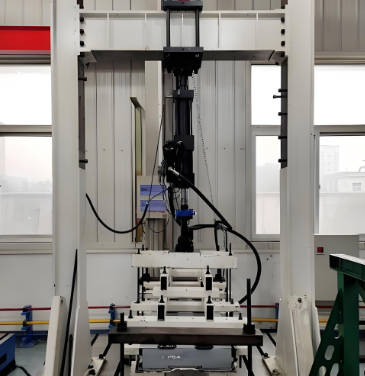
The hydrostatic pressure rigs, vacuum chambers and precision displacement sensors in our facility accommodate pipes, vessels and structural components up to several metres in diameter. The following categories represent the most frequently tested items:
- Plastic piping systems and conduits – PVC‑U, PP, PE and GRP pipes and fittings for water supply, drainage, cable protection and industrial effluents
- Structured‑wall and multi‑layer pipes – twin‑wall corrugated pipes, spiral‑wound profile pipes and ribbed pipes for gravity sewers and stormwater management
- Pressure vessels, tanks and silos – cylindrical and rectangular steel, aluminium and composite vessels for compressed air, LPG, water storage and chemical processing
- Inspection chambers, manholes and access shafts – plastic and concrete manholes, pumping station housings, valve chambers and underground enclosures
- Flexible hoses, bellows and expansion joints – rubber, PTFE and metal bellows units that must retain their stiffness under internal pressure while accommodating movement
- Valves, fittings and flanged connections – ball valves, gate valves, butterfly valves and couplings that must remain leak‑tight and dimensionally stable under sustained static pressure
- Composite overwrapped cylinders and lightweight accumulators – CNG and hydrogen tanks, breathing‑air cylinders and composite pressure bladders
- Ductwork, plenums and air‑handling components – sheet‑metal and plastic duct sections, air‑distribution boxes and ventilation elbows
Plastic Pipes and Gravity Systems – Full Static Pressure Stiffness Testing According to EN ISO 9969 and EN 1446
- Ring stiffness of thermoplastics pipes according to ČSN EN ISO 9969 (ISO 9969): a length of pipe is placed between two parallel compression platens, and the force required to achieve a 3 % diametric deflection is measured at a constant test speed. The ring stiffness in kilonewtons per square metre is calculated, and the result is compared with the minimum stiffness class declared by the manufacturer. This full static pressure stiffness testing service is the primary acceptance criterion for flexible pipes used in Czech gravity sewers and stormwater drains, where the pipe must resist the earth load and traffic surcharge without buckling.
- Creep ratio and long‑term ring stiffness according to ČSN EN ISO 9969 and ISO 9967: the pipe is held at a constant deflection of 3 % for 1 000 hours while the relaxation of the reaction force is recorded. The creep factor is calculated, and the long‑term ring stiffness is extrapolated for the design life of 50 years. Czech drainage engineers use these data to specify the backfill and compaction requirements for buried flexible pipes under Czech roads.
- Stiffness under negative internal pressure for vacuum sewer pipes and rising mains: the pipe is sealed and evacuated to the specified negative pressure, and the change in diameter and the ovality are measured by laser or contact extensometry. The pipe must not collapse or buckle, and the measured diametral stiffness is reported. This test is particularly important for Czech municipal vacuum sewer networks.
- Determination of the static stiffness of structured‑wall pipes under external hydrostatic pressure: the pipe is placed inside a pressure vessel filled with water, and the external hydrostatic pressure is increased in steps while the pipe deformation is measured. The critical buckling pressure and the pressure‑deflection curve are recorded, and the data are used to validate the installation depth limits for twin‑wall pipes in high‑groundwater areas of the Czech Republic.
- Ring stiffness after impact and low‑temperature conditioning: the pipe is subjected to a falling‑weight impact at -20 °C, and the residual ring stiffness is measured. The test ensures that a pipe accidentally struck during winter installation will still possess sufficient stiffness to support the permanent load.
Metallic and Composite Pressure Vessels – Full Static Pressure Stiffness Testing for Dimensional Stability and Buckling Resistance
- Hydrostatic stiffness and volumetric expansion test according to the principles of ČSN EN 13445‑5 and ASME VIII: the vessel is completely filled with water and pressurised in increments up to the maximum allowable working pressure. The volume of water pumped in and the corresponding pressure are recorded, and the pressure–volume curve is constructed. The secant stiffness in bar per litre and the deviation from linearity are calculated. For a Czech pressure vessel manufacturer, this full static pressure stiffness testing service verifies that the shell does not exhibit excessive bulging or non‑linear behaviour that could indicate inadequate wall thickness or weld distortion.
- External pressure stiffness and buckling resistance according to ČSN EN 13445‑3 and EN 1993‑1‑6: the vessel or tank is subjected to a controlled vacuum or external hydrostatic pressure, and the strain at critical locations is measured by strain gauges. The buckling pressure and the mode of buckling are recorded, and the results are compared with the design values. This test is mandatory for jacketed vessels, vacuum receivers and buried storage tanks installed in the Czech chemical and food industries.
- Stiffness under combined internal pressure and external mechanical load: a vessel fitted with a nozzle or a manway is internally pressurised while a bending moment or an axial force is applied to the connection. The rotational stiffness and the gasket seating stiffness are measured, providing the data needed by Czech piping stress analysts to model the vessel as a flexible boundary condition.
- Long‑term static stiffness and stress‑relaxation of composite cylinders: a fully wrapped composite cylinder is pressurised to the service pressure and held for 1 000 hours. The increase in volume due to creep of the polymer liner and the relaxation of the fibre overwrap is recorded, and the remaining stiffness at the end of the test is reported. Czech importers of CNG cylinders rely on this test to confirm that the cylinder will maintain its dimensional stability throughout its service life.
- Stiffness after temperature cycles and environmental exposure: the vessel or tank is subjected to a predefined number of thermal cycles and then re‑tested for hydrostatic stiffness. Any change in the pressure–volume characteristic indicates that the material has undergone structural relaxation or that micro‑cracks have formed, and the item is flagged for further investigation.
Flexible Hoses, Bellows and Expansion Joints – Full Static Pressure Stiffness Testing for Axial, Lateral and Angular Resistance
- Axial static pressure stiffness of metal bellows expansion joints according to the principles of EJMA and ČSN EN 14917: the bellows is sealed and pressurised to the design pressure, and the axial force developed by the pressure thrust is recorded. The axial stiffness in newtons per millimetre of extension is calculated, and any hysteresis between the pressurisation and depressurisation curves is noted. This full static pressure stiffness testing service is essential for the correct design of the anchors and guides on Czech district heating and steam lines.
- Lateral and angular stiffness under internal pressure: the bellows or flexible hose is pressurised, and a lateral or angular displacement is applied. The resisting force or moment is measured, and the lateral and angular stiffness values are reported. Czech pipework designers use these data to ensure that the expansion joint will not over‑stress the connected equipment.
- Hydrostatic stiffness and volume expansion of hydraulic and process hoses according to ISO 1402 and SAE J343: the hose assembly is filled with water and pressurised, and the increase in length and diameter is measured with a laser micrometer or a volumetric expansion apparatus. The volumetric stiffness in bar per cubic centimetre is reported, and the hose is checked for any leakage or fitting movement. This test is routinely requested by Czech importers of high‑pressure hydraulic hoses for construction and agricultural machinery.
- Stiffness under combined pressure and vibration: the flexible element is pressurised and then subjected to a swept‑frequency vibration test. The dynamic stiffness and the damping ratio are extracted from the transfer function, and the onset of any resonant amplification is identified. The test supports the fatigue‑life analysis of hoses and bellows on Czech engine test beds and compressor stations.
Report Acceptance and Regulatory Compliance for the Czech Republic
All measurements performed within our full static pressure stiffness testing service are executed under the fully accredited scope of our ISO/IEC 17025 quality management system. Each test report that carries the ILAC mark is therefore automatically recognised by the Czech Trade Inspection Authority, the Technical Inspection of the Czech Republic, customs offices and all notified bodies in the European Union. For Czech pipe producers, vessel manufacturers, valve and fitting importers and industrial system integrators, the report constitutes legally robust evidence that the product meets the stiffness requirements of the applicable harmonised product standards and the essential safety requirements of the relevant EU directives. The documentation can be directly used to support CE marking, to issue inspection certificates according to ČSN EN 10204, to compile the technical file for type‑examination, and to resolve commercial and technical disputes concerning the dimensional stability and structural integrity of pressure‑containing components under static load.