Flame-Retardant Electrolyte Testing Service for Global Battery Safety
As an ISO/IEC 17025 accredited laboratory, we deliver a specialized flame-retardant electrolyte testing service that verifies the thermal stability, fire resistance, electrochemical performance, and chemical composition of electrolytes used in lithium-ion, sodium-ion, and emerging battery systems. Our flame-retardant electrolyte testing service supports manufacturers and exporters of battery materials who must demonstrate compliance with UL, IEC, ASTM, EN, and UN transportation safety standards across the European Union, North America, East Asia, and the Middle East. Every test is conducted under our CNAS-accredited quality system, producing reports that are accepted by notified bodies, battery OEMs, and regulatory authorities worldwide.

Product Samples We Regularly Test in Our Flame-Retardant Electrolyte Testing Service
- Liquid carbonate-based electrolytes with flame-retardant additives — including phosphates, phosphonates, phosphazenes, and fluorinated solvents
- Gel polymer electrolytes with intrinsic flame retardancy — for flexible and solid-state battery applications
- Ionic liquid-based electrolytes — non-flammable molten salts for high-voltage and high-temperature cells
- Deep eutectic solvent electrolytes — for sustainable and low-flammability energy storage systems
- High-concentration and localized high-concentration electrolytes — with reduced free solvent and enhanced fire resistance
- Aqueous and hybrid electrolyte formulations with flame-retardant additives — for intrinsically safer battery chemistries
- Individual flame-retardant co-solvents and additives — TPP, TEP, DMMP, fluorinated ethers, and novel phosphorus-nitrogen compounds
Thermal Stability and Flammability Testing for Flame-Retardant Electrolytes
- Differential scanning calorimetry for onset temperature and reaction enthalpy per ASTM E537 and ISO 11357-1 — the electrolyte sample is heated under controlled conditions to determine the exothermic onset temperature and total heat release, quantifying the thermal stability of the flame-retardant formulation and its resistance to thermal runaway.
- Thermogravimetric analysis for volatility and decomposition per ASTM E1131 and ISO 11358-1 — the mass loss profile is recorded from ambient to 600 °C, measuring the evaporation window and the char residue that indicates the condensed-phase flame-retardant mechanism of the electrolyte.
- Self-extinguishing time and linear burning rate per ASTM D635 and UL 94 HB — a defined volume of electrolyte is ignited and the time to self-extinguish and the mass loss rate are recorded, providing a direct comparative measure of the flame-retardant effectiveness under direct flame exposure.
- Limiting oxygen index per ISO 4589-2 and ASTM D2863 — the minimum oxygen concentration in a flowing oxygen-nitrogen mixture that sustains combustion of the electrolyte is determined, giving a quantitative ranking of the fire resistance of the flame-retardant electrolyte for screening and quality control.
- Micro-combustion calorimetry for heat release rate and total heat release per ASTM D7309 — milligram samples are pyrolyzed and combusted to measure the specific heat release rate, heat release capacity, and total heat release, predicting the flammability hazard of the flame-retardant electrolyte at the material level.
- Cone calorimetry of electrolyte-soaked substrates per ISO 5660-1 and ASTM E1354 — the electrolyte is absorbed onto a standard substrate and exposed to a defined radiant heat flux, measuring time to ignition, peak heat release rate, and total heat release to simulate a real fire scenario involving the liquid electrolyte.
- Flash point and fire point determination by closed cup and open cup methods per ASTM D93, ASTM D92, and ISO 2719 — the minimum temperature at which the electrolyte vapor can be ignited by an external flame is measured, a mandatory safety parameter for transport classification and safe handling of electrolyte chemicals.
Electrochemical Safety and Abuse Tolerance Testing of Flame-Retardant Electrolytes
- Electrochemical stability window by linear sweep voltammetry and cyclic voltammetry per IEC 60424 and customer protocols — the electrolyte is scanned with a platinum or appropriate working electrode to determine the anodic and cathodic decomposition potentials, confirming the flame-retardant additive does not narrow the operating voltage window of the battery.
- Ionic conductivity over temperature per IEC 60424 and internal methods — electrochemical impedance spectroscopy measures the bulk ionic conductivity from -20 °C to +60 °C, verifying that the flame-retardant additive maintains the required conductivity for low-temperature cranking and fast charging.
- Li-ion cell cycling performance with the flame-retardant electrolyte per IEC 62660-1 and customer specifications — coin or pouch cells are assembled with the test electrolyte and subjected to long-term cycling at defined charge-discharge rates, monitoring capacity retention and coulombic efficiency to ensure the flame-retardant chemistry does not degrade cell life.
- Overcharge and overdischarge tolerance testing of electrolyte-filled cells per IEC 62619 and IEC 62133 — the cell containing the flame-retardant electrolyte is subjected to overcharge at defined currents and the voltage, temperature, and venting behavior are recorded to evaluate the electrolyte's ability to delay or prevent thermal runaway under electrical abuse.
- Accelerating rate calorimetry of electrolyte with electrode materials per ASTM E1981 — the electrolyte is mixed with charged cathode or anode powder and heated under adiabatic conditions to detect the onset of self-heating and thermal runaway, quantifying the flame-retardant electrolyte's ability to mitigate the exothermic reactions between electrode and electrolyte.
- Nail penetration and internal short circuit simulation of cells with the flame-retardant electrolyte per UL 1642 and IEC 62619 — a fully charged cell is penetrated by a steel nail and the thermal response is monitored to verify that the flame-retardant electrolyte reduces the probability of fire and explosion during mechanical abuse.
Chemical Composition and Purity Analysis in Our Flame-Retardant Electrolyte Testing Service
- Gas chromatography-mass spectrometry for volatile organic impurity profiling per ASTM D8506 and internal methods — the flame-retardant electrolyte is injected and the full volatile fingerprint is acquired, quantifying residual solvents, unreacted precursors, and any decomposition products that could compromise safety or performance.
- Inductively coupled plasma optical emission spectrometry for trace metal analysis per ASTM E3061 — the electrolyte is analyzed for metal contaminants including iron, sodium, copper, and nickel that can catalyze electrolyte decomposition and promote internal short circuits.
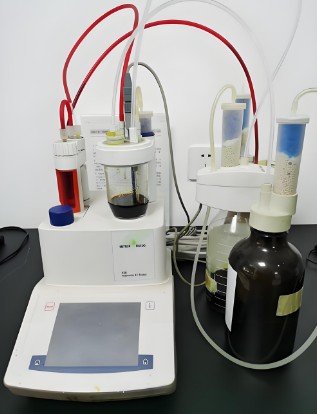
- Karl Fischer coulometric titration for water content per ASTM D6869 and ISO 15512 — the moisture level in the flame-retardant electrolyte is measured at parts-per-million sensitivity to confirm that the water content meets the stringent dryness requirements for Li-ion battery electrolytes and does not promote hydrolysis of the LiPF6 salt or the flame-retardant additive.
- Ion chromatography for halide and anion contamination per ASTM D4327 — the electrolyte is extracted with ultrapure water and the levels of fluoride, chloride, bromide, and sulfate are measured to verify that corrosive ions are below permissible limits and that the flame-retardant additive is free from ionic contamination.
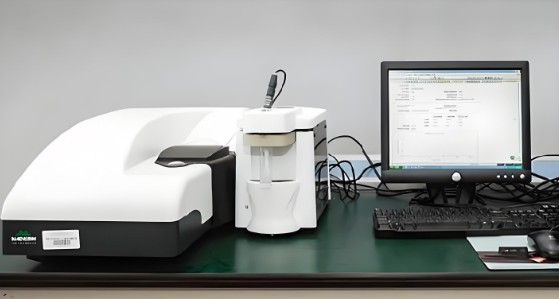
- Fourier transform infrared spectroscopy for chemical identity and degradation assessment per ASTM E1252 — the infrared spectrum of the flame-retardant electrolyte is compared against reference standards to confirm the chemical structure of the additive and to detect any oxidation or decomposition after accelerated aging.
- Nuclear magnetic resonance spectroscopy for structural confirmation of flame-retardant additives per ASTM E2977 — 1H, 13C, and 31P NMR spectra are acquired to verify the molecular structure and purity of synthesized flame-retardant compounds used in the electrolyte formulation.
Report Recognition and ISO/IEC 17025 Compliance
Every method described in this flame-retardant electrolyte testing service is included within our ISO/IEC 17025 scope of accreditation. Our test reports are accepted by European notified bodies for battery safety and material compliance, by North American certification organizations referencing UL and ASTM standards, and by customs and regulatory authorities across Japan, Korea, and the Gulf region. Whether you require a complete qualification dossier for a new flame-retardant electrolyte formulation, a batch release inspection for an export shipment, or a root cause failure analysis of a thermal runaway incident, our laboratory provides the measurement accuracy and battery material expertise that the global energy storage industry demands.