
Fire Control Blanket Fabric Testing Service – Accredited Safety and Performance Evaluation for Global Markets
Our internationally accredited laboratory provides a specialist fire control blanket fabric testing service that enables manufacturers, importers, fire‑safety equipment suppliers, hospitality chains, industrial users and public‑sector buyers worldwide to independently verify that their fire blankets meet the demanding thermal, mechanical and quality requirements of the applicable international standards. Every test is conducted under the strict framework of ISO/IEC 17025, and each report bearing the ILAC mark is unconditionally accepted by regulatory authorities, fire brigades, customs offices and notified bodies in all major economies. The fire control blanket fabric testing service subjects the base fabric, the reinforcing seams and the complete assembled blanket to a comprehensive programme that covers flame spread, resistance to radiant and convective heat, tensile and tear strength, thermal shrinkage, burn‑through time and, where required, electrical insulation properties. For an exporter shipping blankets to the Middle East, a manufacturer seeking CE marking under the Construction Products Regulation or the Personal Protective Equipment Regulation, or a municipal buyer specifying fire blankets for school kitchens, our reports deliver the legally robust, independent evidence needed for product certification, insurance approval and marketplace confidence.
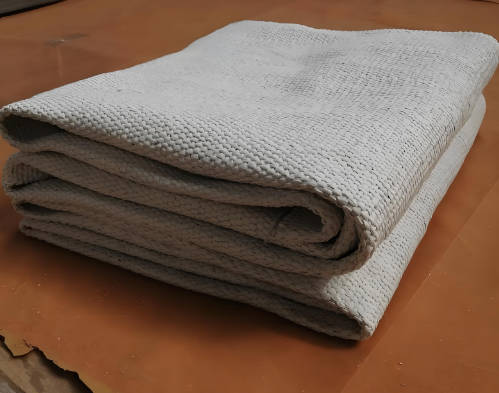
Product Samples We Regularly Test Through Our Fire Control Blanket Fabric Testing Service
We receive fire blankets and their constituent materials from every sector of the industry. The following categories represent the most frequently tested items submitted for our fire control blanket fabric testing service:
- Woven glass‑fibre fire blankets – plain‑weave and twill‑weave glass fabric with a silicone, vermiculite or graphite coating, supplied in folded or rolled form in quick‑release pouches
- Aramid and oxidised‑polyacrylonitrile fibre blankets – lightweight, flexible blankets used in industrial spark protection, welding curtains and aerospace applications
- Pre‑oxidised acrylic and carbon‑fibre felt blankets – high‑temperature resistant textile structures for specialist foundry and laboratory protection
- Wool and inherently flame‑retardant natural‑fibre blankets – blankets treated with halogen‑free flame retardants for hotel, hospital and domestic use
- Hybrid and multi‑layer blanket constructions – products combining an outer reflective aluminium‑faced layer with an insulating aramid or glass‑fibre core
- Blanket containers, pouches and quick‑release systems – the complete assembly including the wall‑mounted housing, the pull‑tabs, the retaining straps and the fixing devices
- Fabric rolls, individual panels and seam‑welded test coupons – raw fabric prior to cutting, and specially prepared specimens for seam‑strength and coating‑adhesion evaluation
Flame Spread, Ignition and Thermal Barrier Performance – Core of Our Fire Control Blanket Fabric Testing Service
- Small‑flame ignition and flame‑spread test according to ISO 15025 (Protective clothing – Protection against heat and flame) and EN 1869 (Fire blankets): a conditioned fabric specimen is exposed to a defined propane‑gas flame for a specified duration, and the after‑flame time, the after‑glow time and the extent of charring or hole formation are recorded. The fabric must not ignite, must not allow the flame to penetrate to the rear face, and must self‑extinguish within the time limits specified for the declared performance level. This fire control blanket fabric testing service provides the fundamental classification data that determine whether a blanket is suitable for use on burning cooking oil or as a protective wrap for a person.
- Resistance to convective and radiant heat according to ISO 6942 (Protective clothing – Protection against heat and fire) and the principles of EN ISO 11612: the fabric specimen is exposed to a calibrated radiant‑heat flux or to the convective flame of a gas burner, and the time required for the temperature on the unexposed side to rise by 24 °C is measured. The heat transmission factor and the threshold time are calculated, and the material is classified into a thermal‑protection level that indicates how long a person can hold the blanket while approaching a fire.
- Cooking‑oil fire suppression and burn‑through resistance according to the test protocols of EN 1869 and the DIN SPEC 14688: a laboratory‑scale cooking‑oil fire is ignited in a standardised pan, and the fire blanket is deployed over the fire. The ability of the blanket to completely extinguish the fire within a prescribed time, the absence of after‑flame when the blanket is removed, and the integrity of the blanket after the test are evaluated. The blanket must not allow oil to splash through, and the fabric must not burn through or disintegrate.
- Electrical arc resistance and dielectric strength for blankets used near live electrical equipment: the fabric is tested for its ability to withstand a defined arc‑flash exposure without igniting, melting or breaking down, and the dielectric breakdown voltage is measured according to the methods of ASTM F2675 and IEC 61482‑1‑2. This supplementary assessment supports the specification of fire blankets for electrical switch‑rooms and photovoltaic installations.
- Limited oxygen index and glow‑wire ignition temperature according to ISO 4589‑2 and IEC 60695‑2‑10: the minimum oxygen concentration required to support flaming combustion is determined, and the resistance of the fabric to ignition by a hot wire is measured. These data provide the fundamental flammability parameters that guide the selection of the fibre type and the flame‑retardant finish.
Mechanical Strength, Seam Integrity and Durability Testing – Ensuring Reliability in the Field
- Tensile strength and elongation at break according to ISO 13934‑1 (strip method) and ASTM D5034: the breaking force and the percentage elongation of the fabric are measured in both the warp and the weft directions. High tensile strength is essential to prevent the blanket from tearing when it is rapidly pulled from its container or when it is wrapped around a burning object.
- Tear resistance according to ISO 13937‑2 (single‑tear method) and ASTM D2261: a pre‑cut notch is propagated through the fabric under controlled loading, and the tear force is recorded. Sufficient tear resistance guarantees that a small puncture or cut will not propagate into a catastrophic failure during deployment.
- Seam strength and seam‑slippage resistance according to ISO 13935‑2 and ASTM D1683: the force required to rupture a stitched or welded seam is measured, and the tendency of the yarns to pull apart at the seam is evaluated. This fire control blanket fabric testing service verifies that the seams and the hemming will not fail under the mechanical load imposed by a struggling person or a collapsing object.
- Burst strength of coated fabrics and multi‑layer constructions: a hydraulic or pneumatic burst test according to ISO 13938‑1 is performed, particularly on silicone‑ or aluminium‑coated fabrics, to ensure that the film does not rupture under the pressure of a localized flame impingement.
- Coating adhesion and abrasion resistance: the adhesion of the flame‑retardant coating or the reflective film is measured by a peel test or a Taber abrasion test according to ASTM D4966 and ISO 5470‑1. The coating must remain intact after the mechanical flexing and rubbing that occur during folding, storage and deployment.
- Dimensional stability and thermal shrinkage at elevated temperature: a marked specimen is exposed to a specified temperature – typically 300 °C, 400 °C or 550 °C – for a defined period, and the percentage change in length and width is measured. Excessive shrinkage could cause the blanket to pull away from the edges of the pan or to expose the user to the fire, and the limit values of the product standard must be met.
Durability, Environmental Resistance and Labelling Evaluation – Long‑Term Readiness of the Complete Assembly
- Resistance to water, oil and cleaning agents: the fabric is immersed in water, cooking oil and common cleaning solutions for a specified period, and the change in flame‑retardant performance and mechanical strength is determined. This fire control blanket fabric testing service confirms that the blanket remains effective after accidental contamination in a kitchen or industrial environment.
- Accelerated ageing and UV‑exposure testing according to ISO 4892‑2 and the relevant product‑standard annexes: the fabric and the complete blanket assembly are exposed to xenon‑arc radiation and humidity cycles that simulate several years of storage in a sun‑exposed cabinet. The retained flame‑resistance, the strength and the legibility of the printed instructions are evaluated, and the recommended replacement interval is validated.
- Corrosion resistance of the container, rivets and fittings: the metal components of the pouch or the wall‑mounting bracket are subjected to a neutral salt‑spray test according to ISO 9227, and the degree of rusting is assessed. The container must remain functional and the pull‑tabs must not seize after prolonged exposure to the humid, saline atmosphere of a coastal hotel or a ship galley.
- Pull‑force and deployment test of the complete assembly: the force required to extract the blanket from its container is measured, and a panel of testers performs a timed deployment over a simulated fire. The pull‑force must be low enough for an untrained person to operate, and the blanket must unfold completely and cover the target without snagging.
- Legibility and permanence of safety markings and user instructions: the printed or woven label is examined for abrasion resistance, colour fastness and legibility after the environmental conditioning cycles. The instructions must remain clearly readable in the language of the country of sale, as required by the applicable national regulations and the EU General Product Safety Directive.
Report Acceptance and Global Regulatory Compliance
All measurements performed within our fire control blanket fabric testing service are executed under the fully accredited scope of our ISO/IEC 17025 quality management system. Each test report that carries the ILAC mark is therefore automatically recognised by regulatory authorities, fire brigades, customs offices and notified bodies in all major economies. For fire‑blanket manufacturers, personal‑protective‑equipment importers and industrial safety suppliers anywhere in the world, the report constitutes legally robust, internationally accepted evidence that the blanket and its components meet the flame‑resistance, thermal‑protection and mechanical‑strength requirements of the applicable ISO, EN, ASTM, NFPA and customer‑specified standards. The documentation can be directly used to support CE marking under the Personal Protective Equipment Regulation (EU) 2016/425 or the Construction Products Regulation, to obtain national technical approvals, to issue inspection certificates according to EN 10204 or equivalent national standards, and to resolve commercial and technical disputes concerning the safety and performance of fire control blankets.




