
Safety Valve Set Pressure Testing Service – Accredited Set Pressure Verification and Over‑Pressure Protection Evaluation for Global Markets
Our internationally accredited laboratory delivers a specialist safety valve set pressure testing service that provides valve manufacturers, pressure‑equipment packagers, power‑plant operators, oil‑and‑gas facility managers and marine‑engineering firms worldwide with the independent, traceable data they need to verify and certify the opening pressure, reseating performance and over‑pressure blowdown of their safety and relief valves. Every test is conducted under the rigorous framework of ISO/IEC 17025, and each report bearing the ILAC mark is unconditionally accepted by regulatory authorities, notified bodies and supply‑chain partners in all major economies. The experimental study on setting pressure of safety valve precisely determines the pressure at which a valve pops, the repeatability of that set point across multiple cycles, the seat tightness before and after the pop, and the blowdown – the difference between the opening and the reseating pressures. For a spring‑loaded safety valve destined for a steam boiler, a pilot‑operated relief valve protecting an LNG storage tank, or a rupture‑disc‑backed safety valve on a chemical reactor, this service generates the legally robust, defensible data that underpin product certification, code compliance and the safe, uninterrupted operation of the pressure system.
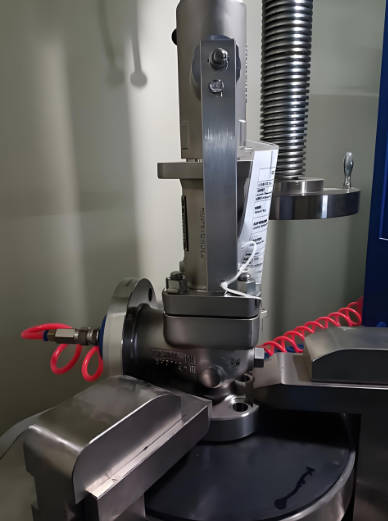
Product Samples We Regularly Subject to Safety Valve Set Pressure Testing
Our high‑pressure gas and liquid test benches accommodate safety valves of every design and size, from miniature instrument valves to large process relief valves. The following categories represent the most frequently tested items:
- Spring‑loaded safety valves – conventional and balanced‑bellows designs for steam, air, water, oil and gas service, with set pressures from a few millibars to over 600 bar
- Pilot‑operated relief valves – pop‑action and modulating pilot valves for gas transmission, petrochemical plants and offshore platforms, where the set‑pressure tolerance is particularly tight
- Proportional safety valves and control‑valve relief functions – valves that open gradually in proportion to the overpressure, used in low‑pressure storage tanks and hygienic applications
- Thermal safety valves – fusible‑plug and temperature‑actuated relief devices for liquid‑full systems where the overpressure is caused by the thermal expansion
- Vacuum relief valves and breather valves – pressure‑and‑vacuum protection devices on atmospheric and low‑pressure storage tanks
- Rupture‑disc‑and‑safety‑valve combinations – the complete assembly where the disc is tested for the burst pressure and the valve for the set pressure, ensuring the correct sequencing of the two devices
- Safety valves after in‑service repair, refurbishment or re‑certification – valves that have been removed from the plant and must be re‑tested before the re‑installation
Set Pressure, Blowdown and Seat Tightness – Experimental Determination According to ASME PTC 25, ISO 4126‑1 and API 527
- Determination of the set pressure and the popping‑point repeatability according to ASME PTC 25 (Pressure Relief Devices) and ISO 4126‑1 (Safety devices for protection against excessive pressure – Part 1: Safety valves): the valve is mounted on a calibrated test stand, and the inlet pressure is slowly raised at a controlled rate using a dry, clean gas or a liquid as the test medium. The pressure at which the valve audibly and visibly opens and achieves the full lift is recorded as the set pressure. The test is repeated a minimum of three times, and the mean, the standard deviation and the maximum deviation from the nominal set pressure are reported. The experimental study on setting pressure of safety valve verifies that the set‑pressure tolerance complies with the code requirement – typically ±3 % of the set pressure for the spring‑loaded valves and ±2 % for the pilot‑operated valves – and it provides the objective evidence for the stamping of the valve nameplate.
- Determination of the blowdown and the reseating pressure according to ISO 4126‑1 and ASME PTC 25: after the valve has popped, the inlet pressure is allowed to fall, and the pressure at which the valve closes completely and the leakage ceases is recorded. The blowdown – the difference between the set pressure and the reseating pressure, expressed as a percentage of the set pressure – is calculated. A blowdown that is too short can cause the valve to chatter; a blowdown that is too long represents a loss of the process fluid. The test certifies that the blowdown meets the specification – typically 4 % to 7 % for the compressible‑fluid valves and 10 % to 20 % for the liquid‑service valves.
- Seat‑tightness and leakage test before and after the pop according to API 527 (Seat Tightness of Pressure Relief Valves) and ISO 4126‑1 Annex C: the valve is pressurised to 90 % of the set pressure, and the leakage rate is measured at the outlet by a bubble‑tube, a mass‑flow meter or a helium‑sniffer mass spectrometer. The leakage must not exceed the maximum allowed for the valve type and the seat material – typically 20 bubbles per minute for the metal‑to‑metal seats and zero leakage for the soft‑seated valves. The test is repeated after the pop to verify that the seat has not been damaged by the opening and the closing action.
- Cold‑differential test pressure and the back‑pressure compensation for the balanced‑bellows valves: the set pressure is adjusted to account for the superimposed back‑pressure on the valve outlet, and the cold‑differential test pressure is calculated. The experimental study on setting pressure of safety valve verifies that the valve will open at the correct pressure in the installed condition, and the data are stamped on the nameplate for the guidance of the installation technician.
- Influence of the temperature on the set pressure – hot‑set and cold‑set correlation: for the valves that will operate at the elevated or the cryogenic temperature, the set pressure is measured at the ambient temperature and is corrected to the service temperature using the spring‑modulus‑versus‑temperature data. Where required by the code, a hot‑set test is performed on a steam or a hot‑oil test bench, and the actual opening pressure at the service temperature is reported, providing the direct verification of the set‑point accuracy under the real operating conditions.
- Full‑lift and capacity‑verification testing for the safety‑valve type‑examination: the valve is subjected to a full‑capacity blow‑down on a steam, an air or a water test rig, and the discharged mass flow and the lift of the disc are measured. The certified coefficient of discharge and the de‑rated capacity at the set pressure are reported, supporting the sizing calculation that the process‑safety engineer performs for the protection of the pressure vessel or the boiler.
Specialised Tests for Pilot‑Operated, Proportional and Multi‑Stage Safety Valves
- Pilot‑valve set‑pressure and modulating‑action test for the pilot‑operated relief valves: the pilot valve is isolated and tested separately, and the set pressure, the pop‑action sharpness and the reseating characteristics are measured. The main‑valve opening and the closing pressures are then verified with the pilot connected, and the stability of the valve at the pressure just below the set point is assessed, ensuring that the valve does not simmer or flutter during the normal process operation.
- Proportional‑opening and the lift‑versus‑pressure curve for the proportional safety valves: the valve lift is measured by a linear‑variable‑differential transformer or a laser displacement sensor as the inlet pressure is increased, and the lift‑pressure curve is recorded. The experimental study on setting pressure of safety valve verifies that the valve opens progressively and that the rated lift is achieved at an overpressure not exceeding 10 % of the set pressure, as required by the design code.
- Testing of the vacuum and the back‑pressure functionality for the breather and the vacuum‑relief valves: the set pressure and the set vacuum are measured on both the pressure and the vacuum sides, and the hysteresis and the dead‑band are reported, ensuring that the tank will be protected against both the over‑pressure and the implosion.
- Rupture‑disc‑and‑safety‑valve combination sequencing test: the burst pressure of the disc and the set pressure of the valve are individually measured, and the assembly is then tested to demonstrate that the disc bursts first, followed by the valve opening at the specified set pressure, and that the disc does not fragment or interfere with the valve function.
Set‑Pressure Stability, Creep‑Relaxation and Environmental Durability of Safety Valves
- Set‑pressure stability and the creep‑relaxation test of the spring according to the relevant clauses of ISO 4126‑1: the valve spring is compressed to the solid height and held for a defined period at the maximum service temperature, and the set pressure of the assembled valve is remeasured. The shift in the set pressure due to the spring relaxation is reported, and the test verifies that the spring has been correctly sized, pre‑set and heat‑treated to maintain its load over the service life.
- Set‑pressure repeatability after the mechanical cycling and the endurance test: the valve is popped a prescribed number of times – typically 50, 100 or 500 cycles – and the set pressure, the blowdown and the seat tightness are re‑evaluated after the cycling. The experimental study on setting pressure of safety valve demonstrates that the valve will retain its calibration over the repeated opening and closing cycles that occur during the normal operation and the periodic in‑situ testing.
- Set‑pressure stability under the superimposed back‑pressure, the vibration and the thermal‑cycling conditions: the valve is subjected to a defined back‑pressure, a mechanical vibration profile or a temperature‑cycling sequence, and the set pressure is measured before and after each environmental stress. The data are used to validate the robustness of the valve for the offshore, the marine and the seismic applications.
- Set‑pressure and seat‑tightness after the exposure to the corrosive or the fouling service fluid: the valve is immersed in or flowed with a representative process fluid – such as a sour‑gas condensate, a polymerisable monomer or a scaling brine – and the set pressure and the leakage are remeasured. The test determines whether the valve requires the special materials, the bellows‑seal or the heating jacket for the reliable operation in the aggressive service environment.
Report Acceptance and Global Regulatory Compliance
All tests performed within our experimental study on setting pressure of safety valve are executed under the fully accredited scope of our ISO/IEC 17025 quality management system. Each test report that carries the ILAC mark is therefore automatically recognised by regulatory authorities, notified bodies, customs offices and supply‑chain partners in all major economies. For safety‑valve manufacturers, pressure‑equipment packages, power‑plant operators and process‑industry maintenance departments anywhere in the world, the report constitutes legally robust, internationally accepted evidence that the set pressure, the blowdown, the seat tightness and the capacity of the safety valve have been determined in accordance with the applicable ASME, ISO, API, EN and customer‑specified methods. The documentation can be directly used to support the CE marking under the Pressure Equipment Directive, the ASME code stamping, the issue of inspection certificates according to EN 10204 or equivalent national standards, the compilation of the technical file for the type‑examination, and the resolution of commercial and technical disputes concerning the over‑pressure protection performance of any safety or relief valve.




