Damping Device Inspection Service for Photovoltaic Systems
As an ISO/IEC 17025 accredited testing laboratory, we deliver a rigorous damping device inspection service for photovoltaic systems that verifies mechanical performance, environmental durability, material integrity, and structural safety. Our damping device inspection service for photovoltaic systems supports manufacturers and exporters of structural dampers, vibration isolators, and motion control components used in solar tracking systems, fixed-tilt mounting structures, and floating PV platforms who must demonstrate compliance with ISO, IEC, EN, and regional standards across the European Union, North America, the Middle East, and Asia Pacific. Every test is conducted under our CNAS-accredited quality system, producing reports that are accepted by notified bodies, EPC contractors, and project owners worldwide.

Product Samples We Regularly Test in Our Damping Device Inspection Service for Photovoltaic Systems
- Hydraulic dampers and viscous fluid dampers — for single-axis and dual-axis solar trackers to control wind-induced oscillations
- Friction dampers and hysteretic dampers — for fixed-tilt PV structures to dissipate seismic and wind energy
- Elastomeric mounts and rubber-metal isolators — for isolating panels from frame vibrations and thermal expansion stresses
- Spring-damper assemblies and tuned mass dampers — for large-scale PV arrays and floating solar platforms
- Metallic yield dampers and buckling-restrained braces — for steel support structures in high-seismic zones
- Polymer and composite damping pads and gaskets — for inter-panel connections and rail-to-module interfaces
- Magneto-rheological and semi-active dampers — for smart PV tracking systems with real-time damping adjustment
Mechanical Performance and Damping Characteristics Testing
- Damping coefficient and equivalent viscous damping ratio per ISO 10846-1 and ASTM E756 — sinusoidal displacement inputs are applied at varying frequencies and amplitudes while the force-displacement hysteresis loop is recorded. The energy dissipated per cycle is calculated to determine the damping coefficient in N·s/m and the equivalent viscous damping ratio, providing the fundamental design parameters for solar tracker stability analysis.
- Dynamic stiffness and loss factor measurement per ISO 18437 and ASTM D5992 — the complex stiffness of the damping device is characterized across the temperature and frequency range relevant to photovoltaic installations, separating the elastic and dissipative components that govern structural resonance control.
- Force-velocity relationship characterization for fluid viscous dampers per ISO 22762 — the damper is cycled at multiple velocities up to the maximum design wind speed equivalent, and the peak force is plotted against velocity to verify the velocity exponent and to confirm the damper provides the specified resistance at each operational speed.
- Static stiffness and ultimate load capacity per ISO 22762-1 and customer specifications — the damping device is loaded in tension and compression to the maximum rated force and held for a defined duration, with the deformation recorded to verify the static stiffness and to confirm no yielding or permanent set occurs below the design limit.
- Fatigue and cyclic endurance testing per ISO 12106 and ASTM E606 — the damping device is subjected to tens of thousands of load cycles at representative displacement amplitudes to simulate years of wind-induced vibration and daily tracking motions, with periodic inspection for performance degradation, seal leakage, and material fatigue.
- Creep and stress relaxation under sustained loading per ISO 899 and ASTM D2990 — elastomeric and polymeric damping elements are compressed or sheared at a constant strain or load for extended periods at elevated temperatures to predict long-term dimensional stability and clamping force retention on the PV module frame.
Environmental Durability and Aging Testing for Damping Devices in Photovoltaic Systems
- Thermal cycling and thermal shock per IEC 61215-2 MQT 11 and IEC 60068-2-14 — the damping device is cycled between -40 °C and +85 °C for hundreds of cycles to replicate diurnal temperature variations and seasonal extremes, followed by functional retesting to verify that the damping force and stiffness remain within the specified tolerance.
- Damp heat and humidity exposure per IEC 60068-2-78 and ASTM D2247 — the device is exposed to 85 °C and 85% relative humidity for a minimum of 1000 hours to accelerate moisture ingress, then the internal components are inspected for corrosion, and the damping performance is remeasured to ensure no loss of function in tropical and coastal PV installations.
- UV and xenon-arc accelerated weathering of external seals and coatings per ISO 4892-2 and ASTM G155 — elastomeric seals, bellows, and painted surfaces are irradiated with simulated solar spectrum to evaluate cracking, chalking, and loss of flexibility that could lead to fluid leakage or dust ingress over the design life of the PV plant.
- Neutral salt spray and cyclic corrosion resistance per ISO 9227 and ASTM B117 — the complete damping device or its metallic components are exposed to salt fog for up to 1500 hours to assess red rust, pitting, and coating degradation, critical for photovoltaic systems installed in coastal deserts and offshore floating solar farms.
- Ozone resistance of rubber and elastomeric components per ISO 1431-1 and ASTM D1149 — rubber boots, seals, and damping pads are exposed to ozone at defined concentrations under tensile strain, then inspected for characteristic cracking that would indicate premature failure in polluted industrial and high-altitude UV environments.
- Dust and sand ingress resistance per IEC 60529 IP5X/IP6X and MIL-STD-810 — the damping device is exposed to a circulating dust chamber to verify that the seals and wipers prevent abrasive particle entry that would cause internal scoring, increased friction, and damping degradation in desert PV plants.
Material Verification and Coating Inspection for Damping Devices in Photovoltaic Systems
- Optical emission spectrometry for alloy grade verification per ASTM E415 and ISO 14284 — the chemical composition of metallic damper bodies, rods, and fasteners is analyzed to confirm conformance to specified stainless steel, carbon steel, or aluminum grades, ensuring corrosion resistance and structural capacity.
- Hardness testing by Rockwell, Brinell, and Vickers methods per ISO 6508-1 and ISO 6507-1 — hardness measurements are taken on piston rods, cylinder bores, and bearing surfaces to verify heat treatment quality and to predict wear resistance under the continuous small-amplitude motion typical of solar tracker dampers.
- Coating thickness and adhesion per ISO 2178 and ISO 2409 — the dry film thickness of protective paint, powder coating, or electroplating on the damping device housing is measured, and cross-cut adhesion testing verifies the coating will not delaminate under thermal cycling and mechanical stress.
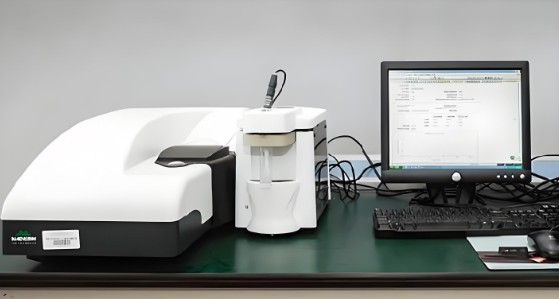
- Elastomer identification by Fourier transform infrared spectroscopy per ASTM E1252 — the polymer type of seals, O-rings, and damping pads is identified and checked against the specification to confirm compatibility with the hydraulic fluid and the expected operating temperature range of the photovoltaic system.
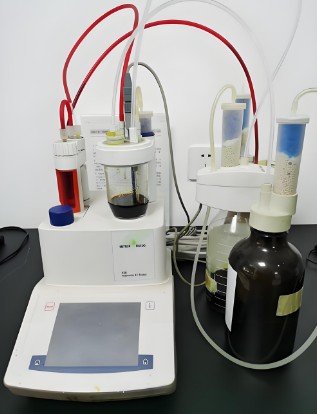
- Fluid analysis for hydraulic dampers per ASTM D445 and ASTM D6304 — the viscosity, water content, and particle contamination level of the damping fluid are measured before and after endurance testing to assess fluid degradation and the effectiveness of the sealing system in preventing moisture and dust ingress.
Report Recognition and ISO/IEC 17025 Compliance
All methods described in this damping device inspection service for photovoltaic systems are covered by our ISO/IEC 17025 scope of accreditation. Our test reports are accepted by European notified bodies for construction products and machinery, by North American solar project developers and structural engineers referencing ASCE and ASTM standards, and by regulatory and procurement authorities across the Middle East, Australia, and Asia. Whether you require a complete qualification dossier for a new damper design, a batch release inspection for a production shipment, or a root cause failure analysis of a field performance issue, our laboratory provides the measurement accuracy and engineering expertise that the global solar energy industry demands.