Composite Geomembrane Testing Service – Accredited Performance and Durability Evaluation for Global Markets
Our internationally accredited laboratory delivers a comprehensive composite geomembrane testing service that provides manufacturers, installation contractors, landfill designers, mining operators, water‑containment engineers and environmental consultants worldwide with the independent, traceable data they require to verify the mechanical, hydraulic and durability properties of these critical barrier materials. Every test is conducted under the rigorous framework of ISO/IEC 17025, and each report bearing the ILAC mark is unconditionally accepted by regulatory authorities, notified bodies and supply‑chain partners in all major economies. A composite geomembrane testing programme evaluates the complete product – the polymeric core sheet, the reinforcing textile layer, and the bond between them – quantifying the tensile strength and elongation, the tear and puncture resistance, the seam peel and shear integrity, the hydraulic conductivity and the resistance to oxidative degradation and ultraviolet radiation. For an exporter supplying high‑density polyethylene geomembrane to a mining project in South America, a manufacturer qualifying a new composite liner for a European landfill, or an environmental agency verifying the performance of a reservoir liner, this service provides the legally robust, defensible data that underpin product certification, design validation and compliance with the relevant ASTM, ISO, EN and GRI standards.
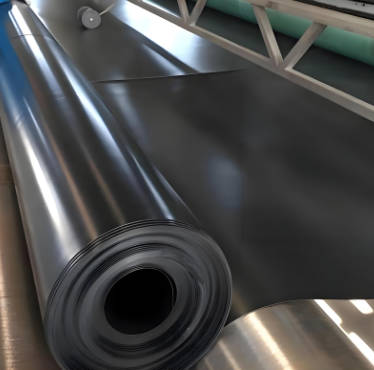
Product Samples We Regularly Subject to Composite Geomembrane Testing
Our universal testing machines, hydraulic transmissivity cells, environmental‑ageing ovens and thickness‑measuring instruments accommodate a wide variety of composite geomembrane materials. The following categories represent the most frequently tested items:
- Textile‑reinforced composite geomembranes – high‑density polyethylene, linear low‑density polyethylene, polyvinyl chloride and ethylene‑propylene‑diene monomer sheets laminated with a woven or a nonwoven geotextile on one or both sides
- Multi‑layer co‑extruded geomembranes – products combining a smooth or a textured polymeric core with an integral signal layer for leak‑detection, and a factory‑bonded drainage or protection geotextile
- Bituminous and elastomeric composite liners – polymer‑modified bitumen membranes reinforced with a glass‑fibre or a polyester fabric, used in the canal‑lining, the dam‑facing and the tunnel‑waterproofing applications
- Clay‑geosynthetic composite barriers – bentonite‑impregnated geotextile layers that are needle‑punched or stitch‑bonded to a geomembrane backing
- Factory‑fabricated panels and roll goods – full‑width production samples taken from the beginning, the middle and the end of a roll, and factory‑welded seams prepared under the controlled conditions
- Field‑seamed and repaired specimens – coupons cut from the installation seams, the repair patches and the penetration boots, submitted for the verification of the contractor’s workmanship
- Aged and exposed samples – geomembrane specimens retrieved from the service after several years of exposure, or artificially aged in the laboratory, for the residual‑property assessment and the remaining‑life prediction
Physical and Mechanical Properties – Composite Geomembrane Testing According to ASTM D7176, ASTM D6693 and ISO 10319
- Determination of the tensile properties of the composite geomembrane by the wide‑width strip method according to ASTM D7176 (Standard Specification for Non‑Reinforced Polyvinyl Chloride Geomembrane Seams) and ISO 10319 (Geosynthetics – Wide‑width tensile test): a 200 mm‑wide specimen is gripped in a calibrated tensile testing machine and loaded at a constant strain rate. The breaking force in kilonewtons per metre, the elongation at break and the tensile modulus are reported for both the machine direction and the cross direction. This composite geomembrane testing provides the fundamental design parameters that the engineer uses to calculate the liner’s resistance to the installation stresses and the long‑term tensile loads imposed by the subgrade settlement and the waste settlement.
- Tear resistance of the composite geomembrane by the tongue‑tear and the Elmendorf methods according to ASTM D5884 (Standard Test Method for Determining Tear Strength of Internally Reinforced Geomembranes) and ASTM D4533 (Trapezoid Tearing Strength of Geotextiles): the force required to propagate a tear through the reinforcing textile and the polymeric sheet is measured, and the result is reported in newtons. The test identifies the minimum tear strength that the liner must possess to resist the propagation of a puncture or a cut during the placement of the drainage gravel and the protective cover soil.
- Puncture and static‑puncture resistance of the composite geomembrane according to ASTM D4833 (Standard Test Method for Index Puncture Resistance of Geomembranes and Related Products) and ASTM D6241 (Standard Test Method for Static Puncture Strength of Geotextiles and Geotextile‑Related Products Using a 50‑mm Probe): a flat‑tipped or a bevelled steel probe is driven through the specimen at a constant rate, and the maximum force and the energy to puncture are recorded. This composite geomembrane testing simulates the penetration of a stone or an angular aggregate that may be present in the subgrade or the protective layer, and it sets the minimum allowable puncture resistance for the specified cover‑soil thickness.
- Multi‑axial tension test (burst strength) according to ASTM D5617 (Standard Test Method for Multi‑Axial Tension Test for Geosynthetics) and ISO 12236: the specimen is clamped around its perimeter and deformed by a pressurized fluid or a spherical plunger until rupture, and the burst pressure or the force at failure is reported, providing the data that characterise the liner’s capacity to resist the out‑of‑plane deformation caused by the gas uplift or the uneven settlement.
- Inter‑ply adhesion and the peel strength of the textile‑to‑geomembrane bond according to ASTM D7003 (Standard Test Method for Strip Tensile Properties of Reinforced Geomembranes) and the internal procedures: a strip is peeled apart at a constant angle, and the force required to separate the textile from the polymeric core is measured in newtons per millimetre of width. The test verifies that the factory lamination process has produced a bond that is strong enough to transfer the shear stress between the layers under the service load.
Hydraulic and Barrier Performance – Composite Geomembrane Testing According to ASTM D4491, ASTM D5887 and EN 14150
- Determination of the hydraulic conductivity and the water‑vapour transmission rate of the composite geomembrane according to ASTM D4491 (Standard Test Methods for Water Permeability of Geotextiles by Permittivity) and ASTM E96 (Standard Test Methods for Water Vapor Transmission of Materials): the specimen is mounted in a flexible‑wall permeameter or a vapour‑transmission cup, and the flow of water or the water vapour through the barrier is measured under a controlled hydraulic gradient. The hydraulic conductivity in metres per second and the permeance in grams per square metre per day are reported. This composite geomembrane testing quantifies the fundamental barrier function of the liner and verifies that it meets the regulatory limit for the landfill leachate or the mining‑solution containment.
- Resistance to hydrostatic pressure and the liner‑integrity testing according to ASTM D5887 (Standard Test Method for Measurement of Index Flux Through Saturated Geosynthetic Clay Liner Specimens Using a Flexible Wall Permeameter) and the principles of the electrical‑leak‑location survey: the composite liner is subjected to an increasing water pressure, and the pressure at which the first leak or the rupture occurs is recorded, providing the data that the installation‑quality‑assurance engineer uses to set the maximum‑allowable head on the liner.
- Fluid‑compatibility and the chemical‑resistance immersion test according to ASTM D5747 (Standard Practice for Tests to Evaluate the Chemical Resistance of Geomembranes to Liquids) and EN 14415: the geomembrane specimen is immersed in the site‑specific leachate, the acid‑mine‑drainage solution or the hydrocarbon fluid at the design temperature for 28 days or longer, and the change in the tensile properties, the mass and the dimensions are measured and compared with the un‑exposed control, verifying the long‑term chemical resistance of the liner in the intended service environment.
- Stress‑cracking and the environmental‑stress‑crack resistance of the polyethylene geomembrane according to ASTM D5397 (Standard Test Method for Evaluation of Stress Crack Resistance of Polyolefin Geomembranes Using Notched Constant Tensile Load Test) and ASTM D1693: a notched specimen is subjected to a constant tensile load while immersed in a surfactant solution at an elevated temperature, and the time to failure is recorded, providing the accelerated‑ageing data that the resin formulator uses to qualify the stress‑crack‑resistant grade for the critical long‑term containment applications.
Seam Strength, Peel Adhesion and Connection Integrity – Composite Geomembrane Testing According to ASTM D6392 and ASTM D6497
- Determination of the shear and the peel strength of the factory and the field seams according to ASTM D6392 (Standard Test Method for Determining the Integrity of Non‑Reinforced Geomembrane Seams Produced Using Thermo‑Fusion Methods) and ASTM D4437 (Standard Practice for Non‑destructive Testing of Geomembrane Seams): a strip containing the seam is loaded in tension for the shear mode, or the two layers are peeled apart in a T‑configuration for the peel mode. The shear strength and the peel strength in newtons per millimetre of the seam width are reported, and the failure mode – film‑tear‑bond, delamination or break‑in‑the‑sheet – is documented. This composite geomembrane testing is mandatory for the qualification of the welding procedure and for the daily quality‑control sampling on the installation site.
- Hot‑wedge and the extrusion‑weld seam evaluation by the non‑destructive and the destructive methods: the seam is first inspected by a vacuum box, an air‑pressure test or a spark‑test to detect any continuous leak paths, and then the coupons are cut and destructively tested for the shear and the peel strength. The combination of the non‑destructive and the destructive testing provides the complete quality‑assurance record for the installed liner.
- Seam strength after the accelerated ageing and the fluid immersion: the seamed specimens are exposed to the same chemical and thermal environment as the base material, and the retention of the seam shear and the peel strength is reported, verifying that the seam will not become the weak link in the barrier system over the design life of the facility.
Durability, Ageing and Ultraviolet Resistance – Composite Geomembrane Testing According to ASTM D7238, ASTM D4355 and EN 12224
- Resistance to the accelerated ultraviolet weathering and the xenon‑arc exposure according to ASTM D7238 (Standard Test Method for Effect of Exposure of Unreinforced Polyolefin Geomembrane to Fluorescent UV Condensation Apparatus) and EN 12224 (Geotextiles and geotextile‑related products – Determination of the resistance to weathering): the geomembrane specimen is exposed to a cycle of UV radiation, heat and condensation in a xenon‑arc or a fluorescent‑UV apparatus for a defined radiant exposure. The retained tensile strength, the elongation and the oxidative‑induction time are measured, and the data are used to predict the outdoor‑storage life and the exposed‑service life of the liner.
- Standard and high‑pressure oxidative‑induction time by the differential scanning calorimetry according to ASTM D3895 (Standard Test Method for Oxidative‑Induction Time of Polyolefins by Differential Scanning Calorimetry) and ASTM D5885 (Standard Test Method for Oxidative Induction Time of Polyolefin Geosynthetics by High‑Pressure Differential Scanning Calorimetry): a small sample of the geomembrane is heated in an oxygen atmosphere, and the time to the onset of the exothermic oxidation reaction is measured. This composite geomembrane testing quantifies the amount and the effectiveness of the antioxidant package that protects the polymer from the thermal‑oxidative degradation during the processing and the service life.
- Stress‑crack‑resistance and the ductile‑to‑brittle transition after the thermo‑oxidative ageing: the geomembrane is aged in a forced‑air oven at the elevated temperature for a specified duration, and the notched constant‑tensile‑load test or the single‑point‑notched‑constant‑ligament‑stress test is performed to determine the time to the embrittlement. The data are used to calculate the antioxidant‑depletion time and the service life of the liner at the design temperature.
- Dimensional stability and the thermal‑expansion coefficient of the composite geomembrane: the specimen is heated to a specified temperature, and the change in the length and the width is measured, providing the data that the installation engineer uses to specify the correct slack and the anchoring detail for the liner that will experience the daily and the seasonal temperature swings.
Report Acceptance and Global Regulatory Compliance
All measurements performed within our composite geomembrane testing programme are executed under the fully accredited scope of our ISO/IEC 17025 quality management system. Each test report that carries the ILAC mark is therefore automatically recognised by regulatory authorities, notified bodies, customs offices and supply‑chain partners in all major economies. For geomembrane manufacturers, installation contractors, landfill and mining‑project designers and environmental regulators anywhere in the world, the report constitutes legally robust, internationally accepted evidence that the tensile strength, the tear and the puncture resistance, the hydraulic barrier performance, the seam integrity and the long‑term durability of the composite geomembrane have been determined in accordance with the applicable ASTM, ISO, EN, GRI and customer‑specified methods. The documentation can be directly used to support CE marking under the Construction Products Regulation, the issue of inspection certificates according to EN 10204 or equivalent national standards, the compilation of the technical file for the design approval, and the resolution of commercial and technical disputes concerning the performance and the service life of any composite geomembrane product.