Aviation Kerosene Filter Inspection Service for Global Aircraft Fuel System Compliance
As an ISO/IEC 17025 accredited laboratory, we deliver a specialized aviation kerosene filter inspection service that verifies filtration efficiency, water separation performance, mechanical integrity, electrical conductivity safety, and long-term reliability of filter elements and filter separators used in aviation fuel handling systems. Our aviation kerosene filter inspection service supports manufacturers and exporters of filter monitor vessels, filter water separators, microfilter elements, and coalescer cartridges who must demonstrate conformity to EI 1581, API/IP 1581, ASTM D3948, SAE ARP 1401, and regional aviation fuel quality standards across the European Union, North America, the Middle East, and Asia. Every test is performed under our CNAS-accredited quality system, producing reports accepted by notified bodies, aviation authorities, and procurement teams worldwide.

Product Samples We Regularly Test in Our Aviation Kerosene Filter Inspection Service
- Filter water separator coalescer elements — for removal of free water and solid particulates from Jet A and Jet A-1 aviation kerosene at airport fuel farms and hydrant systems
- Filter monitor elements and vessels — for final-stage filtration with water-absorbing and particulate-removing media to protect aircraft during refueling
- Microfilter elements and cartridges — high-efficiency particulate filters for aviation kerosene polishing and critical application protection
- Clay treatment and adsorbent filter elements — for removal of surfactants, polar compounds, and color bodies from aviation kerosene
- Prefilter and particulate removal elements — for protecting downstream coalescers and extending the service life of water separation cartridges
- Filter separator vessels and complete skid-mounted systems — including automatic water drain valves, air eliminators, and pressure relief devices
- Differential pressure indicators and water detection sensors — for fuel filter monitoring and maintenance alerting
Filtration Efficiency and Particulate Retention Testing for Aviation Kerosene Filters
- Multi-pass filtration efficiency per ISO 16889 and SAE ARP 1401 — the aviation kerosene filter element is challenged with standardized test dust suspended in fuel, and particle counts upstream and downstream are continuously measured to determine the Beta ratio and the absolute micron rating, verifying the filter removes the specified particle sizes to protect aircraft fuel system components.
- Single-pass efficiency and effluent cleanliness per ASTM F795 — the filter is tested with a dilute suspension of standard particles to measure the initial clean-filtration efficiency and to confirm the filtered aviation kerosene meets the cleanliness requirements of ISO 4406 and the applicable fuel quality specifications.
- Dust holding capacity and loading curve determination per ISO 19438 and EI 1581 — the filter element is loaded with contaminant at a constant flow rate until a terminal differential pressure is reached, and the mass of contaminant retained is measured to predict service life and replacement intervals under real airport fuel handling conditions.
- Bubble point and pore size distribution per ASTM F316 and ISO 2942 — the filter media is wetted and the pressure at which the first bubble emerges is recorded, verifying the maximum pore diameter and detecting any manufacturing defects or oversized pores that would allow unfiltered fuel to bypass the aviation kerosene filter.
- Gravimetric efficiency and micron rating verification per ISO 19438 — the filter is challenged with a known mass of test dust, and the mass captured is measured to verify the declared efficiency and nominal micron rating of the filter element.
- Filter efficiency after water and surfactant exposure per EI 1581 — the filter is tested with fuel containing water and surfactants to verify it maintains particulate removal efficiency under the challenging conditions of real aviation fuel systems.
Water Separation and Coalescing Performance Testing for Aviation Kerosene Filters
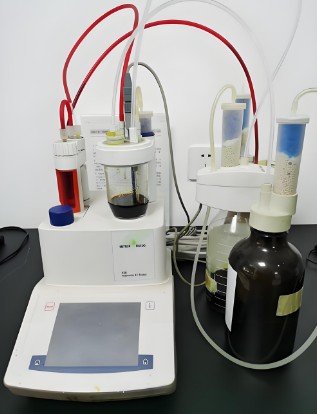
- Water separation efficiency per ASTM D3948 and EI 1581 — the aviation kerosene filter water separator is challenged with a fuel-water emulsion at controlled flow rate and temperature, and the downstream free water content is measured using a laser-based water detector or Karl Fischer titration, verifying the filter removes free water to below the specified limit for safe aircraft refueling.
- Coalescing performance and water droplet removal per API/IP 1581 — the filter's ability to coalesce finely dispersed water droplets into larger drops that settle and drain is evaluated, ensuring reliable water removal across the full range of aviation kerosene contamination levels.
- Water slug and high-water-content challenge testing per EI 1581 — the filter is subjected to a defined water slug or sustained high water content to verify it maintains water removal performance under the most severe contamination events without water breakthrough.
- Surfactant and additive resistance testing per ASTM D3948 — the filter is tested with aviation kerosene containing fuel additives and surfactants to verify the coalescing media remains effective and does not become disarmed by polar compounds that reduce water separation efficiency.
- Water removal under varying flow rates and fuel temperatures — the water separation performance is measured across the design flow range and at cold and hot fuel temperatures to verify consistent performance under all operating conditions encountered at airport fuel facilities.
- Water detector and drain function verification per EI 1581 — for filter vessels with automatic water detection and drain systems, the sensor activation threshold and the drain function are tested to confirm reliable water removal and alerting during aviation kerosene filtration.
Mechanical Strength and Structural Integrity Testing for Aviation Kerosene Filters
- Collapse and burst pressure test per ISO 2941 and EI 1581 — the filter element is subjected to increasing differential pressure or internal pressure until structural failure, determining the minimum collapse pressure and verifying it exceeds the bypass valve setting by the required safety factor for aviation fuel service.
- Bypass valve opening pressure and leakage verification per EI 1581 — the bypass valve is tested to confirm it opens at the specified pressure and fully reseats without leakage after repeated cycles, ensuring continued fuel flow to the aircraft even when the filter is clogged.
- Vibration and mechanical shock resistance per IEC 60068-2-6 and IEC 60068-2-27 — the filter assembly is vibrated under profiles representative of fuel pump and piping vibration, and subjected to shock pulses, with post-test filtration and leak verification to confirm no structural damage or performance degradation.
- Pressure pulse and cyclic loading endurance per EI 1581 and customer protocols — the filter is subjected to repeated pressure pulses from zero to rated pressure to simulate the start-stop and surge conditions of airport fuel hydrant systems, with post-test integrity and efficiency retests.
- Housing pressure containment and leak tightness per ISO 1402 and ASME B16.5 — the complete filter vessel is pressurized to a defined multiple of the rated working pressure and held to verify no leakage or permanent deformation of the aviation kerosene filter housing.
- End cap and core tube structural integrity per ASTM D2412 — the center tube and end caps are tested for hoop strength and crush resistance to ensure the pleat pack is supported under full contaminant loading and maximum system pressure.
Electrical Conductivity and Static Dissipation Testing for Aviation Kerosene Filters
- Surface resistance and volume resistance of filter media per ASTM D257 and IEC 61340-2-3 — the electrical resistance of the aviation kerosene filter media is measured to verify the material provides adequate static dissipation and prevents the accumulation of electrostatic charge during fuel flow, which could create a fire or explosion hazard.
- Static decay time measurement per IEC 61340-2-1 — the time for a charge to dissipate through the filter media is recorded to verify rapid static charge bleed-off in the aviation kerosene filtration system.
- Grounding continuity and bond resistance per EI 1581 and customer specifications — the electrical continuity between the filter element, housing, and the grounding terminal is measured to ensure reliable static charge dissipation to earth in the installed fuel system.
- Triboelectric charge generation during fuel flow per internal protocols — the filter is tested under flowing aviation kerosene and the generated static voltage is monitored to verify the filter materials minimize charge accumulation during normal refueling operations.
- Electrical conductivity after environmental exposure per IEC 60068-2-78 — the surface resistance is remeasured after humidity, thermal cycling, and fuel immersion to ensure the static dissipation properties are retained over the service life of the aviation kerosene filter.
Chemical Compatibility and Thermal Durability Testing for Aviation Kerosene Filters
- Fuel immersion and chemical compatibility per ISO 2943 and ASTM D471 — the filter media, adhesives, and seals are immersed in aviation kerosene, fuel additives, and cleaning solvents at the maximum rated temperature, and the change in mass, hardness, and dimensions is measured to verify compatibility with the intended fuel service.
- Hot fuel and oxidative aging resistance per ASTM D6511 — the filter is aged in hot aviation kerosene with aeration for extended durations to simulate the oxidative conditions inside a fuel handling system, then retested for filtration efficiency and collapse strength.
- Cold start and low-temperature soak simulation per SAE J1858 — the aviation kerosene filter is conditioned at -30 °C or lower and then subjected to a pressure pulse to verify the media does not crack and the filter remains operational in cold climates and high-altitude airports.
- Thermal cycling and thermal shock per IEC 60068-2-14 — the filter is rapidly cycled between hot and cold temperatures to verify the housing, seals, and internal components withstand thermal expansion and contraction without cracking or performance loss.
- Neutral salt spray and corrosion testing per ISO 9227 — the filter housing, base plate, and fasteners are exposed to salt fog to evaluate red rust, white corrosion, and coating degradation, ensuring durability in marine and coastal airport environments.
- Resistance to fuel additives, biocides, and ice inhibitors per ASTM D543 — the filter components are exposed to common aviation fuel additives to verify no softening, swelling, or loss of function occurs during fuel system maintenance and treatment.
Report Recognition and ISO/IEC 17025 Compliance
Every test method described in this aviation kerosene filter inspection service is covered by our ISO/IEC 17025 scope of accreditation. Our technical reports and certificates of analysis are accepted by European notified bodies for aviation fuel handling equipment, by North American aviation authorities and airport fuel system operators referencing EI and ASTM standards, and by customs and procurement agencies across the Middle East, Australia, and Asia. Whether you require a complete qualification dossier for a new aviation kerosene filter design, a batch release inspection for an export shipment, or a root cause failure analysis of a water breakthrough or particulate contamination issue, our laboratory provides the measurement accuracy and aviation fuel filtration expertise that the global aircraft refueling industry demands.