Aviation Pipeline Inspection Service for Global Aerospace and Defense Compliance
As an ISO/IEC 17025 accredited laboratory, we deliver a specialized aviation pipeline inspection service that verifies the structural integrity, fluid compatibility, dimensional accuracy, and long-term reliability of metallic and composite tubing systems used in aircraft hydraulic, fuel, pneumatic, and oxygen systems. Our aviation pipeline inspection service supports manufacturers and exporters of aerospace tubes, hoses, couplings, and complete pipeline assemblies who must demonstrate conformity to SAE AS standards, ISO 6772, ISO 7257, EN 10216, and regional airworthiness requirements across the European Union, North America, the Middle East, and Asia Pacific. Every test is performed under our CNAS-accredited quality system, producing reports accepted by notified bodies, aircraft OEMs, and aviation regulatory authorities worldwide.

Product Samples We Regularly Test in Our Aviation Pipeline Inspection Service
- Hydraulic system pipelines — stainless steel, titanium, and aluminum alloy tubes for flight control, landing gear, and braking systems
- Fuel and lubrication system pipelines — rigid and flexible lines for engine feed, transfer, and scavenge circuits
- Pneumatic and bleed air pipelines — for cabin pressurization, anti-icing, and engine starting systems
- Oxygen system pipelines — for crew and passenger oxygen supply, including low-pressure and high-pressure lines
- Composite and PTFE-lined flexible hoses — for vibration isolation, thermal expansion, and high-flex applications
- Pre-formed and bent tube assemblies — with permanent or separable fittings, sleeves, and couplings
- Pipeline components and accessories — clamps, brackets, flanges, gaskets, and protective sleeves
Dimensional and Geometrical Inspection in Our Aviation Pipeline Inspection Service
- Tube outside diameter, wall thickness, and ovality measurement per ISO 7257 and ASME B46.1 — laser micrometers, ultrasonic thickness gauges, and coordinate measuring machines verify that the aviation pipeline conforms to the specified dimensions and tolerances, ensuring correct fit-up with couplings and minimal stress concentration.
- Bend radius, angle, and wall thinning assessment per ISO 6772 and customer drawings — the formed tube geometry is measured against the CAD model, and the bend extrados and intrados are scanned to confirm wall thinning remains within the allowable limit for the design pressure and fatigue life.
- Straightness, camber, and alignment of the complete pipeline assembly — the pipeline is checked with a laser alignment system or coordinate measuring machine to ensure it can be installed without preload or misalignment that would induce bending stress and vibration fatigue.
- End preparation and fitting compatibility per AS1300 and ISO 7257 — the tube end flare, bead, or butt-weld preparation is verified with optical comparators and gauge pins to ensure a leak-tight and structurally sound connection with the specified fitting.
Mechanical and Pressure Integrity Testing for Aviation Pipelines
- Hydrostatic proof pressure test per ISO 6772 and ASME B31.3 — the pipeline assembly is pressurized with water or an approved test fluid to a minimum of 1.5 times the maximum allowable working pressure and held for a code-specified duration, with zero visible leakage or permanent deformation permitted to verify the tube and fitting containment capability.
- Burst pressure and ultimate strength verification per ISO 1402 and SAE AS1339 — the pipeline is pressurized hydraulically until rupture to determine the ultimate safety margin, which must exceed a minimum factor specified by the aircraft manufacturer or the applicable airworthiness standard.
- Impulse and cyclic pressure fatigue testing per ISO 6772 and SAE AS1501 — the aviation pipeline is subjected to hundreds of thousands of pressure pulse cycles from zero to rated pressure at elevated temperature, simulating the repetitive loading of hydraulic and pneumatic systems during flight operations, with post-test leak and dimensional checks.
- Combined pressure, bending, and vibration endurance per customer and internal protocols — the pipeline is tested under simultaneous internal pressure, dynamic bending, and vibration to simulate the multi-axial stresses of engine-mounted and airframe-installed tubing, predicting the fatigue life under real operating conditions.
- Axial pull-off and torsional strength of fittings and couplings per ISO 7257 — the force required to separate or rotate the tube from the fitting is measured to verify the connection withstands installation torque, thermal expansion, and operational loads without loosening or leaking.
Non-Destructive Testing in Our Aviation Pipeline Inspection Service
- Eddy current inspection of tube walls and fittings per ASTM E426 and ISO 12718 — encircling coil and surface probe eddy current systems scan the full tube length and the fitting transition zone to detect surface-breaking cracks, laps, seams, and corrosion pits at production speeds with automatic defect recording.
- Liquid penetrant inspection per ISO 3452-1 and ASTM E1417 — the tube ends, welded joints, and machined fittings are examined for surface-breaking discontinuities that could initiate fatigue cracks in service, with fluorescent or visible penetrant techniques.
- Ultrasonic thickness mapping and lamination detection per ASTM E797 and ISO 17640 — pulse-echo ultrasonic scanning verifies the remaining wall thickness and detects internal laminations, inclusions, or wall thinning from manufacturing or service exposure.
- Radiographic testing of welded and brazed pipeline components per ISO 17636-1 and ASTM E1742 — digital or film radiography inspects welded sleeves, brazed joints, and permanent fittings for volumetric defects such as porosity, lack of fusion, and inclusions, with acceptance criteria per the relevant aerospace material specification.
- Magnetic particle inspection of ferromagnetic components per ISO 17638 and ASTM E1444 — for steel fittings and clamps, fluorescent magnetic particle examination reveals surface-breaking and near-surface discontinuities that could compromise the pipeline assembly.
Fluid Compatibility and Cleanliness Testing for Aviation Pipelines
- Compatibility with hydraulic fluids, fuels, and lubricants per ISO 1817 and ASTM D471 — the pipeline material, seals, and fittings are immersed in the specified Skydrol, MIL-PRF-5606, Jet A, or synthetic lubricant at elevated temperatures, and the change in mass, hardness, and tensile properties is measured to verify compatibility with the intended aircraft fluid.
- Particulate contamination and cleanliness verification per ISO 11218 and SAE AS4059 — the internal surface of the aviation pipeline is flushed and the rinse fluid is analyzed for particle count, size distribution, and total mass of residue, ensuring the tube meets the cleanliness class required for hydraulic and fuel systems.
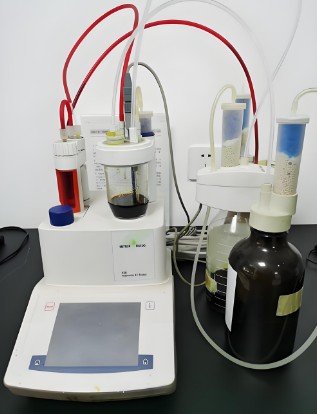
- Internal corrosion and moisture content testing per ASTM D4928 and customer protocols — the pipeline interior is sampled for water content and corrosive species, and the tube surface is inspected for pitting, crevice corrosion, and microbial growth that could degrade system performance.
- Resistance to de-icing fluids, cleaning agents, and disinfectants per ISO 2812-1 — the pipeline exterior is exposed to common aircraft de-icing and cleaning chemicals to verify no staining, softening, or stress corrosion cracking occurs during routine maintenance.
Corrosion Resistance and Environmental Durability Testing for Aviation Pipelines
- Neutral salt spray and cyclic corrosion testing per ISO 9227 and ASTM B117 — the pipeline assembly with its protective coatings is exposed to salt fog for up to 3000 hours, and the development of red rust, pitting, and coating degradation is evaluated to validate the corrosion protection in marine and coastal operating environments.
- Intergranular corrosion testing for stainless steel and aluminum alloy pipelines per ASTM A262 and ASTM G110 — the sensitization resistance of the tube material is verified after welding or thermal processing to ensure the pipeline withstands intergranular attack in the presence of aircraft fluids and atmospheric moisture.
- Stress corrosion cracking resistance per ASTM G47 and ASTM G129 — stressed specimens of the aviation pipeline material are exposed to a chloride-bearing environment or a simulated aircraft fluid to verify the tube is not susceptible to stress corrosion cracking under residual or applied tensile stress.
- Hydrogen embrittlement testing for high-strength steel and titanium fittings per ASTM F519 — the pipeline components are subjected to a sustained load test to verify that no hydrogen-induced delayed fracture occurs after plating, pickling, or exposure to hydrogen-generating environments.
- Coating thickness and adhesion per ISO 2178 and ISO 2409 — the dry film thickness and adhesion of paint, primer, or conversion coatings on the aviation pipeline are measured to ensure long-term corrosion protection and compliance with the manufacturer's finish specification.
Material Verification and Hardness Testing for Aviation Pipelines
- Optical emission spectrometry for alloy grade confirmation per ASTM E415 and ISO 14284 — the chemical composition of the tube, fittings, and weld filler metal is analyzed to verify conformance to specified grades such as 21-6-9, 304, 321, 6061-T6, or Ti-3Al-2.5V, preventing material substitution and ensuring the correct mechanical and corrosion properties.
- Hardness testing by Brinell, Rockwell, and Vickers methods per ISO 6506-1 and ISO 6507-1 — hardness measurements are taken across the tube wall, fittings, and welds to verify uniform heat treatment, detect decarburization, and confirm the pipeline meets the hardness limits required for the alloy and temper designation.
- Microstructure and grain size analysis per ASTM E112 — metallographic examination of the tube cross-section verifies the grain structure, inclusion content, and freedom from defects that could initiate fatigue cracks in the aviation pipeline.
- Positive material identification using handheld XRF — non-destructive verification directly on the finished pipeline surface confirms alloy type and prevents material mix-ups during production, storage, and shipping.
Report Recognition and ISO/IEC 17025 Compliance
Every test method described in this aviation pipeline inspection service is included within our ISO/IEC 17025 scope of accreditation. Our technical reports and test certificates are accepted by European notified bodies under the applicable airworthiness directives, by North American aircraft OEMs and MRO providers referencing SAE and ASTM standards, and by civil aviation authorities and customs agencies across the Middle East, Australia, and Asia Pacific. Whether you require a complete qualification dossier for a new aviation pipeline design, a batch release inspection for an export shipment, or a root cause failure analysis of an in-service tube failure, our laboratory provides the measurement accuracy and aerospace engineering expertise that the global aircraft systems industry demands.