Amplitude Frequency Characteristic Testing Service – Accredited Dynamic Response Evaluation for Global Markets
Our internationally accredited laboratory delivers a specialist amplitude frequency characteristic test service that provides manufacturers of electronic components, mechanical assemblies, vibration sensors, automotive parts, aerospace structures and consumer electronics worldwide with the independent, traceable data required to verify the gain, attenuation, resonance and bandwidth of their products under sinusoidal or swept‑frequency excitation. Every measurement is performed within the rigorous framework of ISO/IEC 17025, and each report bearing the ILAC mark is unconditionally accepted by regulatory authorities, customs offices and notified bodies in all major economies. The amplitude frequency characteristic test precisely maps the output‑amplitude versus frequency curve of a device or material, quantifying the resonant frequencies, the damping ratio, the pass‑band ripple and the roll‑off slope, and it is the fundamental tool for the design verification, quality control and failure analysis of any product that must withstand or transmit dynamic forces. By employing calibrated electrodynamic shakers, precision signal analysers, laser vibrometers and environmental chambers, we provide our global clients with the legally robust, defensible dynamic‑response data that underpin product certification, finite‑element model validation and compliance with the relevant ISO, IEC, ASTM, MIL and customer‑specific standards.
Product Samples We Regularly Subject to Amplitude Frequency Characteristic Testing
The vibration exciters, shaker tables and non‑contact laser‑Doppler systems in our facility accommodate components, sub‑assemblies and complete structures. The following categories represent the items most frequently evaluated through our amplitude frequency characteristic test programme:
- Electronic components and electro‑mechanical devices – crystal oscillators, ceramic resonators, MEMS accelerometers, gyroscopes, geophones, microphones, loudspeakers and ultrasonic transducers
- Mechanical structures and sub‑assemblies – brackets, mounting frames, chassis, turbine blades, printed‑circuit‑board assemblies, heatsinks and welded joints
- Vibration‑isolation and damping materials – elastomeric mounts, wire‑rope isolators, viscoelastic damping pads, constrained‑layer damping sheets and metal‑rubber composites
- Automotive and transport components – engine‑mount assemblies, exhaust‑system hangers, suspension bushings, body‑in‑white panels and electric‑vehicle battery‑pack casings
- Aerospace and defence articles – satellite payload adaptors, avionics‑rack isolators, antenna‑reflector support struts, missile‑guidance‑section housings and cockpit‑instrument panels
- Consumer and industrial products – washing‑machine drums, power‑tool handles, air‑conditioning‑compressor mountings, vacuum‑cleaner motor‑housings and sports‑equipment frames
Amplitude Frequency Characteristic Testing for Electronic Sensors, Transducers and Signal‑Processing Components
- Determination of the frequency response and the mounted resonant frequency of accelerometers and velocity transducers according to ISO 16063‑21 and ISO 5347‑15: the sensor is mounted on a reference‑standard back‑to‑back calibration shaker, and a sinusoidal vibration is applied at a constant acceleration amplitude while the frequency is swept from 0.5 Hz to 20 kHz. The charge or voltage output is recorded, and the amplitude‑versus‑frequency curve is normalised to the reference sensitivity at 80 Hz or 160 Hz. The ±3 dB bandwidth, the first mounted resonance and any spurious secondary resonances are reported. This amplitude frequency characteristic test provides the data that measurement engineers need to select the correct accelerometer for the frequency range of interest and to avoid the distortion introduced by sensor resonance.
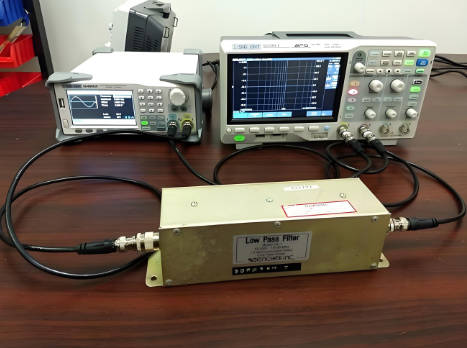
- Measurement of the transfer function and the pass‑band ripple of analogue and digital filters, amplifiers and signal‑conditioning modules: a swept‑frequency sinusoidal signal is applied to the input of the device, and the output amplitude and phase are measured by a dynamic signal analyser. The -3 dB cut‑off frequencies, the pass‑band flatness in decibels, the stop‑band attenuation and the group‑delay variation are reported, verifying the filter design and the component values against the circuit‑simulation predictions.
- Electro‑acoustic frequency‑response testing of microphones, loudspeakers and ultrasonic transducers according to IEC 60268‑4 and IEC 60268‑5: the device is placed in an anechoic chamber or a plane‑wave tube, and a calibrated reference source generates a constant sound‑pressure level. The output voltage or the sound‑pressure level produced by the device is measured as a function of frequency, and the frequency‑response curve, the effective frequency range and the sensitivity are reported. This amplitude frequency characteristic test is mandatory for the certification of professional‑audio equipment, public‑address systems and medical‑ultrasound probes.
- Characterisation of crystal oscillators, ceramic resonators and MEMS timing devices: the output power and the harmonic‑content of the oscillator are measured over a range of supply voltages and temperatures, and the amplitude‑frequency stability, the phase‑noise profile and the pullability are reported. The data are used to verify that the oscillator meets the short‑term and long‑term frequency‑stability specifications of the target communication or navigation system.
- Laser‑Doppler‑vibrometer mapping of the operational deflection shape and the frequency‑response function of printed‑circuit‑board assemblies: the board is excited by a modal shaker or an electrodynamic transducer, and the vibration velocity is measured at a grid of points. The amplitude and phase at each point are plotted, and the natural frequencies, the mode shapes and the damping loss‑factors are extracted, supporting the optimisation of the component placement and the solder‑joint reliability under random vibration.
Amplitude Frequency Characteristic Testing for Mechanical Structures, Materials and Damping Systems
- Experimental modal analysis and the extraction of natural frequencies, mode shapes and damping ratios from the frequency‑response functions of structures according to ISO 7626‑2 and ASTM E1876: the structure is instrumented with an array of accelerometers, and an impact hammer or a modal shaker applies a controlled force. The transfer function between the force and the acceleration at each measurement point is recorded, and the pole‑residue model is fitted to the data. The natural frequencies, the modal damping and the mass‑normalised mode shapes are reported, providing the experimental validation of the finite‑element model and the basis for the structural‑dynamics modification, flutter analysis and vibration‑fatigue prediction.
- Determination of the dynamic stiffness and the transmissibility of vibration‑isolation mounts and flexible couplings according to ISO 10846‑1 and ISO 7626‑5: the mount is installed in a test rig between a shaker‑driven mass and a rigid reaction frame, and the blocked‑force and the acceleration on both sides are measured. The dynamic stiffness in N/m and the transmissibility in dB are plotted as a function of frequency, and the isolation efficiency and the resonant amplification are reported. This amplitude frequency characteristic test provides the data that automotive, marine and industrial equipment designers use to select the correct mount compound and geometry for the target engine‑order or road‑input frequencies.
- Measurement of the complex elastic modulus and the loss factor of viscoelastic damping materials by the Oberst beam method according to ASTM E756 and ISO 6721‑3: a metal beam coated with the damping material is excited by a non‑contact electromagnetic transducer, and the frequency‑response function of the beam is measured. The resonance peaks are analysed, and the Young's modulus, the shear modulus and the material loss factor are calculated as a function of temperature and frequency. The data are used to design constrained‑layer‑damping treatments for automotive body panels, aircraft fuselages and precision‑machine bases.
- Shaker‑table frequency‑response testing of assembled electronic enclosures, battery packs and control cabinets: the complete assembly is mounted on a shaker table and subjected to a logarithmic or linear frequency sweep at a defined acceleration level. The response accelerations at critical locations – such as the power‑supply capacitors, the relay armatures and the connector pins – are measured, and the amplification factors and the resonance frequencies are identified. The test ensures that no internal resonance coincides with the excitation frequency of the fan, the compressor or the road‑wheel rotation.
Amplitude Frequency Characteristic Testing for Aerospace, Automotive and High‑Reliability Applications
- Sinusoidal vibration and resonance search of aircraft components according to RTCA DO‑160G Section 8 and MIL‑STD‑810H Method 514.8: the component is swept through the specified frequency range – typically 10 Hz to 2 000 Hz – at a constant displacement or acceleration amplitude, and the amplitude‑frequency response of the critical internal parts is monitored by strain gauges or accelerometers. The test identifies the resonant frequencies that must be avoided by the engine‑operating speed or the aerodynamic buffet, and it verifies that the component can withstand the endurance‑vibration test without fatigue damage.
- Automotive‑component frequency‑response and squeak‑and‑rattle detection under swept‑sine excitation according to the procedures of the automotive OEMs: the instrument panel, the door‑trim assembly or the seat frame is subjected to a frequency sweep at a low excitation level, and the vibration response is recorded by laser vibrometry and a microphone array. The amplitude‑frequency characteristics of the substructure are extracted, and any local resonance that could cause an annoying buzz, squeak or rattle inside the passenger compartment is identified and eliminated by a stiffening rib, a damping patch or a felt‑tape application.
- High‑frequency resonance and ultrasonic‑horn amplitude‑frequency testing for medical, welding and cutting tools: the ultrasonic horn or the transducer‑booster‑horn stack is driven by a frequency generator and a power amplifier, and the longitudinal‑vibration amplitude at the working face is measured by a laser vibrometer. The amplitude‑versus‑frequency curve is recorded, and the resonant frequency, the mechanical quality factor Q and the bandwidth are reported. This amplitude frequency characteristic test is critical for the tuning of ultrasonic surgical aspirators, wire‑bonding transducers and thermoplastic‑welding sonotrodes to the correct operating frequency, typically 20 kHz, 30 kHz or 40 kHz.
- Frequency‑response and tracking‑filter verification of rotating‑machinery vibration‑monitoring systems: a known vibration signal is injected into the proximity‑probe, the accelerometer or the velocity‑transducer channel, and the amplitude and phase response of the entire monitoring chain – from the sensor through the signal conditioner to the protection‑relay output – is measured. The test confirms that the monitoring system correctly measures the 1×, 2× and higher harmonic amplitudes of the shaft vibration and that the tracking filter accurately follows the rotor speed during a run‑up or a coast‑down.
Report Acceptance and Global Regulatory Compliance
All measurements performed within our amplitude frequency characteristic test programme are executed under the fully accredited scope of our ISO/IEC 17025 quality management system. Each test report that carries the ILAC mark is therefore automatically recognised by regulatory authorities, notified bodies, customs offices and supply‑chain partners in all major economies. For electronics manufacturers, mechanical‑structure designers, automotive‑component suppliers, aerospace engineers and consumer‑product developers anywhere in the world, the report constitutes legally robust, internationally accepted evidence that the dynamic‑response characteristics, the resonant frequencies and the bandwidth of the tested article have been determined in accordance with the applicable ISO, IEC, ASTM, MIL and customer‑specified methods. The documentation can be directly used to support CE marking, the issue of inspection certificates according to EN 10204 or equivalent national standards, the compilation of the technical file for type‑examination, and the resolution of commercial and technical disputes concerning the amplitude‑frequency behaviour of any device or structure.